
About Ion Fury
Ion Fury is a single-player retro first-person shooter starring Global Defense Force bomb technician Shelly “Bombshell” Harrison. When Dr. Jadus Heskel unleashes his cybernetic cult on Neo D.C., Shelly fights through the city with a varied arsenal, exploring interconnected locations, finding keys and secrets, and using alternate fire modes against human and mechanical threats.
Ion Fury follows Shelly “Bombshell” Harrison, a Global Defense Force bomb technician whose codename comes from her work defusing explosives. Her assignment changes when Dr. Jadus Heskel, a transhumanist mastermind, sends members of his cybernetic cult into the streets of Neo D.C. Shelly responds with the tools she once used to prevent explosions and a growing supply of weapons suited to causing them. The story is delivered through this pursuit across the city rather than through a long account of Heskel’s motives. The setting mixes a near-future urban environment with the sharp silhouettes, industrial machinery and arcade-like details associated with older first-person shooters. Shelly’s dry remarks give the action a comic edge, while the threat itself remains a violent cult and its altered fighters.
The campaign moves through linked chapters and a succession of distinct city spaces. Streets and rooftops open onto indoor areas such as a police academy, a shopping mall, train stations, offices and research facilities; later routes include a moving train and less conventional environments. Neo D.C. is not presented as a continuous open world. Individual levels instead connect through short transitions and provide several routes within their boundaries, sometimes looping back after the player finds a key or activates a mechanism. The change of location also changes the shape of a fight: a broad exterior gives room to evade incoming fire, while stairs, corridors and rooms make close encounters harder to avoid. The campaign’s spaces are built to be explored as well as crossed, with side passages and concealed rooms branching away from the clearest route forward.
Navigation combines familiar locked doors and coloured keycards with switches, breakable surfaces and explosive solutions. A player may reach a barrier before finding the card that opens it, then retrace a route through an area that has become more dangerous as enemies appear. Subtle visual cues can point toward a hidden entrance, but some secrets are deliberately easy to miss, rewarding a careful look at walls, ledges and objects that seem out of place. The levels also fold back on themselves, so finding a new route can connect earlier rooms rather than simply add another corridor. Environmental details such as arcade machines, jukeboxes, toilets, rain, flickering signs and water effects give locations ordinary functions alongside their combat purpose. These interactions make the city feel inhabited, while doors, keycards and switches keep the player moving through it.
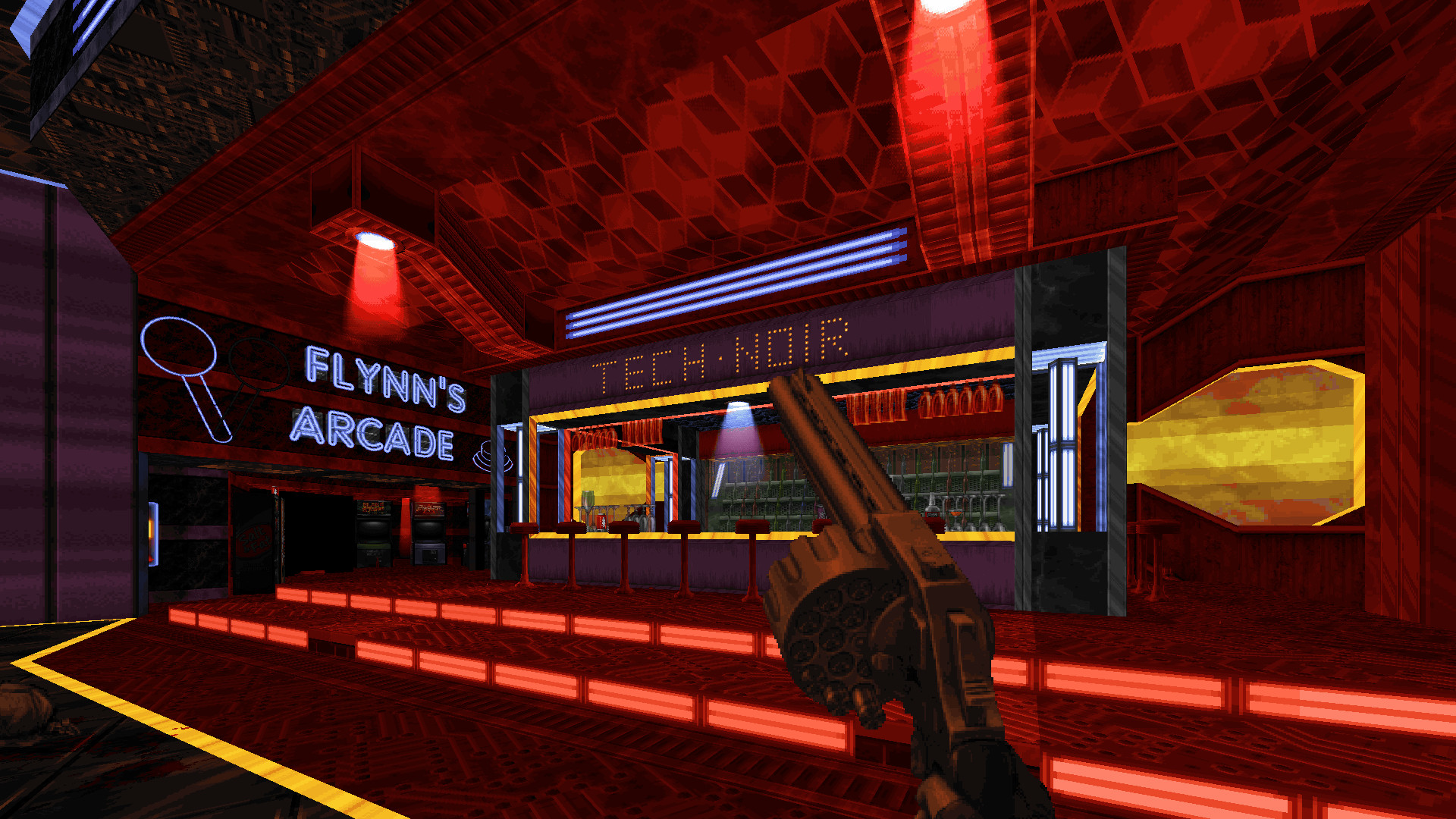
Combat is built around fast movement and changing weapons to meet different threats. Shelly can keep moving through a room, dodge or circle around an attack, and fire while searching for a useful position. Headshots give precise shots a clear role, while enemies use different approaches and attack angles that can make standing still costly. Cultists, cybernetic soldiers and stranger mechanical or hybrid opponents require the player to watch where a threat is coming from and choose a response. Some enemies attack from above or below, while others can fill a narrow passage with projectiles. Because encounters are arranged in the spaces the player is already navigating, a fight can also interrupt a search for a key or turn a previously safe route into a dangerous return trip.
The signature Loverboy revolver is a tri-barrel sidearm with a conventional single-shot attack and a faster hammer-fanning alternate mode. It remains useful beyond the opening because accurate fire can reward careful aim, while its alternate mode offers a different answer when pressure rises. Other weapons add separate rhythms and functions: a shotgun can fire buckshot at close range or accept pipe grenades, a crossbow supplies a precise projectile, and the arsenal also includes submachine guns, a chaingun, explosive discs, proximity mines and Bowling Bombs. Alternate firing modes and ammunition choices give familiar weapon types extra uses without making any one gun a solution to every situation. The player can move between direct shots, sustained fire and explosives as the enemy mix and available space change.
Finding ammunition and health is part of deciding how to approach each stretch of the campaign. Supplies can be left along the main path or hidden in a side room, so exploration can replenish a weapon before a larger encounter. Explosives can clear enemies around a corner or help open routes, while other weapons are more useful when a target is visible at a distance or advancing through a tight doorway. A limited supply encourages switching among the available tools instead of relying on a single attack throughout. The game also supports quick saves and autosaves, letting progress persist through a sequence of rooms and fights. Its single-player structure keeps the focus on moving through the campaign, reading the level and responding to the next encounter rather than coordinating with other players.
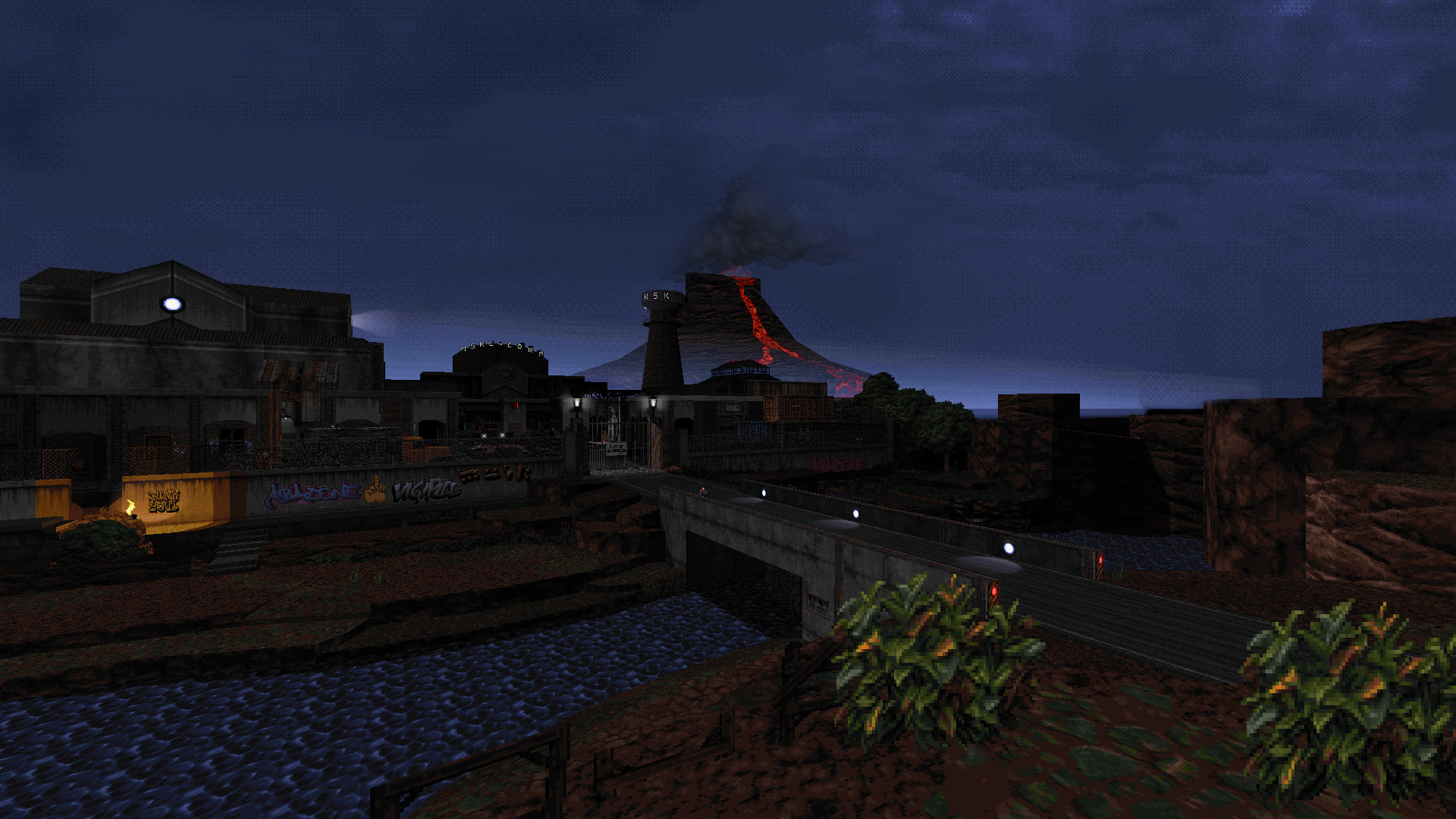
Ion Fury uses a modernised version of the Build Engine, technology associated with several influential 1990s shooters. Its presentation draws on that lineage through pixel-based art, strong colour contrasts and environments assembled from visible architectural pieces, but the design adds effects and interactivity suited to its own setting. Rain, thunder, neon, smoke and moving machinery contribute to the atmosphere; the player can also interact with ordinary fixtures scattered through rooms. The result ties the game’s look to its level structure: areas are legible enough to navigate at speed, yet detailed enough to reward stopping and looking for a switch or concealed opening. That balance shapes the campaign from one chapter to the next, pairing quick firefights with stretches of route-finding through a layered version of Neo D.C.
- Developer
- Voidpoint, LLC
- Genre
- Single-player retro first-person shooter