
About Into the Breach
Human settlements face an invasion by the Vek, and a small force of time-travelling pilots answers with powerful mechs. In compact turn-based battles, anticipate enemy attacks, reposition threats and protect the Power Grid while securing corporate islands and building a squad for the next operation.
Into the Breach casts the player as a commander responding to a Vek invasion that threatens the scattered remains of human civilization. The Vek are enormous creatures that emerge from beneath the earth; mechs piloted by soldiers from the future are sent to defend settlements and the people living there. The setting combines a science-fiction premise about repeated attempts to save the world with a more immediate concern: each battle takes place in a small area where homes, infrastructure and the mechs themselves can be damaged. The campaign moves across corporate islands, whose inhabitants and facilities become the focus of missions. Rather than unfolding as a long sequence of cutscenes, the story is carried by the struggle to preserve these communities and push the Vek back.
Combat happens on a square grid, with the player controlling a squad of three mechs. At the start of a battle, the Vek appear and announce the attacks they intend to make; their targets and directions are visible before the player acts. The player then moves and uses each mech’s weapons or abilities, arranging the board to interrupt those planned strikes. A mech can destroy an attacker, push it away from a building, pull it into another enemy’s path or block a space where another Vek is about to emerge. Attacks are deterministic during the player’s turn, so the main challenge is reading the order and consequences of events rather than betting on a hit. A displayed attack may threaten a building, another mech or several units at once, turning each turn into a compact positioning problem.
The Power Grid represents the survival of the islands’ connected settlements. If buildings take damage, the grid loses power; if its supply is exhausted, that timeline is lost. Keeping every structure untouched is not always possible, so the commander weighs grid damage against other risks, including a mech being disabled or a mission objective being missed. Battles reward survival through the enemy turns and completion of selected objectives, which can ask the squad to protect a particular structure, destroy enemies or block emerging Vek. Mechs can repair themselves, and the player can move units even when they are not attacking, so a turn may be spent saving a target rather than dealing damage. The tactical map also includes hazards and terrain that can change how a push, shot or movement resolves.
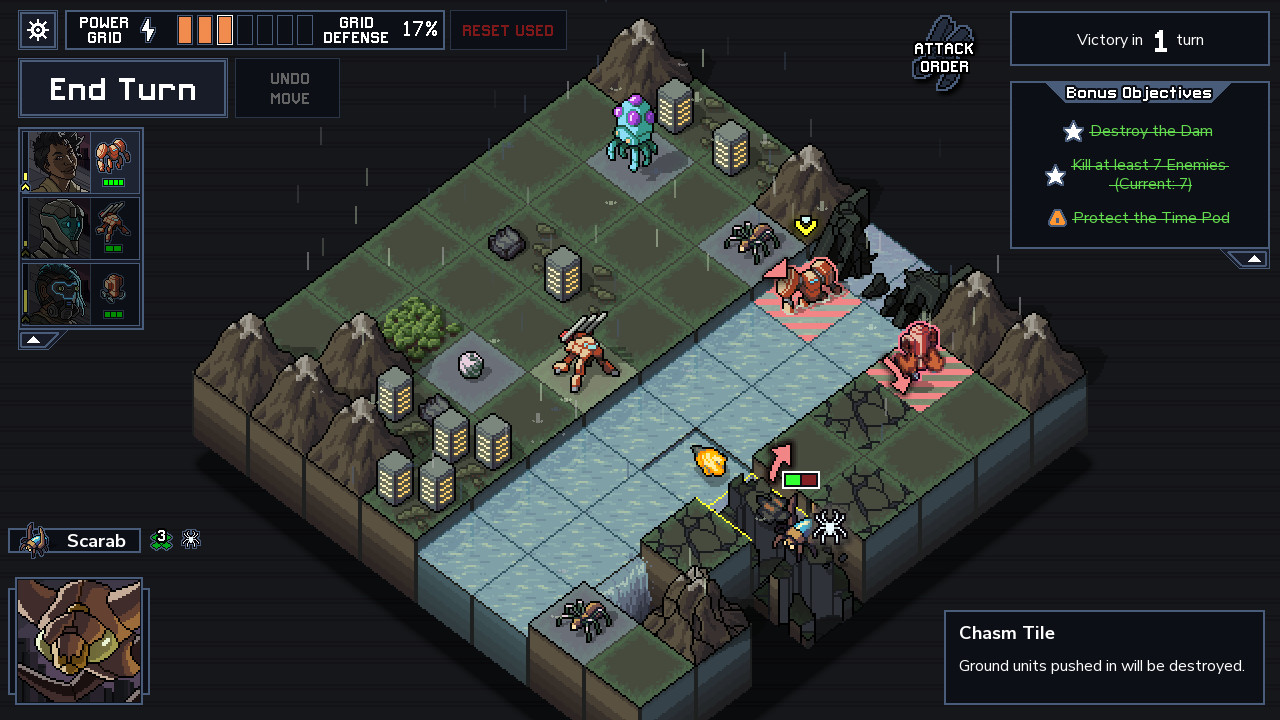
The three mechs in a squad belong to a chosen team, and their weapons determine how they can influence a battle. Some weapons strike directly; others push, pull, shield, freeze or otherwise alter a unit’s position or status. Displacing an enemy can cancel the attack it had announced, and a push can send a Vek into water or a chasm, into another unit, or away from a threatened building. This makes low-damage tools useful even when they do not remove an enemy. The player can also use the environment: fire, smoke, ice, water and shifting terrain affect units differently, while structures can block movement and line up shots. Mechs have health and movement values, and taking damage can constrain the next plan. Repair and repositioning are therefore active tactical choices, not just pauses between attacks.
Each corporate island offers a choice of missions with different risks and rewards. Optional objectives can add reputation, grid power or reactor cores, and recovered Time Pods provide a core with a chance of additional equipment or a pilot. Reputation can be spent after an island is defended to acquire weapons and equipment; reactor cores power upgrades or activate some equipment and pilot skills. Those resources create trade-offs between protecting the campaign’s energy supply, increasing a mech’s mobility or health, and improving the squad’s ability to control enemies. Completing all objectives on an island can earn an additional choice of reward. Since the team must decide which operations to attempt, pursuing every bonus can expose the grid or pilots to danger, while a cautious route may leave fewer resources for later battles.
Pilots contribute personal abilities and can gain experience as they take part in a campaign. Their skills can alter how a mech moves, survives or uses its equipment, and some abilities need reactor power before they can be used. If a mech is destroyed, its pilot may be lost, making protection of the crew another concern alongside buildings and objectives. New weapons can change a squad’s tactical role, but equipment and power are limited, so an upgrade on one mech can mean foregoing an improvement elsewhere. When a timeline fails, the time-travel premise lets a surviving pilot carry experience and abilities into a fresh attempt. A run therefore links short tactical encounters through a persistent but vulnerable team, with each island’s results shaping the tools available in the next.
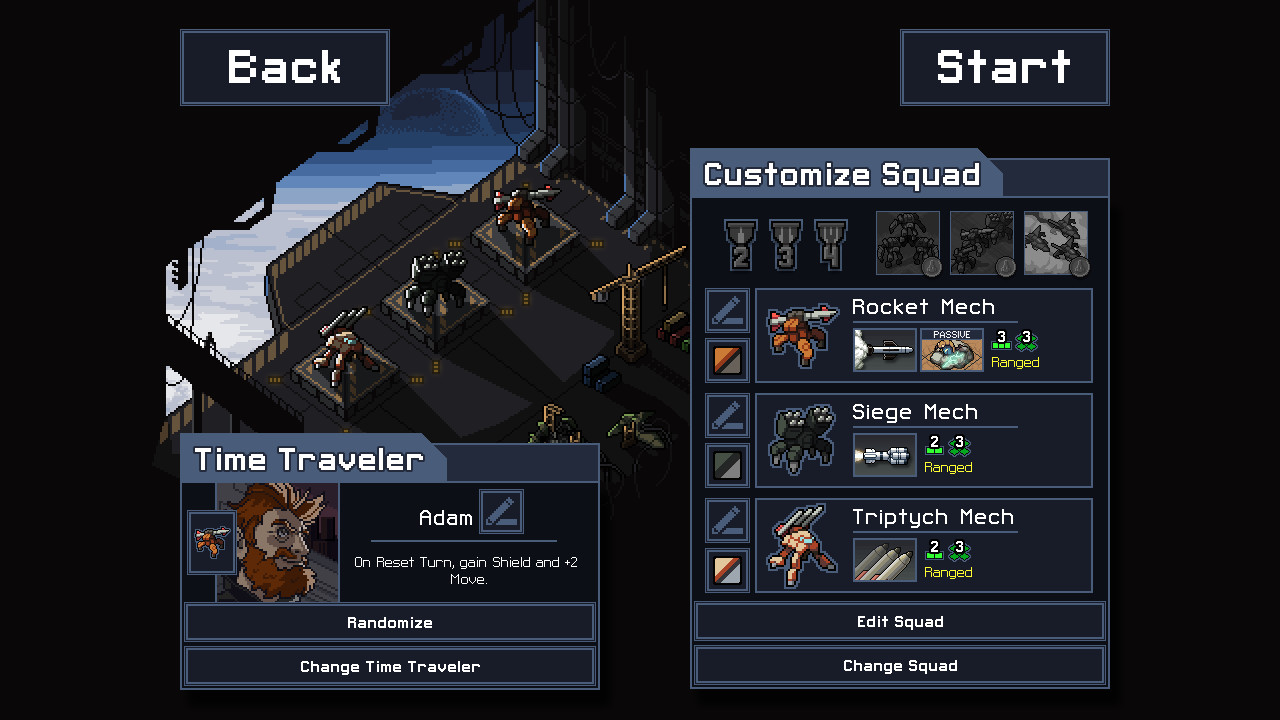
Into the Breach is built around repeatable campaigns, unlockable squads and self-contained tactical battles rather than a large continuous battlefield. The original campaign structure centers on choosing corporate-island missions, defending the Power Grid, strengthening mechs and ultimately challenging the Vek threat. The currently sold Steam version includes the free Advanced Edition update, which adds further squads, weapons, enemies, pilots, objectives and a higher difficulty mode. The update broadens the available choices around the original island-defense loop. Across either edition, the central activity remains clear: inspect the attacks the Vek have telegraphed, decide which consequences matter most, and use three mechs to change the board before the enemy turn resolves.
- Developer
- Subset Games
- Genre
- Turn-based strategy / tactical mech combat