

About INDIKA
In an alternate Russia at the turn of the nineteenth century, young nun Indika leaves her monastery on a journey that brings religious visions into contact with hard daily realities. The third-person adventure combines exploration and environmental puzzles with conversations, a devilish voice, faith points and pixel-art episodes recalling her past.
INDIKA centres on a young nun named Indika, whose life in a Russian monastery is unsettled by an unusual inner companion: the devil. The game places her in an alternate version of Russia around the turn of the nineteenth century, where religious visions, institutional authority and the demands of ordinary survival meet. The premise follows Indika beyond the monastery and into a journey of self-discovery, but it does not present that journey as a conventional heroic quest. Her relationship with faith and the voice that accompanies her complicate what she sees and how she interprets events. The game keeps its narrative close to her perspective, using dialogue, environmental scenes and surreal interruptions to make internal conflict part of the spaces the player moves through. Its tone can move between sombre hardship, strange humour and dreamlike imagery. The devil is introduced as a presence in Indika’s experience rather than as a straightforward external villain, and the story leaves room for uncertainty about what is literal, imagined or symbolic. The adventure is focused on this one protagonist and her changing understanding of herself.
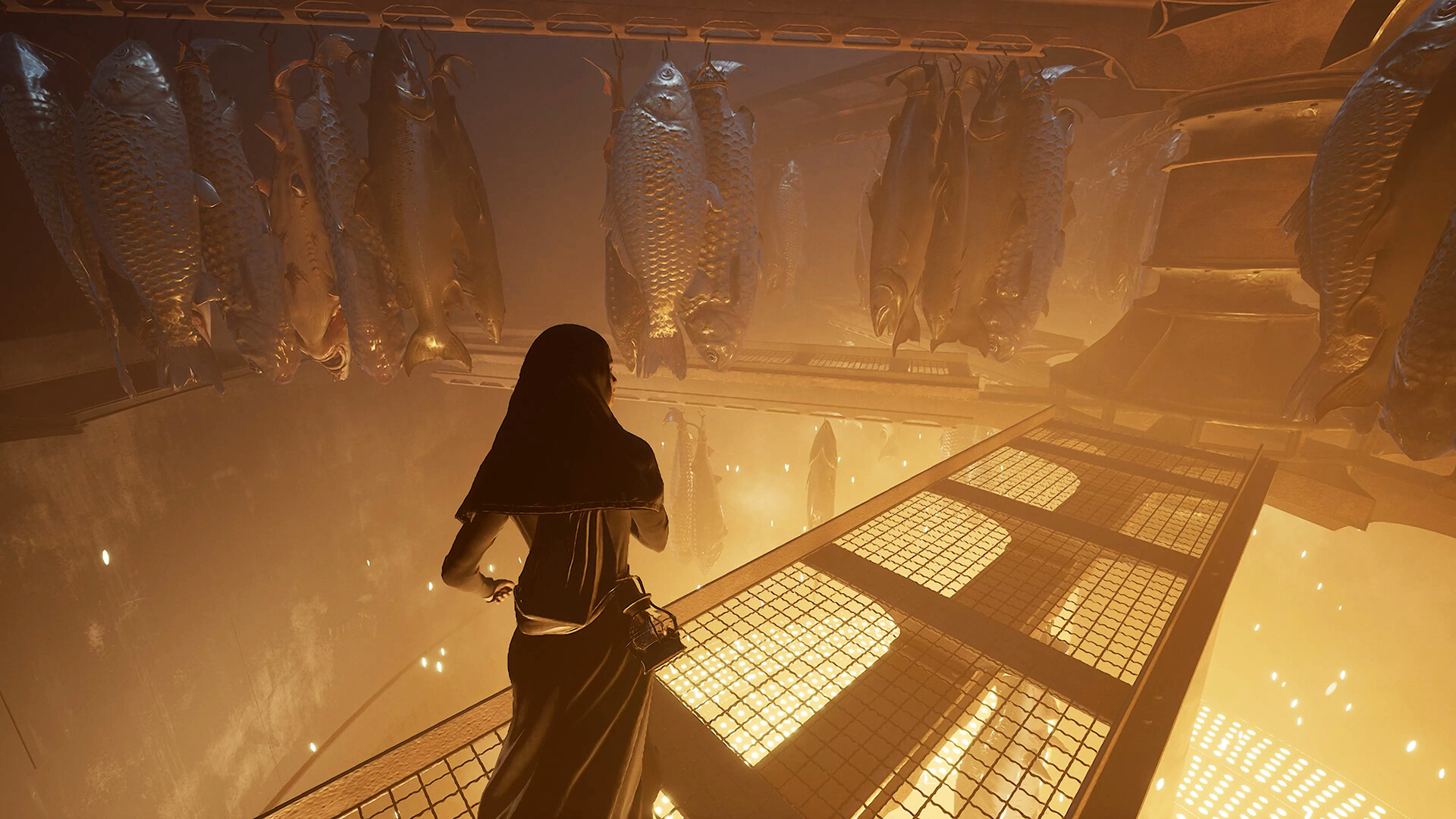
The journey begins in and around monastic life, whose routines are shaped by work, rules and religious hierarchy. Indika appears outwardly to be a quiet nun trying to fit into this demanding environment, but her private exchanges with the devil interrupt the surface of obedience. As she travels farther from the monastery, the world opens into settlements, roads and surreal landscapes that reflect the instability of her thoughts. People she encounters have their own authority, needs and expectations, and Indika must navigate social situations as well as physical routes. The setting is not a documentary depiction of historical Russia; the publisher frames it as an alternate, strange world where harsh reality and religious visions collide. Oversized or distorted features can make familiar surroundings feel uncanny, while more recognizably grounded scenes maintain a stark, material texture. This contrast anchors the adventure in places and objects even when the environment becomes impossible. Moving through these spaces is a way of discovering what Indika notices and what unsettles her, rather than surveying a large open world or taking on unrelated quests.
Movement and observation make up much of the main third-person play. The player guides Indika through constrained environments, looking for paths, objects and mechanisms that can be used to continue. Environmental puzzles ask for spatial reasoning: a route may be blocked, a device may need to be operated or the scene may change in a way that reveals where to go. Some puzzle spaces visibly distort or split, making the world itself part of the problem. The developer has described such moments as reflecting Indika’s state, so the physical confusion can express a crisis rather than function as an abstract lock-and-key challenge. The game also includes short interaction sequences and occasional challenges in movement, but its primary rhythm is to walk, inspect, listen and solve a local obstacle before the next story scene. The player is not managing a combat loadout or fighting through waves of enemies. Instead, progress comes from working through authored spaces and following the narrative thread. These mechanics keep the adventure intimate: the surroundings provide the next practical task while the story gives that task a personal context.
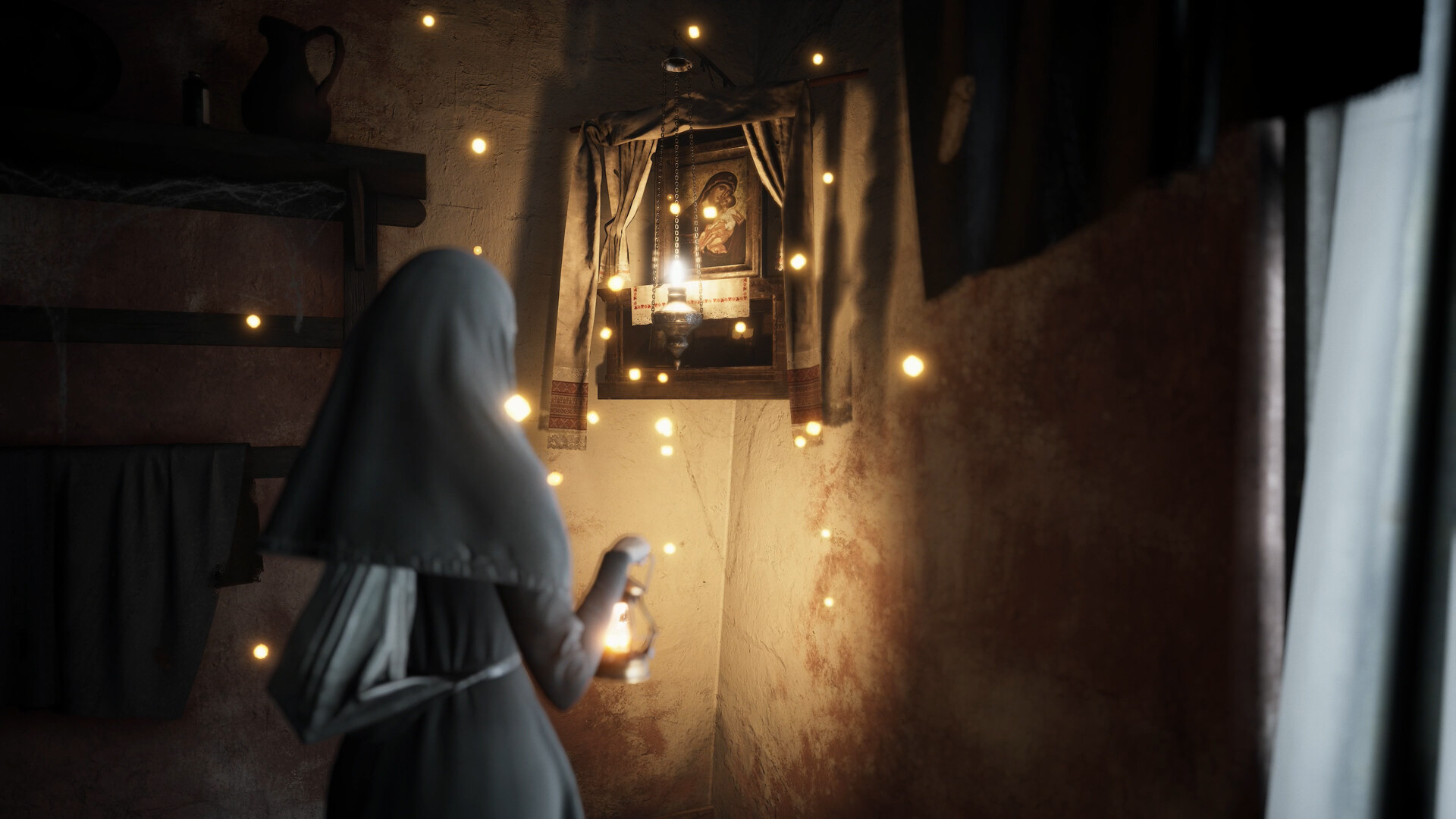
Indika’s relationship with the devil shapes the way scenes and conversations unfold. The voice can comment on actions and religious expectations, giving the player access to a running exchange that complicates the heroine’s outward conduct. Some mechanics are tied to this interaction, although the game does not turn the devil into a selectable companion with a separate skill set or party role. Conversations and observations remain the main way the player learns how a situation is framed. The game’s spiritual concerns are expressed through what Indika does as well as what she says: a routine task, a moment of prayer or a choice about an object can sit alongside the devil’s irreverent response. This does not create a conventional morality meter where decisions determine a good or bad ending. The narrative instead maintains an unsettled relationship between religious rules, personal desire and the voice that challenges them. The player follows that tension through a mostly linear story, with the protagonist’s interpretation changing as she encounters new people and places. Her journey is authored, not a branching role-playing campaign.
Faith points and a small skill-tree-like menu form a deliberately unusual progression layer. Points can be collected through certain interactions and discoveries, and reaching thresholds presents choices in a level-up interface. The game itself openly questions the value of accumulating them; Odd Meter’s director has explained that the system is meant to draw attention to how players continue pursuing points even when their practical purpose is challenged. It should therefore not be described as a conventional power curve that steadily makes Indika stronger or opens a broad set of builds. The menu can suggest familiar role-playing advancement, but the narrative frames it with irony. Separate from that point system, forward movement is driven mainly by story scenes, environmental puzzles and the discovery of routes through each location. The player does not earn equipment or unlock a large catalogue of combat abilities. Instead, the systems give structure to the game’s questions about rules, rewards and the habits people follow. Progression is intentionally narrow and tied to the way the adventure wants the player to think about play itself.
The game changes visual style when it visits parts of Indika’s past. Most of the journey uses a realistic three-dimensional presentation with muted environments, expressive character animation and an unsettling sense of scale. Flashback episodes shift into two-dimensional pixel art and take the shape of short retro-style minigames. Their simplified colours and familiar arcade language contrast with the adult Indika’s bleak present, giving those memories a different pace and visual identity. The changes are not a separate game mode or a collection of optional arcade challenges; they appear within the story and contribute to how the protagonist’s past is presented. Sound also supports the shifts in tone, moving between quiet environmental texture, dialogue and more pronounced musical or electronic accents in altered spaces. The overall presentation uses contrast as a narrative tool: realistic detail makes the world feel tangible, while distorted environments and low-resolution flashbacks signal that the player has moved into a different mental or temporal register. These transitions help distinguish the game’s changing points of view without requiring a large cast of playable characters.
INDIKA is a single-player adventure from Odd Meter and 11 bit studios, with a 2024 PC release and a later Nintendo Switch edition. The journey keeps returning to an uncomfortable mismatch: the monastery teaches obedience and spiritual certainty, while Indika's encounters and the devil's voice keep making certainty difficult. Walking through a bleak settlement, following a distorted passage and seeing a bright pixel-art memory are different ways of moving through the same character's thoughts. Faith points and their skill-tree-like menu add another question about whether an apparent reward has any real value. None of this turns the journey into a build-based role-playing game; scenes and puzzles carry it forward, while conversations and visual changes complicate what Indika believes she understands. The story's later answers remain part of the game to discover, but its opening establishes a distinctive interaction between religious imagery, physical tasks and surreal interruptions.
- Developer
- Odd Meter
- Genre
- Third-person narrative adventure