
About In Other Waters
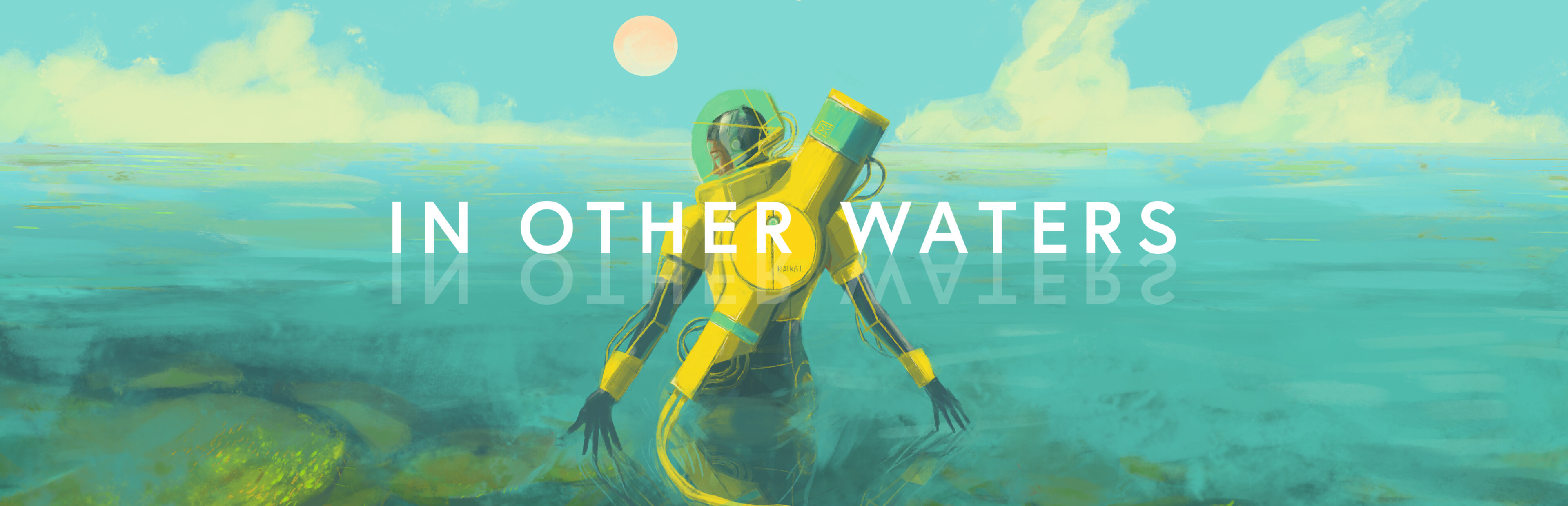
On the ocean planet Gliese 677Cc, xenobiologist Ellery Vas searches for her missing partner, Minae Nomura, with a malfunctioning diving suit and an unfamiliar artificial intelligence as her guides. Navigate the alien seafloor through a compact interface, scan and sample unfamiliar life, and use each discovery to investigate the planet's ecology, history and the bond forming between scientist and AI.
In Other Waters places the player inside the artificial intelligence of a damaged diving suit, accompanying xenobiologist Ellery Vas on Gliese 677Cc. Ellery has come to the ocean world after a call from her research partner, Minae Nomura, but the base she reaches is abandoned and Minae is missing. The AI is not simply a voice giving directions: it is the player’s point of view, a collection of suit functions and a companion whose understanding of itself develops alongside Ellery’s investigation. Their communication is limited, so brief exchanges and Ellery’s field notes carry much of the characterization. The search for Minae gives the dives a personal question to pursue, while the ocean presents a larger one: what kind of living world surrounds them, and what happened there before Ellery arrived? As the two work together, learning about the planet also changes the relationship between the person wearing the suit and the intelligence inhabiting it. The story keeps Ellery a scientist rather than turning her into an armed adventurer; her expertise is expressed through observation, classification and interpretation. The experience is a single-player, non-violent science-fiction adventure whose tension comes from uncertainty, environmental danger and the consequences of knowledge, rather than combat.
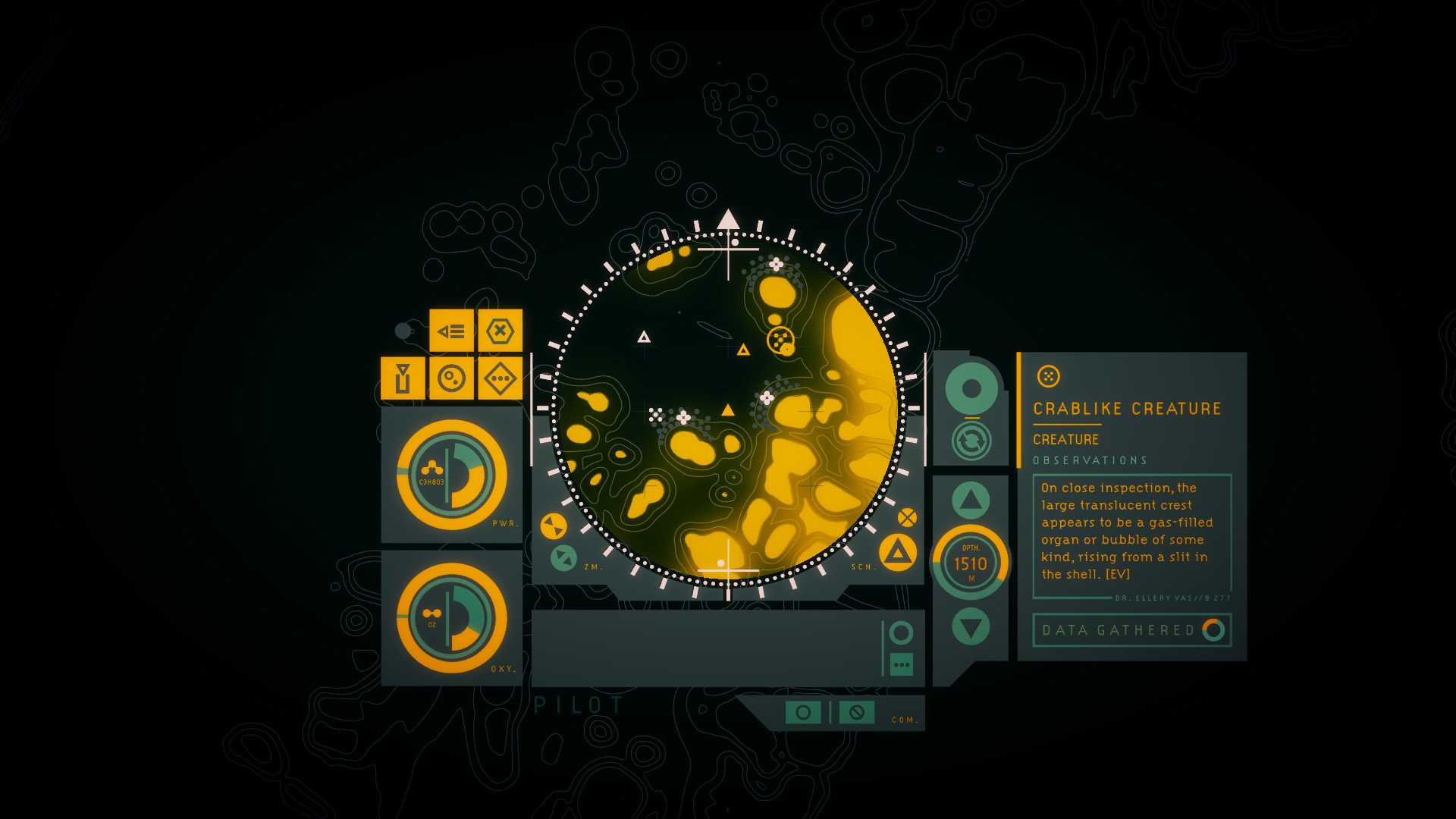
The ocean is represented through a deliberately spare instrument display rather than a conventional underwater view. Ellery, nearby organisms, landmarks and points of interest appear as marks on a map, while interface text and her descriptions make those marks legible as parts of a living place. A ping reveals signals in the surrounding area; scanning selected objects adds information and can make new interactions or routes apparent. The player shifts between reading the map, inspecting signals, choosing a heading and directing Ellery to a destination. This makes navigation a sequence of deliberate observations and commands: identify a reachable point, decide whether it is worth investigating, then send the diver there before scanning again. Different layers and sectors of the seafloor connect into a broader route through the ocean, with discoveries and equipment improvements opening paths that were previously inaccessible. The interface supplies the visual vocabulary of the world, while Ellery’s notes describe shape, movement, texture and behavior that the map cannot show. The result asks the player to assemble a mental picture from coordinates, signals, sounds and prose. The interface’s changing colors and restrained audio also respond to the surrounding environment, so its small set of visual cues helps communicate mood and danger as well as position.
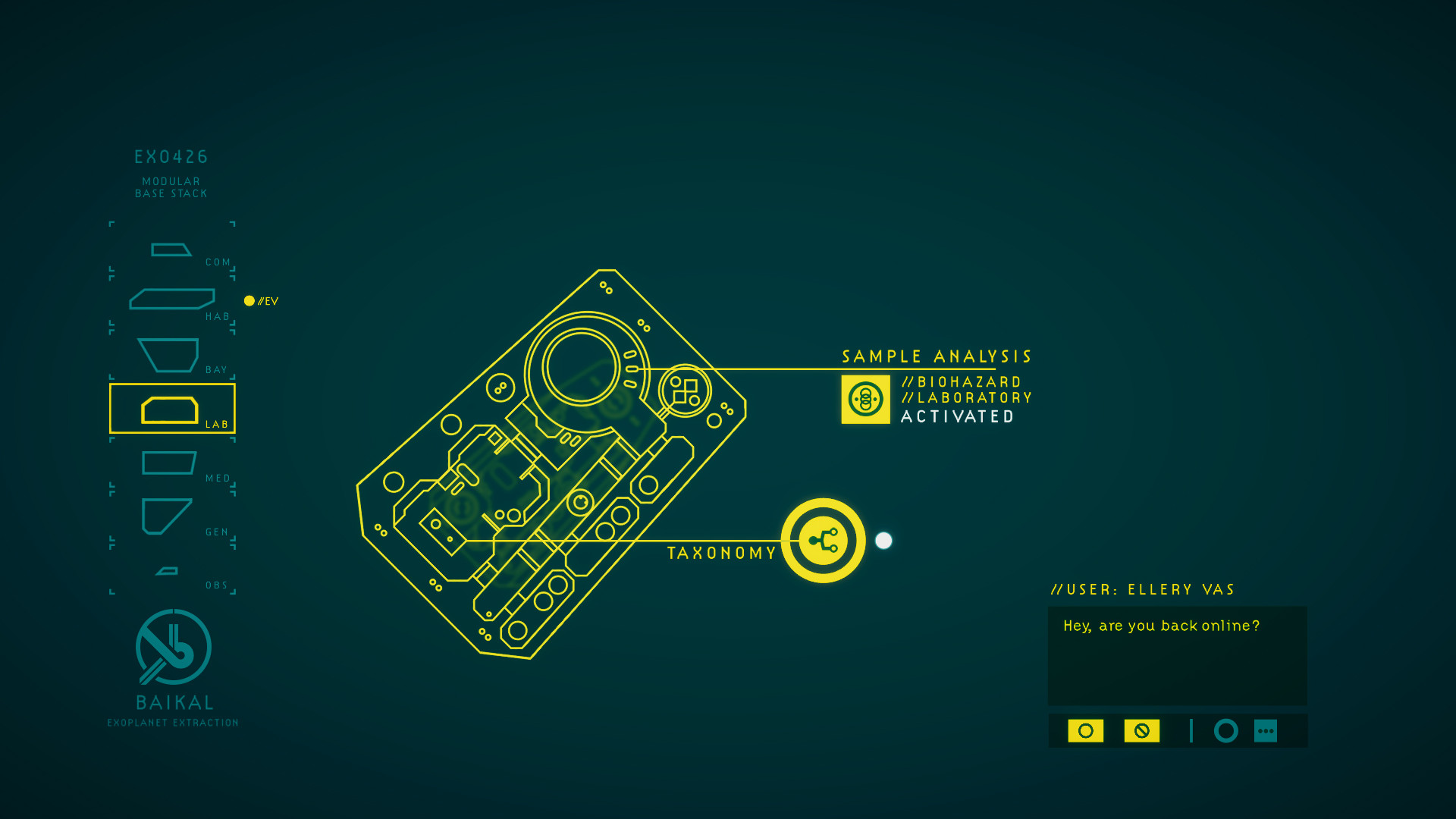
Fieldwork revolves around returning to organisms and environmental features with increasingly informed questions. A first scan can identify a signal or reveal that a specimen merits closer study; observation and repeated encounters then contribute to Ellery’s notes and the suit’s taxonomy. When it is possible to collect a sample, the player must decide how to use it. Some collected material can replenish suit resources, be applied to an environmental obstacle, or be retained for analysis at the base. These choices connect curiosity to practical planning: taking every available sample is not always the same as having the right material for the next interaction, and an organism’s role may become clearer when its behavior is observed in context. In the lab, Ellery studies stored samples and develops a more systematic account of the planet’s life. Her observations, sketches and classifications give discoveries a place in an accumulating scientific record, rather than treating them as isolated collectibles. Completing more of that record can reveal further detail about species and ecosystems, and can help the player notice relationships between organisms. The game’s biological interest lies in those interactions and dependencies: creatures and plants inhabit particular environments, and learning what they do helps explain both the immediate surroundings and the larger history Ellery is trying to reconstruct.
Exploration is also a matter of managing what the suit and diver can safely do. Power and oxygen are limited during a dive, and some environments place additional pressure on those supplies. Moving between mapped points, scanning, collecting and using suit functions all take place within that constraint, so a route may involve weighing a promising detour against the need to return or continue. The suit’s upgrades expand its capabilities as Ellery and the AI make discoveries, allowing access to new routes and interactions; progress therefore comes from combining scientific work with practical improvements to the equipment. Materials found in the ocean can serve as resources or as tools for changing the environment, and the player’s field decisions determine which possibilities are available later in the same expedition. Hazardous areas sharpen this planning because depletion can make delay consequential. Yet the game is not built around fighting creatures: the central responses are to interpret signals, learn what an organism or obstacle requires, and use the suit or a sample accordingly. Where a puzzle appears, it grows out of the environment and the tools already being studied. The dives thus connect navigation, research and resource choices. Understanding an ecosystem can be useful in a very direct sense, because what Ellery learns about a living thing may also suggest how to proceed through the place it inhabits.
The story’s science fiction mystery grows through comparisons between evidence gathered in the water and fragments of the planet’s past. Ellery’s search for Minae is not separate from her research: the route through abandoned facilities, unfamiliar habitats and changing ocean regions offers clues about both the missing expedition and the world’s ecological condition. The AI’s limited communications give these discoveries a second dimension, since the player is helping Ellery while also learning what it means to occupy the suit she relies on. Ellery can respond to the AI, and the tone of those exchanges changes as they share risks and discoveries. Rather than present the ocean as a succession of enemies to defeat, the narrative asks the player to consider how life persists, how ecosystems are shaped, and what distinctions between natural and artificial life mean in this setting. Scientific notes and personal dialogue sit alongside each other, so cataloguing a species can deepen the sense of place even when it does not immediately solve a plot problem. The mysteries are delivered through exploration, records and conversation; the game’s quiet presentation gives room for the player to connect those pieces without requiring a combat system or a conventional action set piece.
The interface is also the game’s distinctive presentation style. Most of the planet is never shown as a conventional rendered landscape: the player reads it through the suit’s map, moving signals, concise system text and Ellery’s vivid descriptions. This abstraction makes the player actively imagine the animals and terrain instead of watching a camera follow the diver. Sound and color carry some of the atmosphere that a literal view might otherwise provide, while the restrained controls keep attention on interpreting information and deciding where to go. The result links form and subject: the player encounters Gliese 677Cc as an intelligence might, through instruments, incomplete data and a human partner’s interpretations. In Other Waters was developed by Jump Over the Age and published by Fellow Traveller. The standard game is a single-player adventure; Steam identifies Windows and macOS, while the publisher also lists Nintendo Switch. The separately sold Xenobiologist Edition is a bundle that adds the companion book, A Study of Gliese 667Cc, and the soundtrack to the game. Those extras are distinct from the playable campaign, whose core activities are guiding Ellery, studying alien life, managing dives and uncovering the linked ecological and personal mysteries of the ocean.
- Developer
- Jump Over the Age
- Genre
- Adventure, Indie