

About If Found...
In December 1993, Kasio returns to Achill Island in Ireland and destroys the diary that records her month. Family conflict, new friendships and imaginative journeys through space converge on New Year’s Eve, as a black hole threatens the world. Players move through the illustrated story by erasing its pages.
If Found… follows Kasio during December 1993, beginning with a later moment: on New Year’s Eve, in the ruins of a mansion on Achill Island, she destroys her diary. Its pages carry the account back through her return to the west of Ireland and the people she encounters there. The story holds two scales together. One is intimate, centred on a young person’s homecoming, family strain and search for connection; the other is a speculative crisis involving a black hole that may destroy the world. The game moves between those scales rather than turning the cosmic thread into a separate action campaign. Kasio’s memories, interests and fears shape how the larger threat is presented, while the approaching date gives the quieter scenes an endpoint. The structure asks the player to attend to what is written, remembered and erased. Its progression does not rely on combat or conventional exploration objectives; the diary is the route through the month.
The central interaction is an eraser used directly on the illustrated page. Dragging it across a scene removes layers of drawing and text, revealing the next part of a memory and moving the account forward. Progress therefore comes from clearing the current image, rather than selecting dialogue from a branching menu or navigating a three-dimensional space. The action repeats across much of the diary, linking a simple input to the story’s concern with memory and letting the player determine the pace at which a page disappears. The mechanic is not a puzzle system built around hidden combinations or a score; its function is to reveal narrative by removing the visible surface. Conversations and other scene formats interrupt that gesture, giving characters room to speak and changing the rhythm without discarding the diary’s central interaction. The repeated action also makes the transition from one remembered moment to another physical: the player participates in uncovering what comes next, rather than merely turning a page automatically.
Kasio’s return home brings her into conflict with family members who do not readily accept her identity or understand the life she wants. Her mother expects a conventional route into work and adulthood, while her brother Fergal adds pressure to an uneasy household. The tension is conveyed through ordinary exchanges and misreadings as well as direct hostility, making homecoming a sequence of specific social encounters rather than abstract backstory. Kasio is a trans woman, and the story places the hurt of being misgendered and dismissed alongside the uncertainty of returning to a small hometown after university. These scenes are not resolved through combat, persuasion meters or relationship statistics. They are part of the diary’s remembered experience, set beside moments in which she can feel more at ease. Because the player advances by erasing a scene, moving forward remains tied to the image and words just encountered. That framing gives the gesture emotional context while keeping the daily events on the island distinct from the cosmic images elsewhere in the book.
Colum, Jack and Shans offer Kasio a different social space. The young friends share a deteriorating house and play in a punk band; Kasio spends time with them during her stay. Their home is materially precarious, but shared routines contrast with the strain of her family home. Meals, television, practice and conversation make up these scenes. Shans, whom Kasio has not known long, becomes especially important as the two begin recognising parts of themselves in one another. Their connection develops through small encounters, including time at Shans’s family chip shop, not through a formal friendship quest or task list. Colum and Jack are also part of the group’s everyday life and the band that anchors several scenes. This refuge gives Kasio room to be herself, while the short December timeline makes clear that the comfort is temporary. A punk concert provides a louder public setting for the same circle and changes the visual scale of the story. These relationships add warmth without removing the uncertainty that follows Kasio through the month.
The diary includes sequences in which Kasio imagines herself among the stars. She is interested in astronomy, and visions involving Jupiter, an astronaut and a black hole place that interest alongside the pressures of life on Achill. These scenes use a more expansive visual register than the domestic memories, but they remain part of the same account rather than opening a separate space-shooter or science-fiction combat mode. The black hole is presented as an approaching threat in the game’s framing, while Kasio’s experiences and cosmic imagery meet through the diary’s transitions. The player does not pilot a spacecraft, manage equipment or fight enemies in these passages. Instead, shifts in scale connect an imaginative view of the universe with Kasio’s attempt to make sense of the month. The relationship develops as the narrative moves toward its New Year’s Eve frame. Memories and space images give the central act of erasure different meanings over time, with the diary itself guiding the order of scenes rather than an upgrade path or a map of missions.
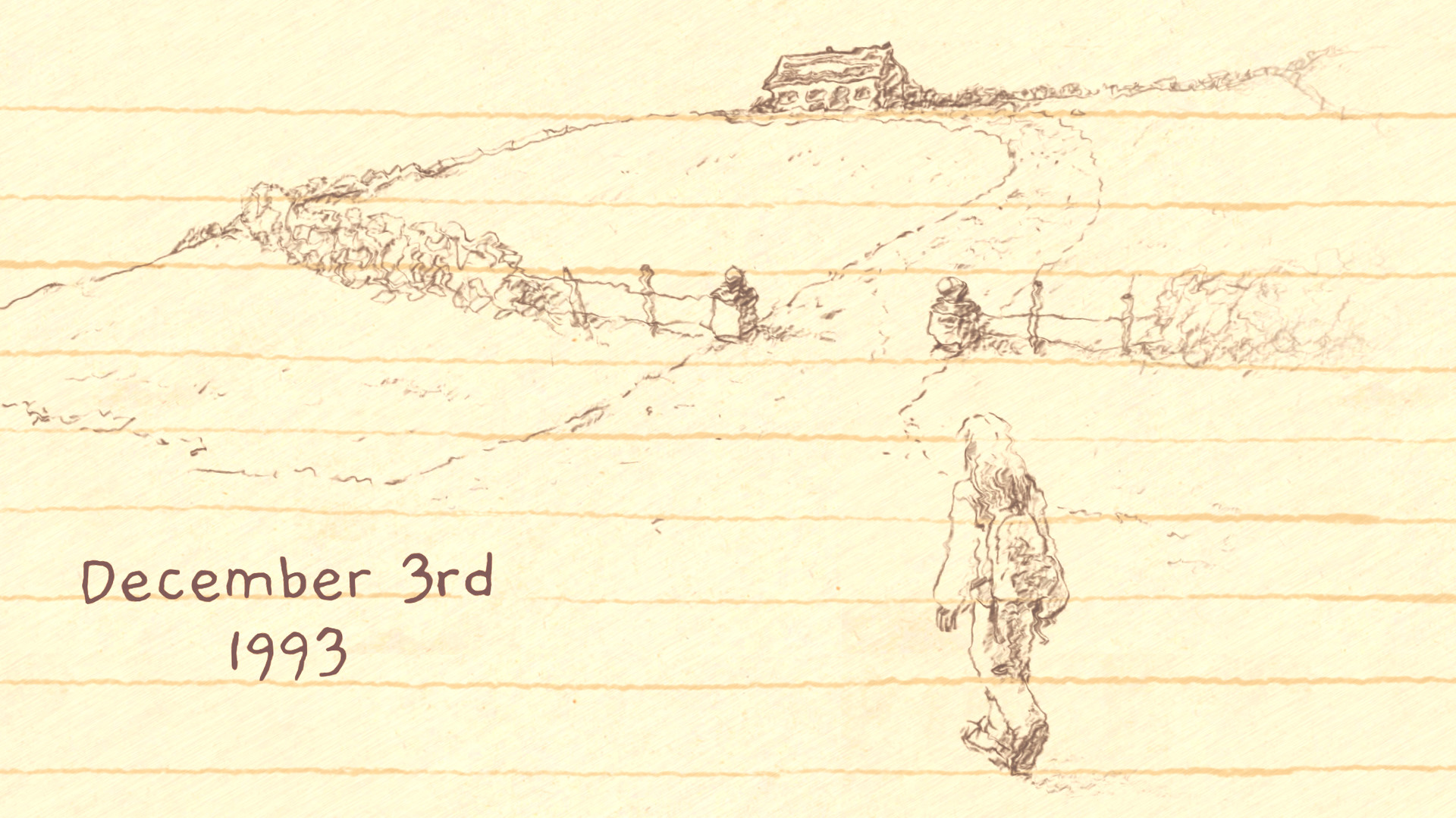
Scenes appear as illustrated pages that shift in composition and style. Some resemble a sketchbook or a compact pop-up book; others move into abstract, vividly coloured or disorienting imagery. Character expressions and body language carry information alongside dialogue, so the page itself helps stage a conversation. The eraser can clear visual layers before a scene is fully visible, changing what can be seen as well as advancing the account. Dialogue sections offer a different cadence from the sweeping motion used on diary pages, and shifts in presentation keep the repeated interaction from being the only way a scene unfolds. Sound and music support these changes: quieter passages use ambient tones, while other moments use more forceful music and environmental sound. Drawing, text and audio establish settings such as a cold night, a crowded performance or a private conversation. These are narrative presentation tools rather than rewards attached to combat, crafting or collecting. The hand-drawn approach also lets small gestures and changes in expression carry weight within otherwise sparse scenes.

Achill Island and the west of Ireland are specific parts of the setting, and the story includes local customs, expressions and details of everyday life. Explanatory footnotes help clarify regional terms and pronunciation, making cultural references part of reading the diary rather than a separate glossary challenge. Family expectations, friendship, music and astronomy give the month different textures, while the recurring erasure interaction keeps the player involved in turning those memories over. The setting is rendered through a private diary rather than an explorable reconstruction of the island. Its local details are encountered as Kasio remembers them: a name, a phrase, a room or a social gathering can acquire a different weight after the next page is uncovered. The story remains centred on Kasio’s return, the relationships formed during her stay and the diary’s frame on December 31. The cosmic threat belongs to that narrative frame; it does not signal a separate action campaign or a combat progression system. No late-story resolution is needed to describe the game’s premise, structure or primary interaction. The month contains happy and painful experiences side by side. That balance matters to the shape of the diary: social gatherings and new affection sit beside family conflict, and neither strand is presented as the only defining part of Kasio’s return. The sequence is therefore built from specific moments rather than a single continuous crisis, with the framing night giving those memories a shared destination.
- Developer
- DREAMFEEL
- Genre
- Narrative adventure / interactive diary