
About I Am Your Beast
After refusing another ‘one last job’, retired operative Alphonse Harding becomes the target of the Covert Operations Initiative in the North American wilderness. He turns the pursuit into a guerrilla campaign across replayable micro-sandboxes, using enemy weapons, traps, tunnels and speed to complete objectives before escaping.
I Am Your Beast casts the player as Alphonse Harding, a former operative who has been retired for six years. The pattern of being recalled for one last mission has reached its limit: Harding refuses the latest assignment, and that decision sparks a conflict with the Covert Operations Initiative, or COI. The organization pursues him through the North American wilderness, turning the hunter into the hunted. The story’s revenge premise gives its compact campaign a clear direction, while the comic-book presentation and kinetic typography carry its fully voiced scenes. Harding’s conflict is personal and immediate, but the opponent is an institutional force with the personnel and equipment to keep searching for him.
The campaign is structured as more than twenty short levels rather than one continuous open landscape. Each mission is a replayable micro-sandbox: a bounded stretch of wilderness or facility where Harding has a target, a route, and an exit to reach. A level may ask him to eliminate threats, pursue a side objective, or accomplish a task while competing for a faster time. This arrangement makes the campaign easy to revisit. The main objective establishes a route through the space, and additional goals encourage a different approach on another attempt. Completion is not only a matter of clearing every enemy; choosing what to do, how quickly to do it, and when to break away shapes each run through a stage.
The central combat rhythm is built around momentum and improvisation. Harding can move rapidly through the environment, climb trees, and use the landscape to close distance or leave a dangerous position. That mobility supports an aggressive approach in which he does not remain fixed behind cover. An encounter can start with a planned route and quickly become a scramble as COI forces react, weapons change hands and targets appear along the way. The game frames this as a guerrilla war: Harding uses the terrain and the opposition’s own resources to keep the initiative. Speed matters because the mission’s objectives and time goals reward decisive movement, while hesitation gives the pursuers more opportunity to concentrate on him.
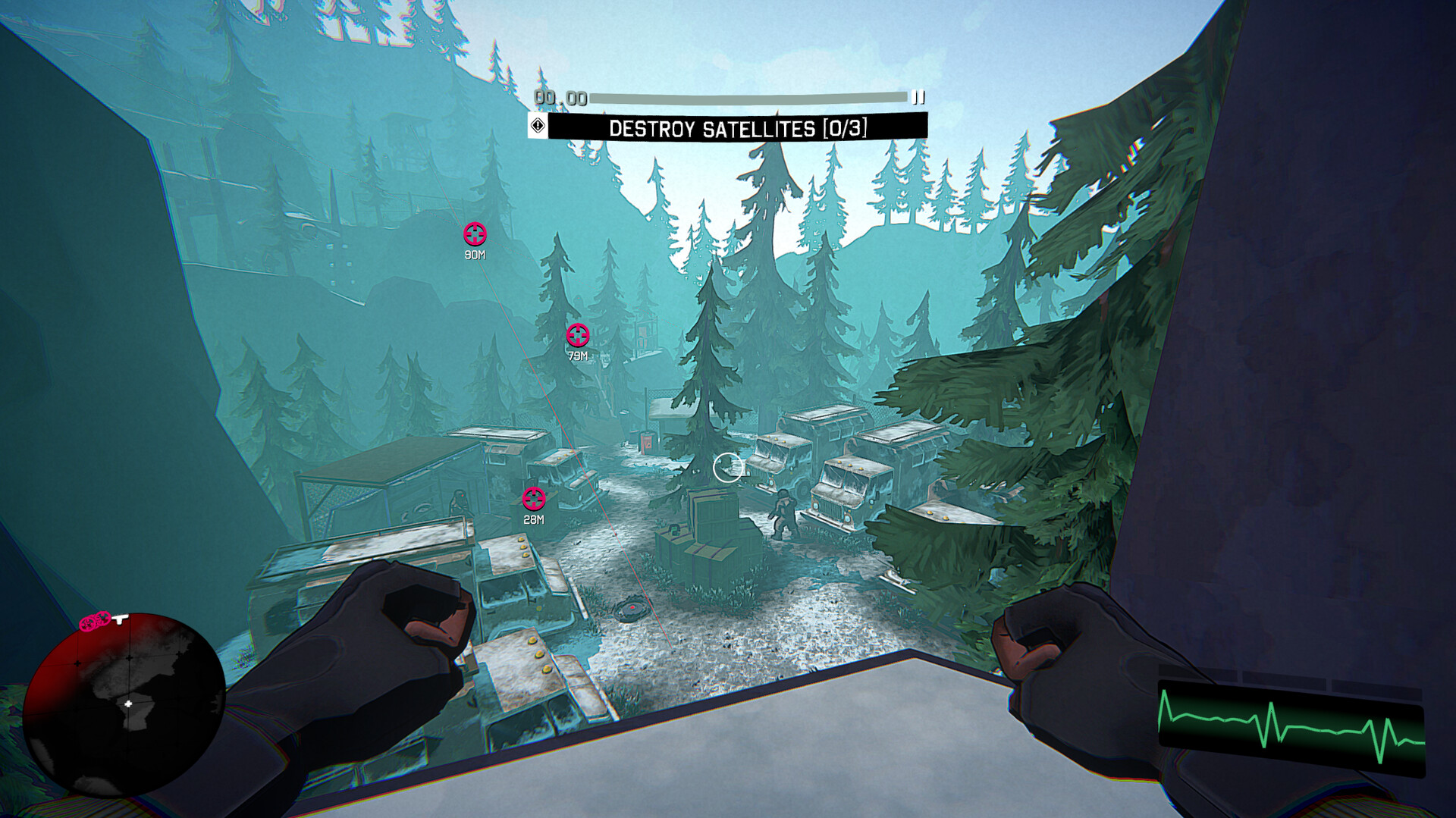
Weapons are part of the environment as much as the loadout. The campaign includes pistols and sniper rifles, alongside improvised or situational tools such as bear traps. Harding can take enemy equipment and use it against the force that brought it into the wilderness. This creates a practical reason to adapt as a stage unfolds: a weapon picked up in one encounter may make the next stretch easier, while a trap can alter how an approaching opponent reaches him. The emphasis is on making use of what is nearby instead of treating every mission as a fixed shooting gallery. The combination of firearms, traps and movement gives each compact space several ways to turn pressure back on the COI.
The tunnel network provides a different kind of route through the pursuit. Harding can duck into it before enemy forces close on his position, using the passages to leave a fight and reposition. That escape option connects the level’s combat with its geography: tunnels are not merely scenery but part of the player’s means of surviving a search. The repeated pattern is to break an opponent’s hold, take advantage of the equipment left behind, and withdraw before the remaining forces zero in. Moving between exposed ground and concealed passages changes the tempo. A rapid attack can be followed by a sudden retreat, then another opening into the same broader mission space.
Side objectives and time targets give the levels a second layer beyond their story purpose. A player can finish the primary task and still return to pursue optional goals or improve a clear time. Because stages are designed for replay, route knowledge becomes useful: knowing where to move, when to engage and how to reach the exit can turn a messy first attempt into a more deliberate sequence. The game’s design accommodates both a direct completion and attempts focused on efficiency. Those goals do not replace the narrative campaign; they add reasons to revisit its small spaces and experiment with their options. The same level can therefore be treated as a story beat, a tactical puzzle, or a timed challenge.
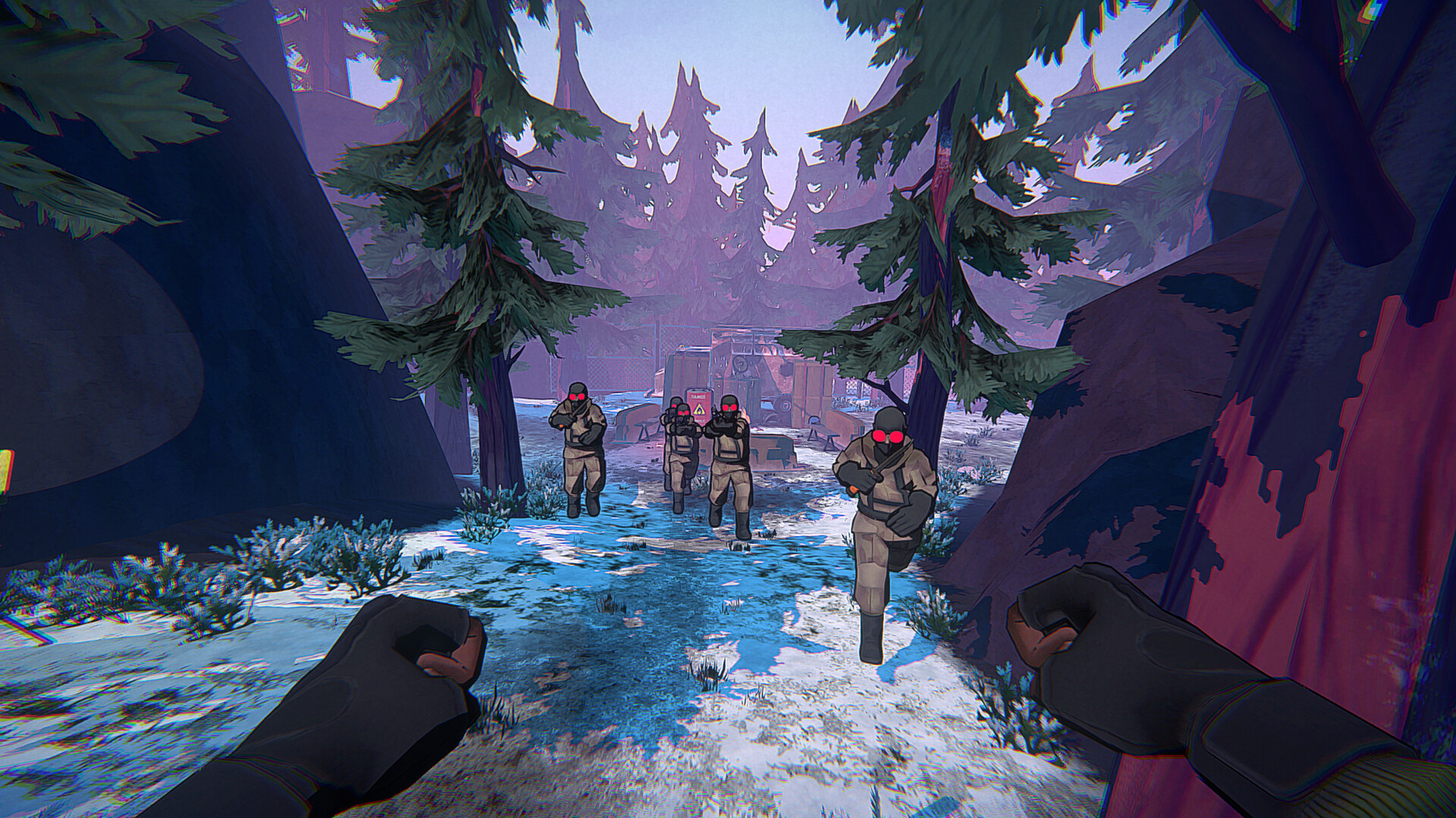
The visual and narrative presentation reinforces the compact structure. Comic-book-inspired art gives the wilderness conflict a heightened, illustrated quality, while kinetic typography turns dialogue and story transitions into part of the game’s graphic language. The fully voiced campaign links its more than twenty missions into Harding’s confrontation with the COI. Its tone combines covert operations with exaggerated violence, including comic-style blood effects and head explosions. Rather than presenting a sprawling military simulation, it focuses on Harding making rapid decisions in tightly bounded situations. Each stage advances the pursuit, then leaves room to replay for side goals and faster times. The result is a focused revenge thriller shaped around movement, improvised combat and escape.
- Developer
- Strange Scaffold
- Genre
- Single-player first-person action shooter and covert revenge thriller