

About I Am Dead
Recently deceased museum curator Morris Lupton reunites with his dog Sparky on Shelmerston, where a threatened volcano puts the island at risk. They search for lost ghosts by revisiting meaningful places, uncovering memories and finding personal mementos. Morris’s ghostly sight lets him peer inside objects, turning local details into the central puzzle system.
I Am Dead opens after Morris Lupton, curator of Shelmerston’s small museum, has died. He reunites with Sparky, his dog, now a ghost, as the island’s long-quiet volcano threatens the place they called home. They set out to find a new custodian by recovering the scattered spirits of people connected to Shelmerston. Morris’s work as a curator gives the premise a natural concern with objects and their histories: everyday belongings can preserve customs, relationships and memories after their owners are gone. The disaster provides the broad purpose of the journey, while each search focuses on an individual life and the island community that remembers it. The game is a puzzle adventure, so progress is built around attention and interpretation rather than combat. Because the central danger is a volcanic disaster, Morris is not searching for his own way home; he and Sparky are trying to identify someone able to take responsibility for the island. The objective gives the ghost stories a shared direction while leaving each resident’s memory its own subject.
Shelmerston is explored through contained places and rooms, with the camera following a track around each area. The player can move the cursor over objects to identify them and read descriptions, then lock onto one for closer inspection. Some tracks loop through a space; others allow more limited movement. The viewpoint gives locations a diorama-like quality: a lighthouse room, a house or another local site becomes a carefully arranged scene rather than a large terrain to cross. People move through some of these spaces, and their names and objects help make the island feel inhabited. The setting draws on British maritime communities and island folklore, combining ordinary local history with invented groups such as tourist finches, fishfolk and morlos. Some rooms are viewed by moving the camera up or down, and characters can indicate that they have a memory to share. The arrangement means the player reads a location twice: first as a physical room full of nested objects, then as a meeting place for the people whose memories give those objects meaning.
Morris’s supernatural sight is the central object interaction. When he locks onto a container or possession, he can peel away its outer layer and look inside, then select objects revealed within it and inspect those in turn. The search can move from a building-scale view to a very small possession, making containers and their contents part of one continuous visual space. Interiors are constructed as visible forms rather than empty shells, so a familiar item may hold a surprising arrangement when opened to ghostly inspection. This ability turns a hidden-object search around: instead of scanning only the surfaces of a room, the player asks what may be inside the things already visible. The power also applies to memories, but the physical inspection of objects and the recollection sequences are distinct interactions. The slicing view is not a free camera that passes indiscriminately through the entire world. The player selects and locks onto an object, then rotates it and peels away its surface in real time. New contents can themselves become targets, so a small object may contain another layer of inspection.

Memories are accessed through living people who knew one of the lost ghosts. A character’s recollection unfolds as an illustrated sequence with spoken narration. The image begins blurred, and the player moves it until the scene lines up and the account continues. This brief alignment puzzle makes a memory something the player actively follows instead of a passive biography. Details in the recollection identify an object that mattered to the person being sought, while the accompanying story supplies context about relationships and local life. Some memories are funny, others reveal habits or history, and together they create a many-sided view of Shelmerston. They are personal recollections rather than a neutral chronicle: the player sees the island through what individual residents remember and choose to recount. A memory’s account comes from someone who knew the ghost, and the illustrated sequence links the recollection to the particular object that anchors it. Aligning the blurred image is a small repeated action, but it marks where the narrator’s story resumes and helps separate that scene from the player’s examination of the current room.
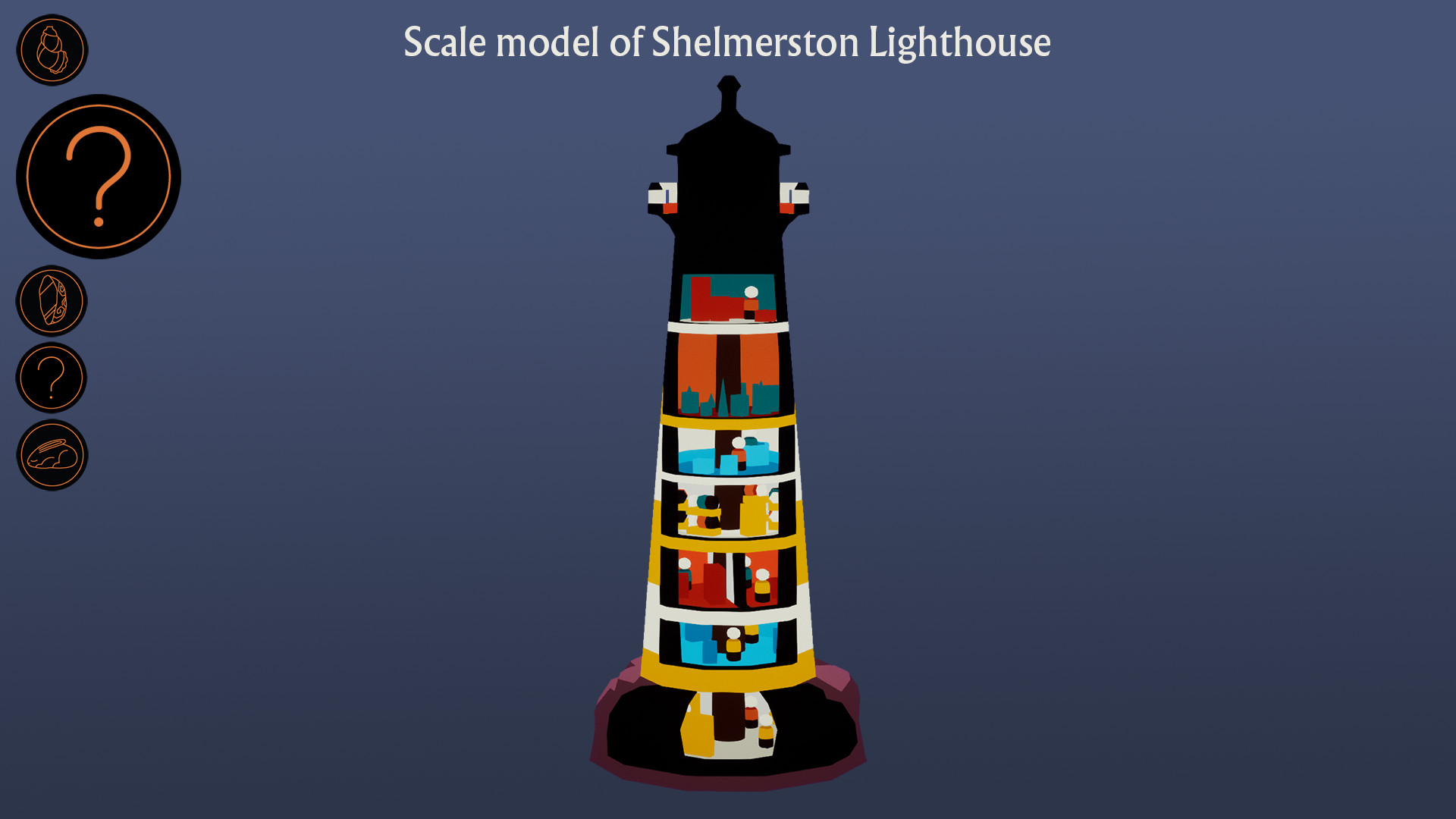
Each location’s main investigation is organized around those personal objects. The player learns what memento to look for through a memory, searches the associated room and its nested contents, then gathers the required items. Sparky’s role changes after that search: he can sniff out the prospective ghost, turning the evidence Morris collected into a final location step. One early example centers on Pete Noach, who ran a lighthouse yoga retreat; finding him involves speaking with people who remember him and searching the lighthouse’s rooms for relevant keepsakes. The wider adventure repeats the pattern with other people and places, but the stories and objects change. There is no equipment build or character-stat progression; advancement means completing one person’s investigation and moving to the next part of the island. Once the collected mementos are complete, Sparky’s scent-tracking activity closes the investigation of that prospect. It differs from the earlier room search because the player follows the dog’s ability to locate a presence rather than opening containers. That handoff gives the dog a concrete role in the search instead of leaving him only as a companion in the story.
Optional discoveries add distinct kinds of observation. Grenkins are small hidden spirits found in certain rooms. Sparky signals when one is nearby, and a silhouette indicates the shape to uncover; the player rotates and moves an object in the slicing view until its contents match that outline. Mr Whistable, a laughing giraffe in a ruff, offers timed riddles that point toward particular objects. Solving one requires interpreting the clue and finding the object before the timer runs out. These challenges sit apart from the required ghost searches, so they do not gate the main story. They reward players who read beyond the central memento clue and pay attention to the many incidental objects placed around a location. Grenkin outlines can be difficult to match because the target may sit inside a complex object rather than appear as a standalone collectible. Mr Whistable’s riddles use a different skill: the player must interpret a verbal clue and then locate one exact object under time pressure. Neither challenge is required for the next ghost.
The island’s identity comes through a mixture of conversational detail, voice acting and visual jokes. Objects receive short labels or longer descriptions, giving possessions a small biography even when they are not needed for a puzzle. Shelmerston’s inhabitants include human locals, visitors and fantastical communities; its folklore reaches back to Aggi, the figure said to have originally silenced the volcano. The story also touches on tensions between long-established residents and outsiders who see the island mainly as a holiday destination. That concern stays in the background of the ghost hunt, carried through places and community stories rather than a separate political system. Colorful 3D scenes, small animated details and narrated memories keep the mood curious and often comic while allowing loss and remembrance to remain present. The island’s objects are described individually, including many that do not advance the current investigation. This supports a sense of local life around the main plot: a possession can be a clue, a joke or simply evidence of someone’s habits. The vocal narration in memories contrasts with the quiet examination of these still objects.
This profile covers the full I Am Dead adventure and avoids its ending. It is a single-player puzzle game developed by Hollow Ponds with Richard Hogg and published by Annapurna Interactive. The Steam edition is the Windows PC release, with PlayStation, Xbox and Nintendo Switch editions also available. The basic structure is a sequence of locations, memories and object searches, with platform-specific control prompts. Movement is limited to camera tracks and selected object views rather than free roaming. Combat is absent; the challenges center on observation, memory and object puzzles. The first-person camera and cursor interaction suit mouse or controller input, while console editions use platform-specific controls. The stable interaction model is track-based movement and selected object inspection. Its central progression connects physical things with the people who valued them: memories reveal why a possession mattered, and finding it lets Morris and Sparky continue their search for the island's lost residents.
- Developer
- Hollow Ponds; Richard Hogg
- Genre
- Puzzle adventure