
About Hotline Miami
In an alternative 1989 Miami, a silent figure receives cryptic answering-machine messages that send him toward the city’s criminal underworld. Hotline Miami pairs fast top-down combat with animal-mask abilities, abrupt retries and a surreal story whose strange encounters leave the reasons behind the violence uncertain.
Hotline Miami places its story in an alternative version of Miami in 1989. The player follows a mysterious, unnamed antihero whose ordinary routines are interrupted by messages left on an answering machine. Each call gives an address and an instruction framed as a visit or a cleanup; arriving there turns the request into a violent assault on a building associated with the Russian Mafia. The game offers little explanation at first for who is calling, why these targets have been selected, or why the protagonist accepts the assignments. That gap between mundane errands and extreme violence is central to the story’s uneasy tone, while its neon colors, distorted imagery and electronic music give the city a dreamlike, unstable quality.
The campaign moves between these jobs and brief returns to the protagonist’s life. An apartment and brief encounters with other people provide quieter pauses around the attacks, and recurring figures in animal masks speak to the protagonist in scenes that blur memory, dream and waking life. The calls themselves remain clipped rather than becoming detailed mission briefings: the player receives a location, goes there, and is left to interpret the larger pattern from the order of events and the imagery around them. The narrative keeps the antihero’s motives unsettled instead of treating the criminal targets as a simple explanation for his actions. Its mystery grows through repetition and interruption, so the story’s context develops beside the action rather than through long exposition.
Most assignments are top-down, room-by-room assaults through buildings occupied by armed opponents. A single hit can kill the player, which makes sightlines, doorways and the position of each enemy consequential. Rooms can be approached with guns or close-range weapons, but gunfire draws nearby enemies toward the sound. A shot can therefore solve the immediate threat while alerting another group, and moving into a room too quickly can leave the player exposed to a distant shooter. The basic loop is to read the layout, choose an entry and route, then adjust when opponents respond. Death sends the player back into the attempt quickly, and cleared floors provide checkpoints within a level, keeping retries focused on the current section.
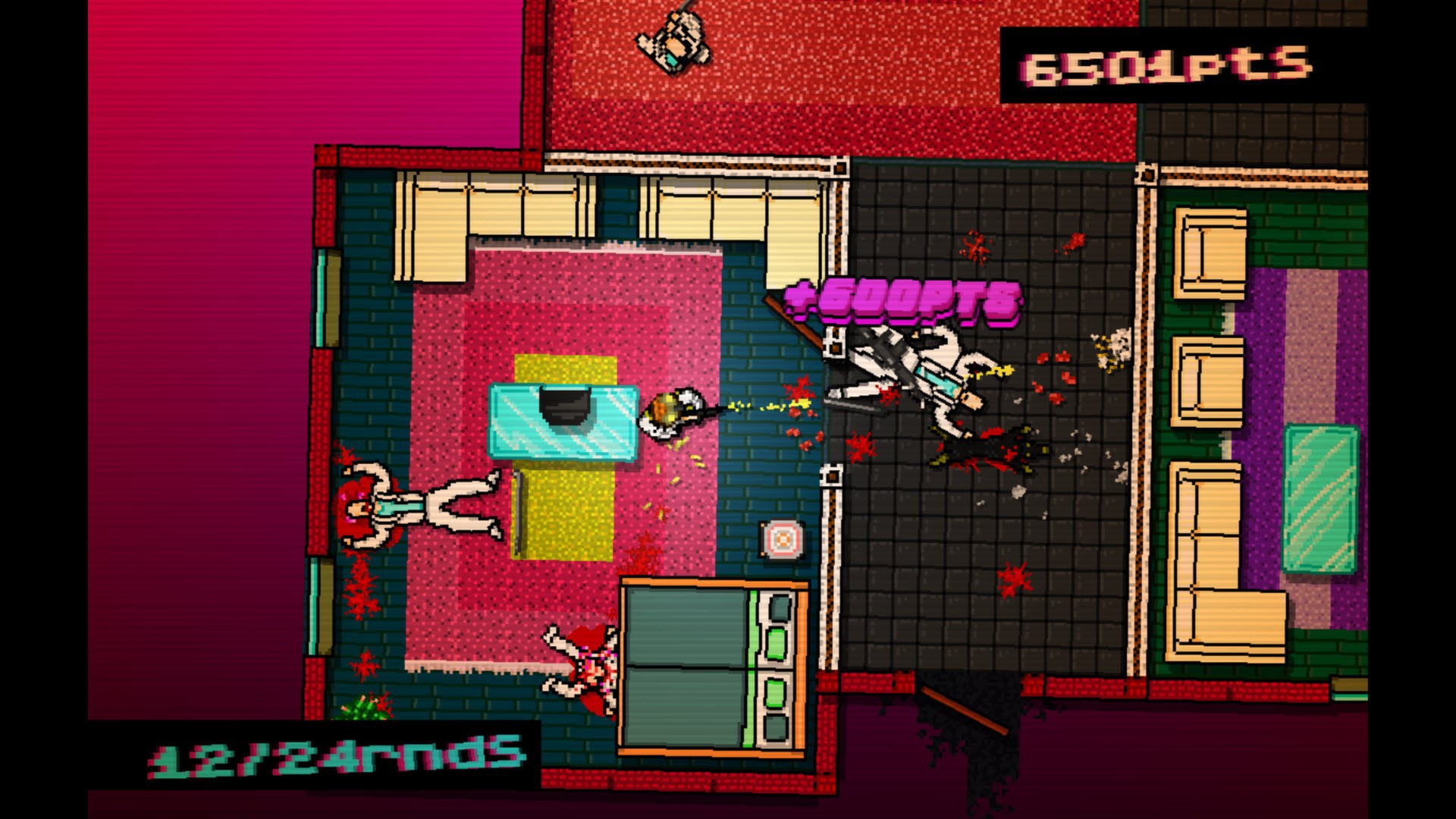
Combat gives the player several ways to turn an encounter around. Melee weapons such as bats, bars, knives and swords can be picked up from the environment or taken after an enemy is knocked down. Firearms include shotguns, automatic rifles, machine guns and silenced pistols, each changing the range and noise of an attack. Doors can knock an opponent off balance, and a thrown weapon can hit and disarm a target before the player closes in to finish the takedown. Some walls can be shot through, allowing an attack across a surface that would otherwise block movement or sight. These interactions make rooms more than collections of enemies: their objects, entrances and barriers shape the available sequence of actions.
Before entering a level, the player can choose from animal masks with different effects. The masks are not only visual disguises: Tony speeds up close executions, while George increases how far the player can see. Other masks alter combat or how enemies behave, making the loadout a way to emphasize a particular approach to the same room. A mask’s advantage does not remove the danger of a one-hit death, so each benefit is weighed against the rest of the level’s layout and the weapons likely to be available there. Masks and weapons are unlocked as the campaign’s score rewards accumulate, adding options for later missions and for revisiting earlier chapters.
Completing a mission produces a score and a grade based on the player’s actions. Kills, movement, timing and the methods used in combat feed into the result, encouraging players to link attacks into continuous sequences instead of stopping after every threat. The score is separate from simply surviving: a cautious route may reach the exit, while a more fluid route can build a stronger chain of actions. Once a floor is cleared, its checkpoint reduces the cost of experimenting with another entry or weapon choice. Replaying a chapter with a newly unlocked mask can change how its early rooms work, while the grade gives a concrete reason to refine routes without requiring a different story outcome.
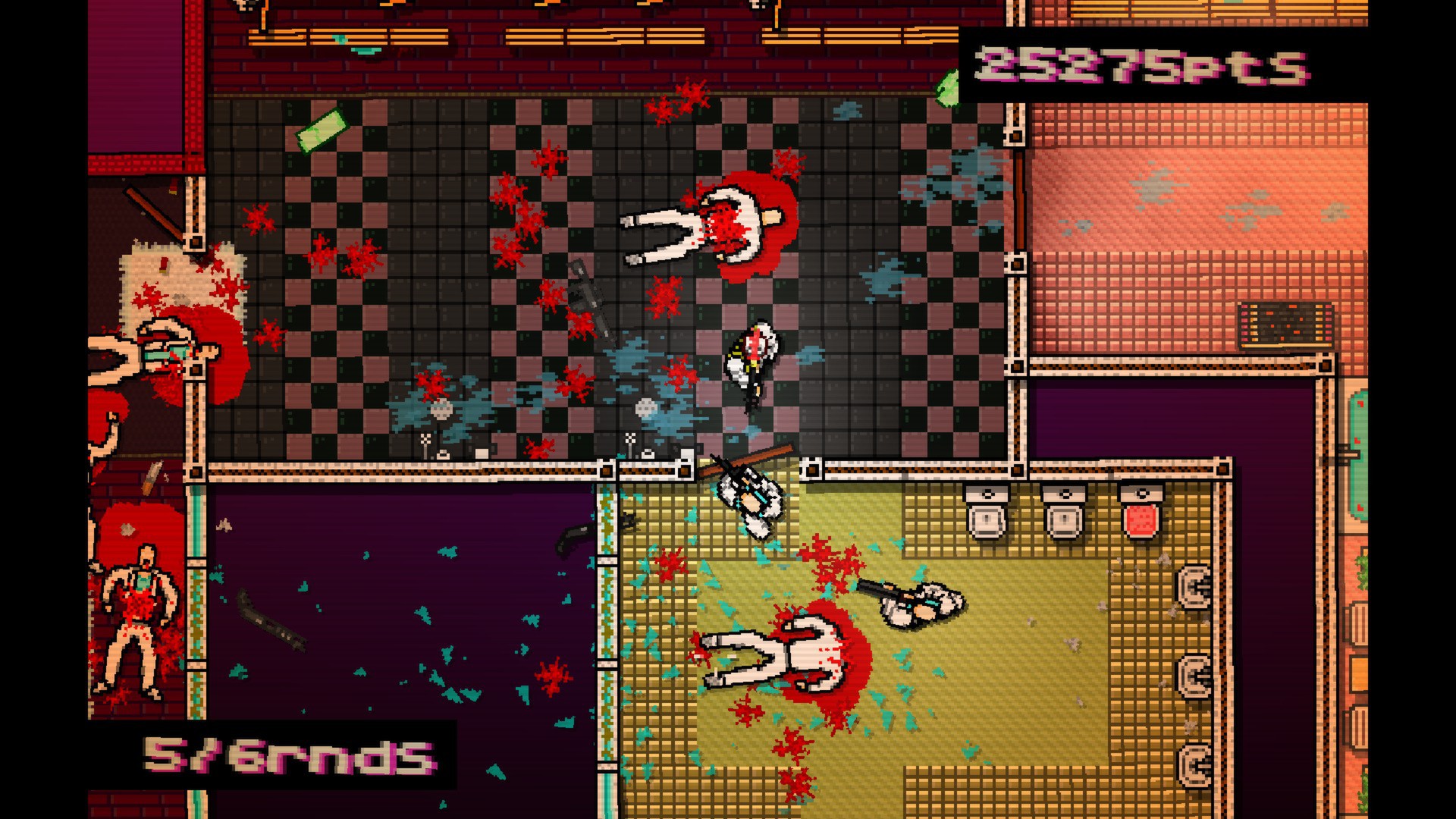
The game’s presentation keeps these systems tied to its unsettling point of view. The apartment and brief social stops contrast with the crowded interiors, and the conversations with masked figures leave open how literally to read what the protagonist sees. During a fight, pulsating colors, screen distortion and a driving soundtrack heighten the speed of each encounter; between jobs, the same surreal style makes the messages feel less like a straightforward criminal contract. The action remains focused on reaching and clearing a target location, but the unexplained calls and recurring imagery complicate that simple structure. The campaign builds its central question through the tension between what the player is told to do and what the protagonist appears to understand.
- Developer
- Dennaton Games
- Genre
- Top-down action