
About Hotline Miami 2: Wrong Number
Hotline Miami 2: Wrong Number follows several people and factions in the wake of the first game’s violence. Its story jumps among characters and periods, while each top-down level reshapes the series’ lethal room-clearing combat through new enemies, weapons and character-specific abilities.
Hotline Miami 2: Wrong Number returns to the alternative Miami of the first game, where the bloodshed has left consequences that spread through different lives. Rather than following one masked antihero for most of the campaign, the sequel follows several distinct factions whose motives and methods remain uncertain. The story moves among people connected to earlier events and others caught up in their aftermath. Escalating violence and retribution drive the conflict, while changing perspectives keep the full picture unsettled. Its neon palette, abrupt shifts and scenes that blur performance, memory and reality continue the series’ surreal crime-story atmosphere without making every connection explicit.
The campaign is arranged as linked episodes rather than a single continuous viewpoint. Each chapter shifts to a different character or group, and the timeline moves between 1985, 1989 and 1991. Some chapters place the player in a familiar sort of criminal assault; others change the role and objective enough to alter the rhythm. A journalist, for example, uses non-lethal takedowns, while a soldier’s combat includes a flamethrower. Conversations and short scenes between missions give context to these changing perspectives, but the story does not pause to explain every transition. The result is a narrative assembled from partial accounts, callbacks and gaps, with the player moving through several intersecting paths instead of receiving one protagonist’s uninterrupted account.
The core action remains a top-down sequence of compact but dangerous rooms. A player enters a building, reads its lanes and sightlines, and must clear hostile opponents before moving on. One hit can be fatal, so the route through a floor matters as much as choosing when to attack. A door can create an opening for a close takedown, while gunfire may attract nearby enemies and change the shape of the encounter. Enemies also vary more in how they challenge a direct approach: some resist melee attacks, some duck bullets, and others rush across a room. The player has to identify what each room demands and react to threats from several directions rather than rely on a single tactic throughout a chapter.
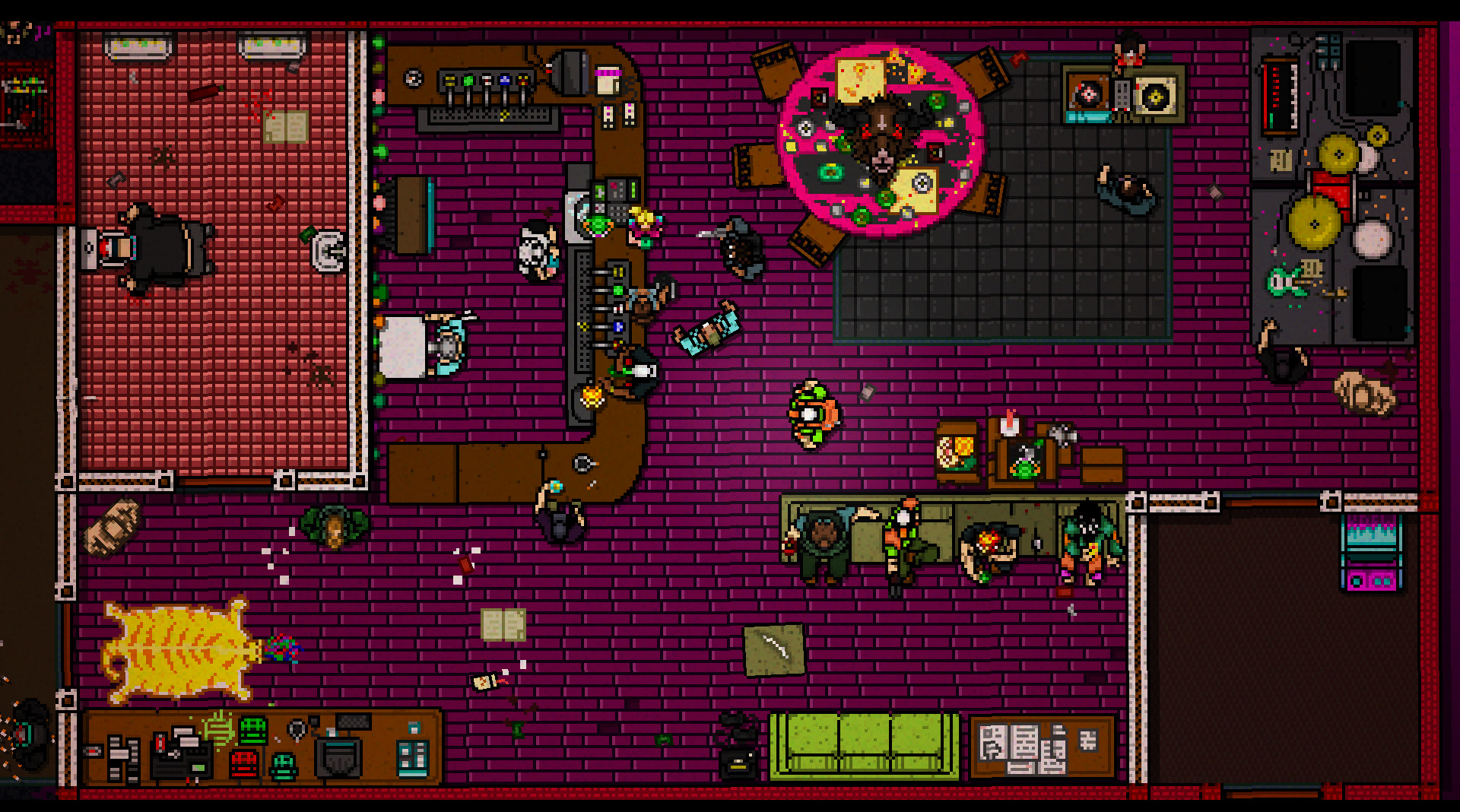
Weapon handling gives each encounter a sequence of tradeoffs. The player can use firearms such as shotguns and automatic weapons, or close-range options including knives and pipes; some objects can also be thrown to interrupt an approaching enemy. Loud shots can draw opponents toward the sound, making noise a way to influence their movement as well as a risk. Mark, who wears a bear mask, carries two machine guns and can fire them to either side with an alternate-fire action. Alex and Ash, a pair wearing swan masks, combine a chainsaw used at close range with guns for covering threats farther away. These characters show how the game builds individual rules into the familiar cycle of entering, fighting and trying again after a fatal mistake.
Character selection is more tightly connected to the story than mask selection was in the original. Most chapters assign a particular person or group, so the player learns a different set of restrictions and tools as the campaign changes perspective. Some chapters offer a limited choice of weapons or characters, while others are built around one distinctive ability. Alex and Ash share control as a duo, with the chainsaw and firearms serving different ranges; Mark’s two guns create an unusual firing angle. Another playable figure is limited to a personal firearm that can switch to a knife and cannot pick up dropped weapons, so ammunition and the placement of refill crates affect the route. The characters’ rules shape which openings are useful and how long a plan can last.
Scores and grades give completed levels an arcade-like measure beyond reaching the exit. Linking actions into a continuous run can raise the score, but long sightlines, distant opponents and specialized enemies can force a more deliberate sequence. A player may use a loud weapon to draw a group closer, open a door to create a close-range opportunity, or cross a room to reach a better angle; a mistake can restart the attempt quickly. After completing the campaign on the standard difficulty, Hard mode becomes available. On that mode, added enemies and the removal of shot lock change how the player reads rooms and aims, giving the same basic spaces a more demanding set of decisions.
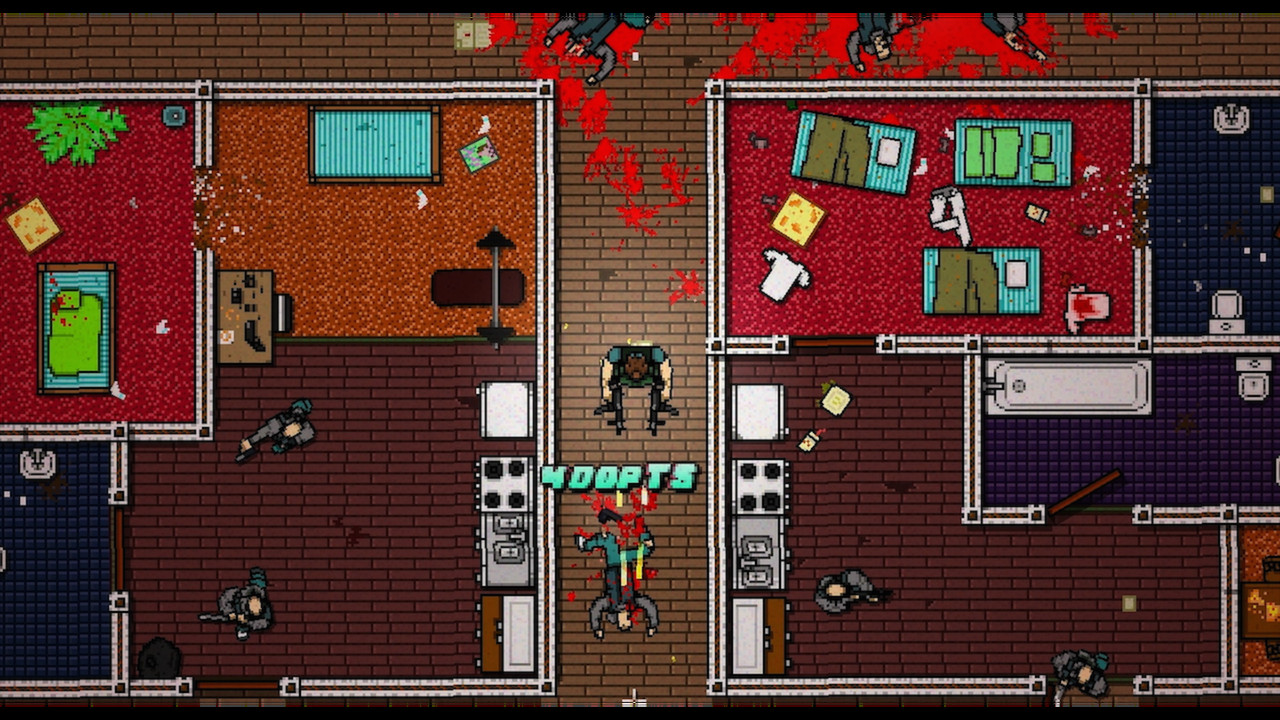
The Steam PC edition also includes a level editor, extending the room-based structure beyond the campaign. It lets players work with the game’s floor-plan vocabulary—rooms, routes and encounters—rather than adding another narrative viewpoint to the main story. The campaign itself keeps shifting between its playable people and factions, with the mechanics changing to fit those shifts. That combination of recurring top-down combat and character-specific limits distinguishes this sequel from the first game’s mask choice before each level. Its central activity is still clearing hostile spaces under pressure, but the identity of the person entering each space now changes what weapons, actions and risks are available.
- Developer
- Dennaton Games
- Genre
- Top-down action