
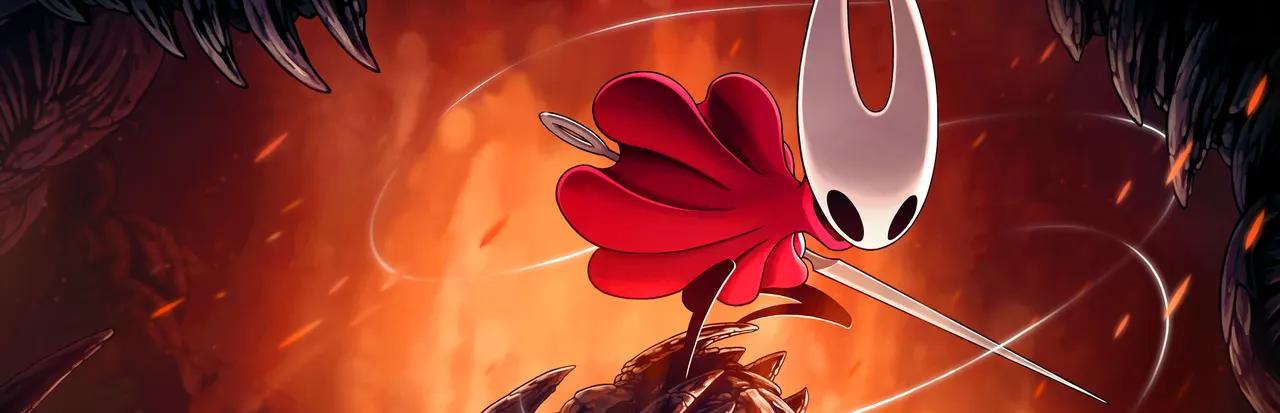
About Hollow Knight: Silksong
Captured and carried to the insect kingdom of Pharloom, Hornet must climb toward its shining citadel while confronting the creatures, customs and mysteries of an unfamiliar land. Exploration, agile needle combat, silk abilities, crafted tools and changing Crests shape how she meets its challenges.
Hollow Knight: Silksong follows Hornet, the lethal hunter introduced in Hollow Knight, after she is captured and taken to the distant kingdom of Pharloom. Alone in unfamiliar territory, she sets out on a pilgrimage toward the shining citadel at the kingdom’s peak. That climb gives the adventure a clear direction, but the route passes through an interconnected insect world rather than a simple sequence of arenas. Hornet’s search for the truth behind her capture gradually intersects with her lineage, echoes of her past and a threat described as a deadly thread running through the land. The story is carried through the places and people she encounters as much as through the forward journey.
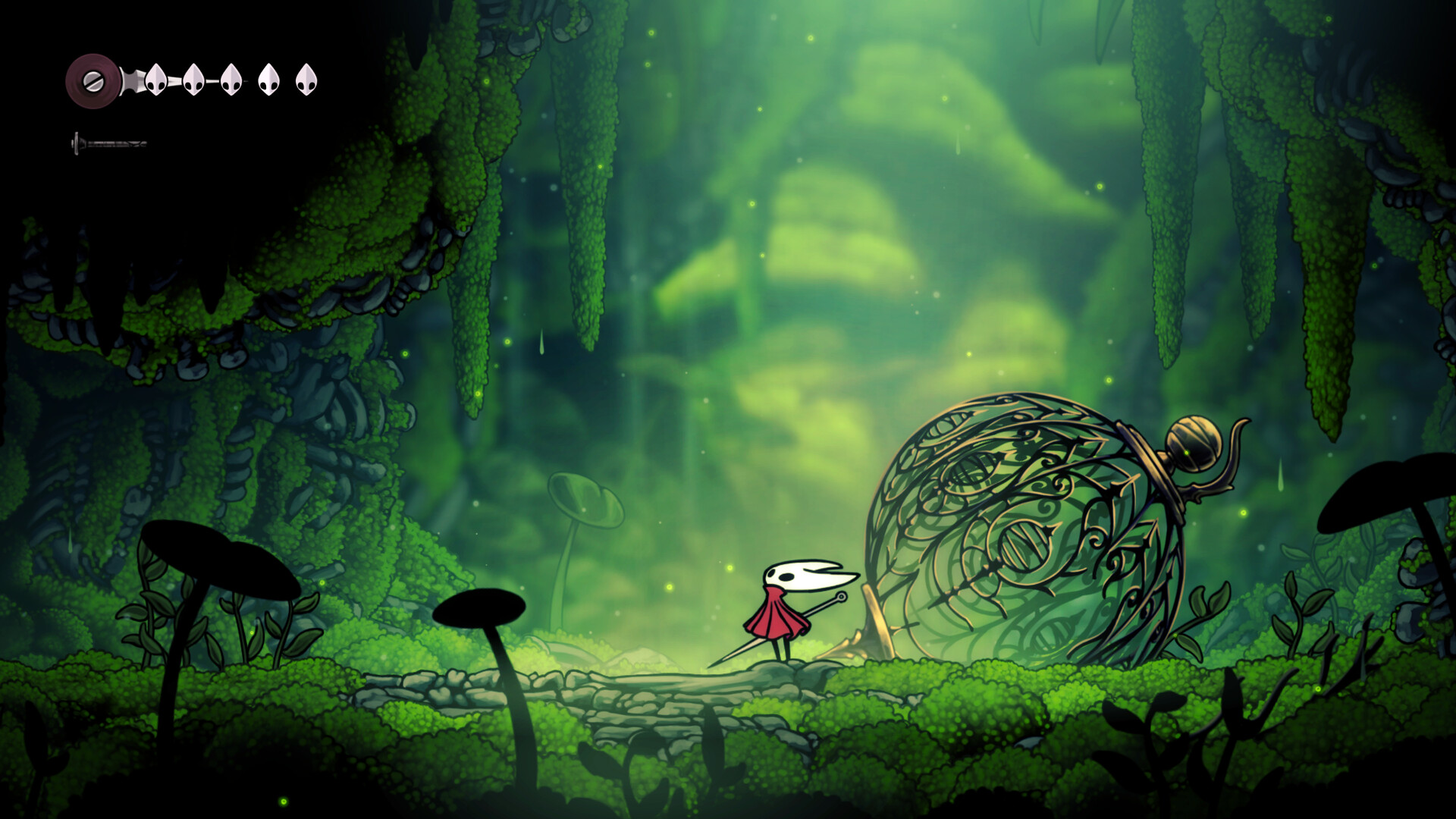
Pharloom shifts between distinct environments that help give each stretch of the ascent its own character. Its environments include mossy grottos, coral forests, misted moors and gilded cities, while also showing chambers, Greymoor and the shining citadel as parts of the wider setting. Their connections make returning through the kingdom part of exploration: a passage seen from one side may later become reachable from another, and routes can open as Hornet learns new ways to move. Allies and strangers inhabit these regions, and the world’s mysteries are framed through its inhabitants, architecture and hostile wildlife. Rather than treating each location as a detached level, the adventure links biomes into a continuous pilgrimage through a haunted kingdom.
Hornet’s movement and combat are built around agility. She fights with a needle and thread, using quick directional attacks, jumps and aerial movement to stay mobile while reading enemy patterns. The official game description emphasizes acrobatic action, but precision still matters: a hunter can be fast without being invulnerable, so positioning and timing decide when to press an attack and when to retreat. Traversal abilities broaden that movement vocabulary, letting Hornet reach platforms and routes that were previously inaccessible. As those abilities accumulate, exploration gains a layered quality: a blocked climb or distant ledge can become a meaningful landmark to revisit rather than an arbitrary wall.
Crests are a major way to alter the feel of combat. Each Crest changes Hornet’s attack set and can affect the special Bind ability, while its available tool slots shape the equipment she brings. The Hunter Crest is the starting style; other examples include the Wanderer Crest, whose faster, shorter strikes recall a different rhythm, and the Reaper Crest, whose heavier arcing attacks can generate additional silk after a Bind. These are not merely cosmetic loadouts. A Crest can change how Hornet attacks from the air, how she approaches a foe and what benefit she receives from binding, so choosing one affects the decisions made in both ordinary encounters and boss fights.
Silk connects offense, recovery and special actions. Hornet builds it through combat and can spend it on silk skills; Bind uses the resource for healing and can carry a Crest-specific effect. That creates a practical exchange during a fight: taking a moment to recover can cost an opening, while continuing to strike can build the resource needed for another ability. Some Crests shift that calculation by producing silk or by changing what Bind does. The system encourages players to notice what their current equipment rewards rather than relying on one universal sequence. New abilities and upgrades expand those options over the course of the climb, making familiar enemies a chance to test a different combination of movement, attacks and resource use.
Tools add another layer beyond the needle. Hornet can craft and carry weapons, traps and mechanisms, and this arsenal connects this arsenal both to fighting and reaching new heights. Their purpose is broader than extra damage: a thrown or placed tool can change the shape of an encounter, while a traversal-oriented device can help interact with the environment. Tool capacity depends in part on the chosen Crest, and Memory Lockets can open additional slots as Hornet develops her loadout. This makes preparation a meaningful choice: a loadout can emphasize a particular combat approach or retain tools that help with varied obstacles, rather than treating every item as a permanent passive upgrade.
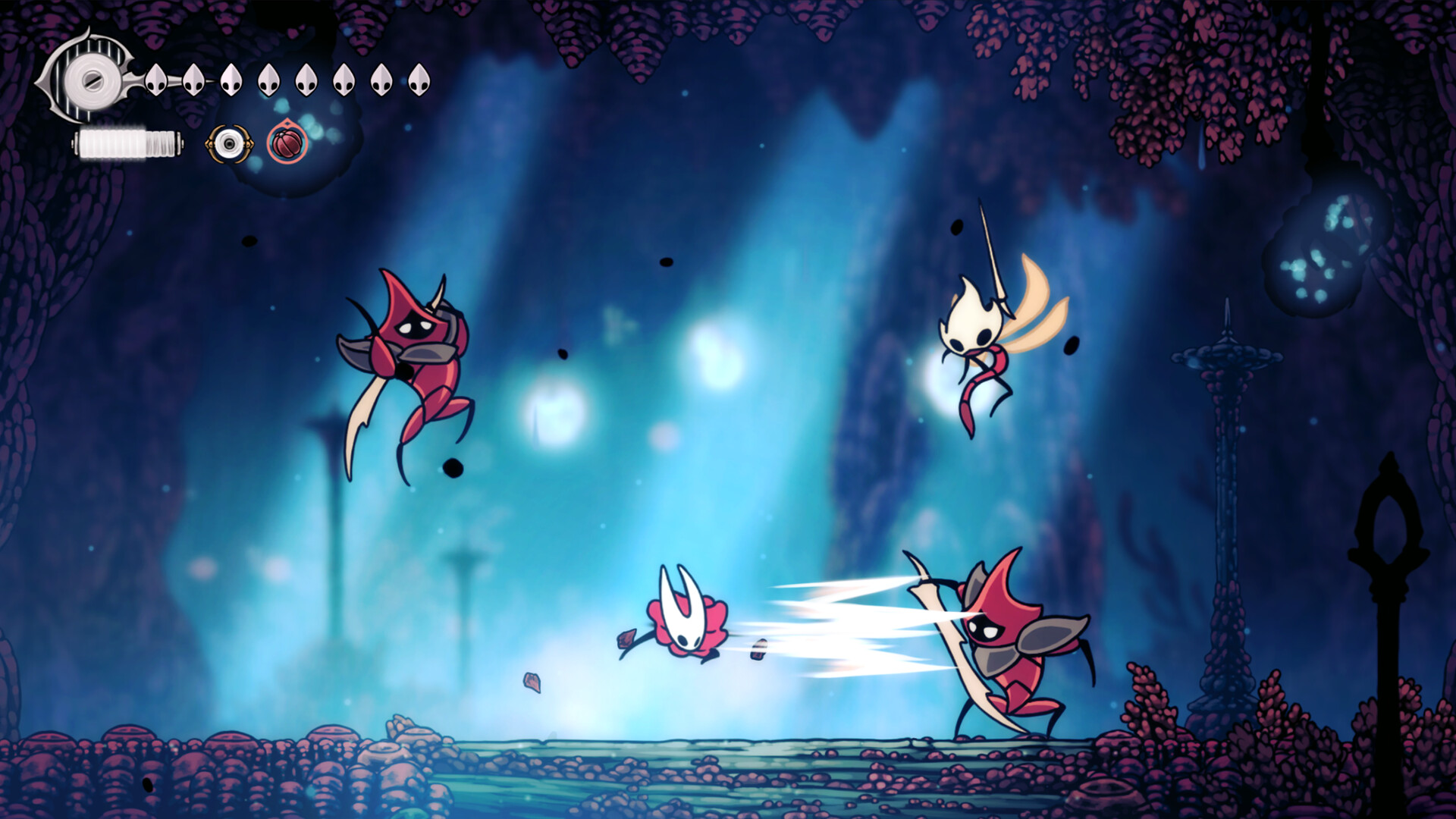
The kingdom’s inhabitants give the ascent a human-scale purpose amid its dangers. Hornet can seek out allies, meet surprising strangers and undertake quests tied to the wishes of Pharloom’s downtrodden; other requests ask her to hunt rare beasts and investigate old mysteries. These tasks complement the central climb without replacing it, connecting local problems to the kingdom’s larger condition. More than two hundred foes appear across the adventure, including beasts, hunters, assassins, kings, monsters and knights, with legendary bosses forming major tests along the way. Each encounter asks Hornet to combine movement, needle strikes, silk abilities and tools. Her progress is therefore measured not only by how far upward she has travelled, but by how much more of Pharloom she can understand and navigate.
Crest progression also extends beyond choosing a different attack pattern. Memory Lockets unlock extra tool slots for individual Crests, and opening slots across multiple Crests contributes toward further upgrades offered by Eva in Weavenest Atla. This creates a longer customization track alongside Hornet’s movement abilities: one discovery can expand the equipment capacity of a Crest, while cumulative slot investment can unlock another stage of development. The system gives returning to earlier loadouts a practical purpose, since experimenting with several Crests can advance shared progression as well as reveal which attacks suit a particular encounter. Eva’s upgrades connect that equipment layer to the broader journey without requiring every Crest to play alike.
Released in September 2025 by Team Cherry, who both developed and published it, Silksong arrives after one of the longest waits in indie gaming. It has come out of that wait looking like a game nobody was rushed into making — and like a game that knows exactly which parts of its predecessor to keep.
Hornet plays nothing like the Knight
You're Hornet this time: quicker, more elegant, and built around aggression rather than the Knight's deliberate defence. The platforming has been sharpened accordingly, and it's the clearest step forward in the whole game — the movement is precise enough to support challenges the first game wouldn't have asked of you, and the areas built around it are the best in either title.
Combat follows the same logic. It's faster and more demanding, and the game is unapologetic about expecting you to keep up. Where Hollow Knight let you retreat and think, Silksong tends to reward pressing your advantage, and boss fights are the better for it. Nearly a decade of iteration shows in the feel rather than in any single new system.
The world is still the point, and it's still horrible
What Team Cherry has always done better than almost anyone is scale. Everything in Silksong is drawn at the size of an insect's world — a bedbug is a hulking armoured thing, a stretch of moss is a forest, a workshop is a cathedral of saw-blades and steam. The hand-drawn craft is extraordinary, and there's a genuine personality to it that's easy to underrate because it looks effortless.
It's also charmingly mean-spirited in a way that will be familiar. The format is best described plainly: go up and there's a boss you can't beat, go down and there's an environment that kills you for stepping into it, and left and right are dead ends you don't have the tools for yet. Being stuck on all four points of the compass at once is the genre working as intended, and if that sentence reads as a warning rather than an invitation, believe it.
Where the sequel shows its seams
The one recurring reservation is structural rather than mechanical. Silksong holds so closely to the shape of the original that the element of surprise is thinner this time — you recognise the rhythm of a Hollow Knight game almost immediately, and the discoveries land as refinements rather than revelations. That's an odd thing to complain about given how good the original is, but it's the honest read on why some people came away slightly less transported than they expected.
The pulse
Reception has been very strong with one live argument attached, and the argument is about difficulty. The game shipped demanding even by this series' standards, and the conversation since has been shaped by patches — including changes to early content and the tuning of certain encounters. The consensus that formed is that this is a rare sequel with real poise: harder than its predecessor, better playing, and confident enough not to explain itself. If you never played Hollow Knight, the near-universal advice is to go back and do that first. Silksong stands on its own, but it's a continuation, not an alternative.
Should you play it
Yes, and especially if you played the first one. The combat and platforming are the best Team Cherry has produced, the world is worth exploring for its art alone, and the wait has clearly been spent on the right things.
Two caveats. Start with Hollow Knight if you haven't — not because Silksong requires it, but because it's the better introduction to a design language this one assumes you can already read. And go in knowing it's a hard game that has been argued about precisely because of that, so if you bounce off difficulty rather than rise to it, this is a poor place to test the theory.
Go deeper with V4mp
- Developer
- Team Cherry
- Genre
- Metroidvania action adventure
Explore Hollow Knight: Silksong further
Explore the wiki for detailed reference pages on the game's world, systems, items and locations.