
About HITMAN World of Assassination
HITMAN World of Assassination brings Agent 47’s globe-spanning contracts together in one stealth-action campaign. Each assignment places targets inside detailed public and restricted spaces where disguises, observation, tools and timing create different routes to an objective. The package also includes repeatable contracts and, in the full edition, the single-player Freelancer mode.
HITMAN World of Assassination gathers the campaigns of HITMAN, HITMAN 2 and HITMAN 3 under one game identity. Agent 47 works as a contract assassin for the International Contract Agency, with longtime handler Diana Burnwood feeding mission information through the agency’s briefings. The assignments begin with individual targets, but they gradually connect to a larger conflict involving the secretive Providence organisation and the people positioned around it. The story travels from a training facility and fashion event to private islands, city districts, luxury compounds and a final journey through the Carpathian Mountains. Each mission gives the plot context, but its immediate task remains concrete: enter a location, identify the people named in the briefing, complete the contract and reach an exit. The presentation mixes cutscenes and radio dialogue with levels that let players investigate at their own pace.
The campaign’s locations are built as populated spaces with layers of access rather than corridors leading directly to a target. In Paris, an exclusive fashion show occupies a palace; Sapienza centres on a coastal town and a private villa; later assignments include a Mumbai film district, a Miami motorsport event, a New York bank and a Berlin nightclub. The full World of Assassination campaign spans more than twenty locations, though access depends on the edition and purchased content. Part One contains six original HITMAN locations—Paris, Sapienza, Marrakesh, Bangkok, Colorado and Hokkaido—and omits Freelancer and VR. The complete package groups content from all three games, while Deluxe adds separate expansion content. A location’s crowd, staff routines, back rooms, checkpoints and security systems shape how 47 can cross it, so learning the layout is as important as learning where a target will go.
In a mission, observation turns the environment into a set of possible routes. Instinct highlights people of interest and useful objects, while the map and mission interface identify objectives and points of interest. Public areas permit ordinary movement; restricted rooms can prompt guards or staff to challenge an intruder. 47 can acquire a uniform from a person he incapacitates, then use it to pass through areas where that role belongs. A disguise is not universal camouflage: certain characters recognise familiar clothing, and some rooms remain restricted even to a worker or guard. Players can move bodies into containers, disable surveillance recordings, use doors and service passages, and choose when to distract or avoid a patrol. A suspicion response may lead to a search or confrontation, so keeping track of who saw an action and where evidence was left matters. Stealth is a chain of choices about access, visibility and escape, rather than a single crouch button.
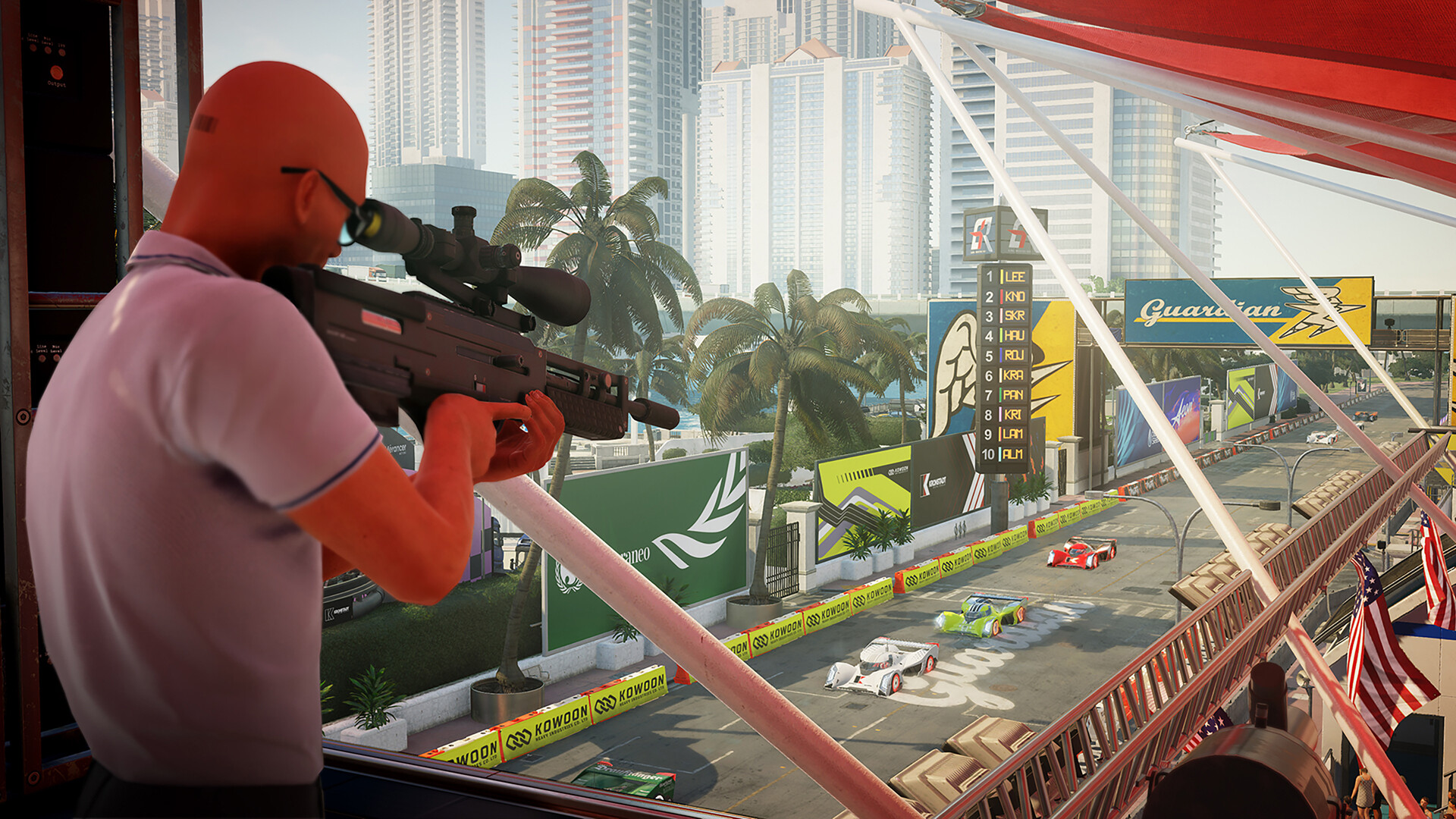
Mission Stories provide optional, guided threads through a level. They begin when 47 discovers a lead, hears a conversation or approaches a marked opportunity; following the prompts can put him in position to meet a target under a particular role or create a staged incident. Guidance can show the next objective, but it does not remove the need to move through the space without drawing attention. Players can also ignore those paths and discover their own plan by listening to conversations, reading environmental cues and testing how people react to objects. Items such as coins create a sound that can pull someone away from a post; keys and access cards open specific doors; poison, distractions, explosives and firearms offer different outcomes with different risks. The same target may follow a routine through several rooms, allowing the player to wait, manipulate a schedule or create a brief opportunity. A successful contract ends when objectives are met and 47 exits.
After a mission, challenges and location Mastery turn experimentation into persistent progression. Challenges reward completing a particular task, using a defined method or discovering a route, while Mastery levels for a location unlock items, starting points and agency pickup locations for later attempts. The planning screen lets 47 select a suit, concealed weapons, tools, an entry point and a stash location, subject to what has been unlocked and the mission’s rules. Replaying a familiar assignment with a different disguise or loadout can change the opening minutes and the available options. Contracts Mode lets players create objectives around targets and conditions within supported locations, and other modes add structured variations: Escalations add restrictions or complications across stages, while Elusive Targets are time-limited assignments designed with reduced guidance and no second chance within that attempt. These modes reuse the game’s stealth spaces while changing what information and resources are available.
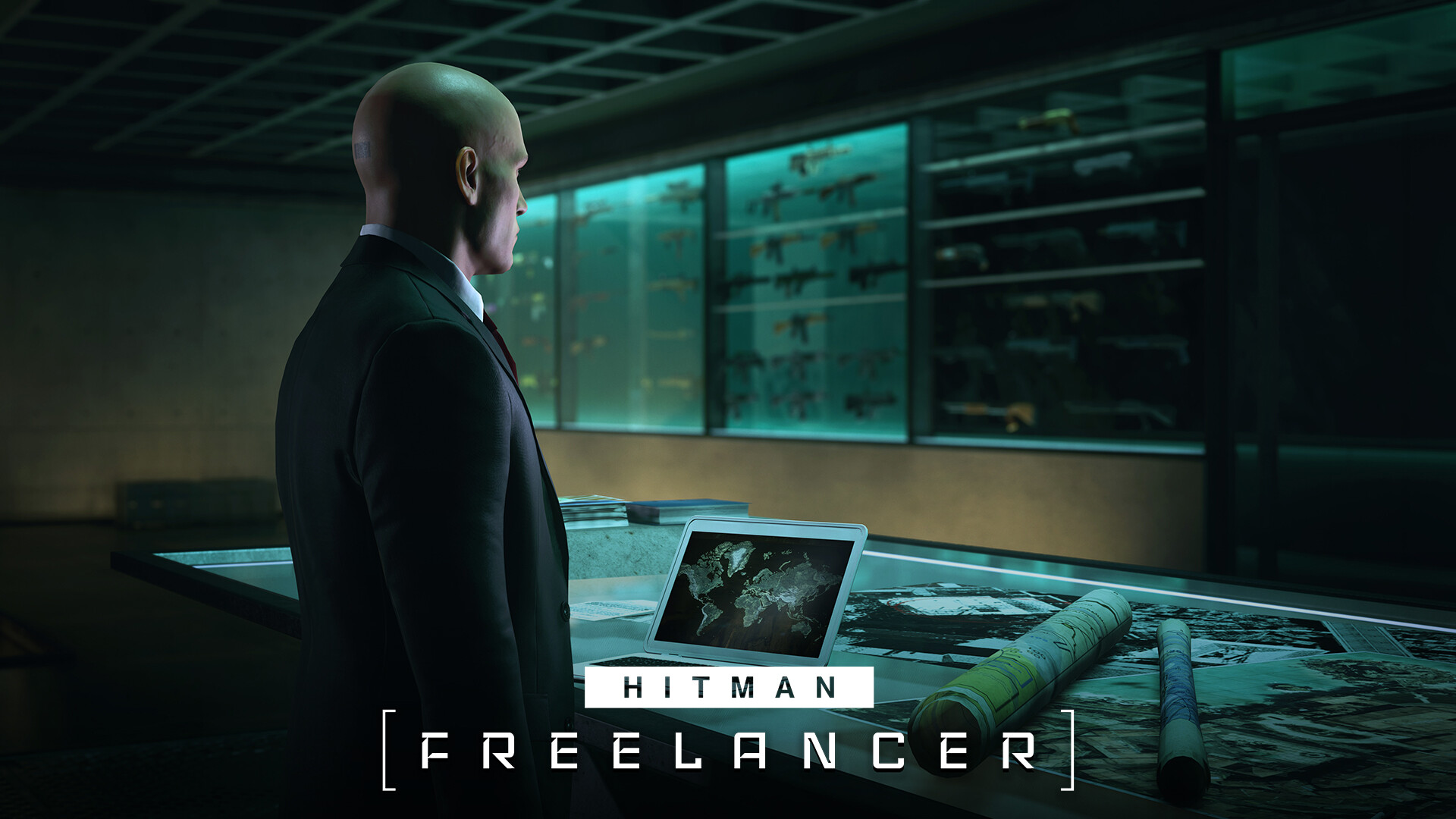
Freelancer is a separate single-player campaign built around planning across successive missions. From a customisable safehouse, 47 chooses among syndicates, completes jobs at available destinations and returns to restock, choose equipment and plan the next operation. The final mission of a syndicate campaign targets its leader, whom the player must identify and eliminate. Unlike the story campaign’s loadout planning, Freelancer’s equipment economy makes carried tools consequential: weapons stored on the safehouse gear walls persist unless lost on an operation, while Freelancer Tools are tied to the campaign and disappear if it fails. Items brought into a mission can be lost if 47 does not bring them back. Safehouse Mastery unlocks areas and customisation as the mode progresses. Its syndicate objectives, limited carried gear and leader-identification finale make preparation across several missions as important as improvising within one map.
- Developer
- IO Interactive
- Genre
- Stealth-action