
About Hitman: Contracts
As Agent 47, a professional assassin working for the Agency, you take on a sequence of contracts across international locations. Hitman: Contracts combines reconnaissance, disguises, stealth and direct combat, letting you study each mission's objectives and decide how to reach its targets and exits.
Hitman: Contracts is a 2004 stealth-action game built around Agent 47, a professional assassin whose work is organized through the Agency. The story looks back across the contracts and adversaries that shaped him, giving the missions a reflective frame rather than one continuous pursuit of a single target. The jobs take him around the world to confront international terrorists and crime bosses, with each assignment placing him inside a different hostile environment. The premise keeps 47 at the centre: he receives objectives, studies the setting, and must find a way to complete the contract and leave. The game presents these operations as deliberate, self-contained scenarios, so each new location brings new people, access rules and risks to read rather than a persistent open-world map.
Each assignment begins with a briefing from the Agency. It lays out target profiles, any additional objectives, background on the scenario, and possible escape points; the player can reopen this information during the mission. The objectives are tracked as they are completed, giving 47 a practical checklist while he moves through the level. A successful mission ends with a statistics screen that records stealth and aggression, alongside mission and overall scores. The structure makes preparation part of the play: the player has to understand which actions are required, where to go afterward, and what equipment to carry. Completing a mission also makes previously collected weapons available for selection when replaying it, connecting the decisions and exploration of one operation to later attempts at that same contract.
Disguises let 47 pass into areas that would otherwise be restricted, but changing clothes does not make him invisible. He must behave in ways that fit the role and avoid drawing attention through suspicious actions or carrying an inconsistent weapon. The Threat Meter signals rising danger, including when a disguise is failing or 47 is noticed inside an out-of-bounds zone. A uniform is therefore a kind of access tool with conditions: the player considers who can see through it, which weapon looks appropriate and whether the route demands a different identity. This system turns routine movement into observation. A corridor guarded by people who know the local staff may be more dangerous than a public room, and an apparently safe disguise can become a problem if 47 acts in a way that contradicts it.
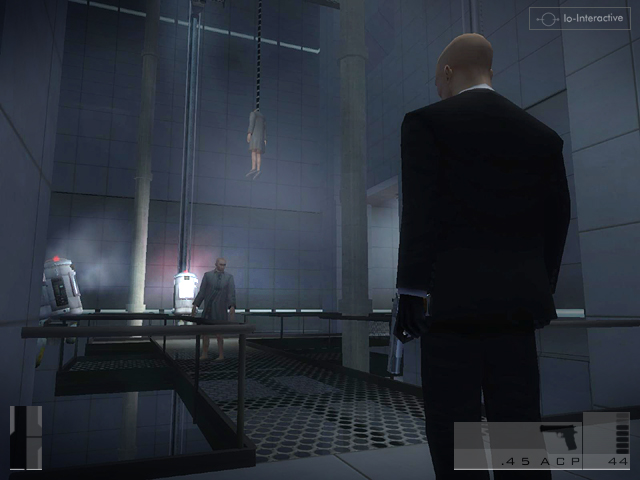
Quiet movement and close-combat tools support an approach that avoids open firefights. Sneaking makes 47's movement silent, while checking a map or looking through a keyhole can reveal activity before he enters a room. Close-combat weapons are most effective when he creeps directly behind an unsuspecting person and fully charges the attack; used in a hurried face-to-face struggle, the same tools are less effective. The map helps plan a route and can expose hidden access points, while binoculars allow surveillance from a distance. Players can also take advantage of environmental sound: loud music may cover gunfire, and a carefully timed action can reduce the chance that a nearby person hears it. The mission spaces reward awareness of sightlines, doors, people and noise, because each can determine whether an approach stays controlled.
When stealth breaks down or a contract calls for another method, 47 has a broad set of firearms and equipment. Concealable pistols can be fitted with silencers, while submachine guns trade accuracy for rate of fire and manoeuvrability in close quarters. Assault rifles suit distance, shotguns are strongest at close range, and a sniper rifle can be carried concealed in its own briefcase. Crouching improves aim with the sniper rifle, and the map, binoculars and night-vision goggles add reconnaissance options; the goggles help in dark places but can raise suspicion if someone sees them. A context-sensitive action list lets 47 manipulate doors, vehicles, objects and people, so the same room can offer several possible interactions. The Threat Meter, ammunition display and on-screen warnings help the player judge when that plan is starting to unravel. Guards can respond with squad-based tactics, so an alarm can turn a local problem into coordinated opposition. Even a useful weapon can compromise the disguise that got 47 through a guarded checkpoint, making the loadout part of the infiltration plan.
The selected difficulty changes the risk attached to each operation. Normal, Expert and Professional adjust how much damage 47 can take, the map's accuracy and the reactions and shooting accuracy of guards and targets; they also restrict how often the player may save during a mission. The PC manual lists seven allowed saves per level on Normal, two on Expert and none on Professional. After a successful hit, the results screen reflects the balance of stealth and aggression, and professional execution can earn bonuses. This creates a clear progression from briefing to preparation, infiltration, objective completion, escape and assessment. Missions can then be replayed with weapons collected earlier, allowing a player to test a different loadout or route while still working within the same contract's objectives and exit conditions.
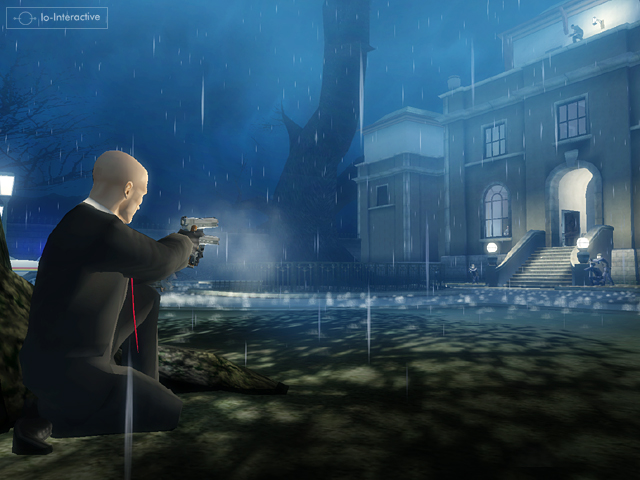
- Developer
- Io-Interactive A/S
- Genre
- Action with stealth mechanics