
About Hitman: Absolution
After a contract turns him against the International Contract Agency, Agent 47 is hunted by former employers and the police. He follows a personal mission tied to his former handler Diana Burnwood and a girl named Victoria, moving through guarded city blocks and compounds with disguises, Instinct, and a scoring system that records how each segment is handled.
Hitman: Absolution shifts Agent 47 from a routine sequence of ICA assignments into a personal pursuit. The story opens with a contract involving Diana Burnwood, his longtime handler, whose final request directs him toward Victoria. With the Agency and police now searching for him, 47 has to protect the girl while tracing the forces behind the pursuit. The journey takes him through a corrupt version of contemporary America, from a suburban estate and a crowded Chinatown district to the town of Hope and heavily guarded facilities. Diana and Victoria shape the central conflict, while 47's choices about how to cross each space remain in the player's hands. The plot gives the series' usually remote assassin a personal stake, but the moment-to-moment work is still about reading people, finding a route, and reaching an exit.
The campaign is divided into named missions and smaller playable sections, with checkpoints that mark progress through each assignment. Some sections revolve around a target moving through a public space; others focus on getting through a building or escaping pursuit. In King of Chinatown, for example, 47 enters a busy square where vendors, police, and the target follow separate routines. Terminus places him inside a hotel with rooms, corridors, service spaces, and security posts. Later locations include Hope and Blackwater Park, where uniforms and access rules differ by area. These spaces are more directed than the largest open-ended contracts in other Hitman games, but they still contain alternate routes, disguises, objects, and timing windows. The player can observe a patrol, identify a useful doorway, and choose whether to move quietly or risk a confrontation.
Instinct is 47's limited-use awareness tool. While it is active, he can identify objectives and useful objects, read opponents' paths, and see people through some obstacles. The feature also supports blending when he is wearing a disguise: a short action can help him pass characters who would otherwise notice that he does not belong. Instinct drains while used, so the player has to reserve it for moments where its extra information or cover matters. The meter can be replenished by completing objectives, making distractions, and taking out enemies stealthily. This links resource recovery to the way a section is handled. A player who quietly subdues a guard or creates a diversion can regain some capacity, then use that reserve to move past a later checkpoint or scrutiny point.

Disguises open access to areas where 47's black suit would draw attention, but each uniform has limits. People wearing the same kind of outfit are more likely to recognise that he is an impostor; Instinct can briefly help him blend in when a route brings him close to them. The outfit can also affect protection, so a security uniform and a light work uniform do not offer the same value if a situation turns into combat. Taking a disguise means approaching a body or clothing bundle, and the body itself may need to be hidden before someone finds it. Nearby objects offer further ways to control attention: a radio, brick, bottle, or other throwable can lure a guard toward a sound, while a tool such as a crowbar can serve as a weapon or interact with the environment. Choosing the right disguise and hiding the person it came from can be part of the same route.
The game tracks performance through a score at the end of mission sections. Actions such as being detected, harming non-targets, leaving bodies exposed, and failing to collect evidence can damage a clean result; careful target elimination and evidence recovery support it. The challenge system gives each mission optional conditions, from using particular disguises to arranging a specific environmental kill. Completing a challenge adds a percentage bonus to the score, and those bonuses accumulate across replays rather than needing to be earned again every time. That makes replay a form of progression: a player can first learn the route, then return to meet a disguise, evidence, or target-method condition that was missed. The requirements vary by section, so the score is built from local actions instead of one universal checklist for every mission.
Stealth uses cover, sightlines, distractions, and body concealment to keep an alert from becoming a firefight. 47 can duck behind furniture or walls, shift between cover points, and drag an unconscious or dead person to a suitable hiding place. If he approaches someone from behind without a weapon drawn, he can subdue them; with the appropriate weapon equipped, he can perform a silent close-combat kill. Items can create openings without directly attacking anyone, and environmental mechanisms can turn a target's surroundings into an accident. If the player chooses open combat, the game also supports aiming, human shields, silenced weapons, and Point Shooting, which lets 47 mark several opponents before firing in quick succession. The mission score then registers the consequences. Each approach changes the amount of suspicion, evidence, and collateral risk that follows him through the rest of that section.
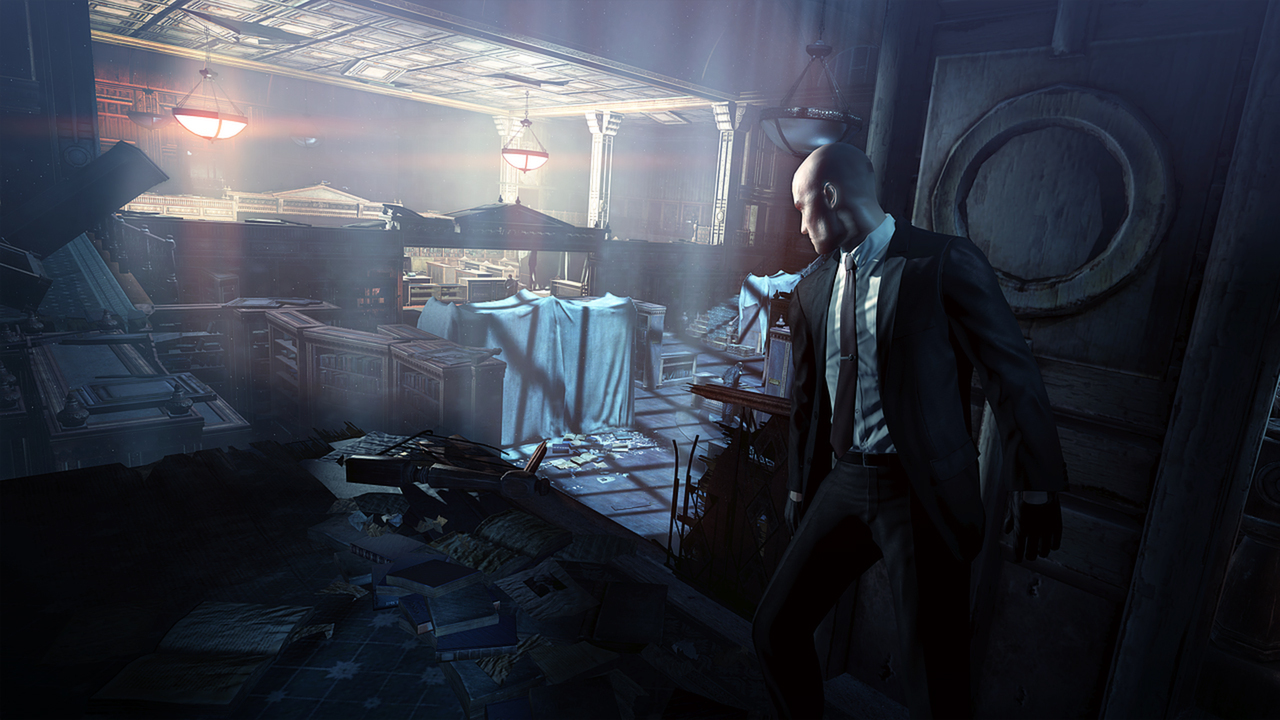
Difficulty settings change the challenge across the campaign, and the highest setting, Purist, is designed for players seeking stricter conditions. Checkpoints divide longer missions into stages, while the score and challenge records give each stage goals beyond simply reaching the next one. This structure lets the player revisit a familiar location with a narrower objective, such as collecting its evidence, using another outfit, or completing a target challenge. Absolution also treats information gathering as part of the route: the notebook and Instinct help locate objectives and read patrol movement, while conversations and background activity can reveal small details about the people in a space. The player can advance by following the immediate objective, or pause to inspect the scene for a quieter way forward and a better result.
- Developer
- IO Interactive
- Genre
- stealth action