
About Hitman 2: Silent Assassin
Agent 47 has left contract work behind, but a betrayal pulls him back into the field. Follow a trail through Sicily, St. Petersburg, Japan, Malaysia and India, preparing for each mission, choosing equipment and disguises, and balancing stealth against force as you pursue your targets.
Hitman 2: Silent Assassin follows Agent 47 after he has retired to a church in Sicily. When the priest Father Vittorio disappears, 47 returns to the International Contract Agency and takes assignments while trying to discover what happened. He had been living as the church's gardener, putting distance between himself and the work that made him a killer. Diana Burnwood and the Agency provide mission information, but the contracts also carry him through a larger conflict involving crime, greed and betrayal. The route moves between Sicily, St. Petersburg, Japan, Malaysia and India, with each place bringing its own targets, guards and security. The game frames the campaign as a return to a life 47 had tried to leave behind. Its briefings set the immediate objectives, and the story gradually connects those jobs to the people responsible for drawing him back into the field.
Before an operation, the briefing and laptop provide the objectives, target information and a satellite map. Important people and objects become clearer after 47 enters the mission, so planning continues on site. The map gives a plan view of the area and can help track guards, targets and possible routes as information is uncovered. The briefing remains useful as the assignment unfolds because all listed objectives must be completed to finish the mission. 47 can approach an assignment in first-person or third-person view, switch between them, and use tools such as binoculars, lockpicks and night-vision goggles alongside firearms and close-range weapons. A mission may ask for more than an assassination, so the player checks the objective list and works out what has to be collected, disabled or reached before leaving. Doors, items and switches use contextual actions; when several choices are available, the player can cycle through them and select the one that fits the situation.
Disguises help 47 enter guarded spaces, but clothing alone does not make him invisible. Guards can become suspicious when he behaves in a way that does not fit the role, and running can create noise and draw attention. The suspicion meter gives a warning when a nearby guard is questioning his presence, so the player can back away before a confrontation. Sneaking and crouching reduce the chance of being heard, while leaning or stepping out around a corner lets the player check a view before committing to a route. Holstering a weapon matters in public areas where carrying it openly can provoke police. The practical loop is to observe a patrol, decide which outfit or path gets 47 closer, and watch how nearby people react. If suspicion rises or a guard sees an attack, the disguise may stop helping and the mission can turn into an armed escape. Keeping the weapon hidden, moving at the right pace and avoiding witnesses all shape how long a cover remains useful.
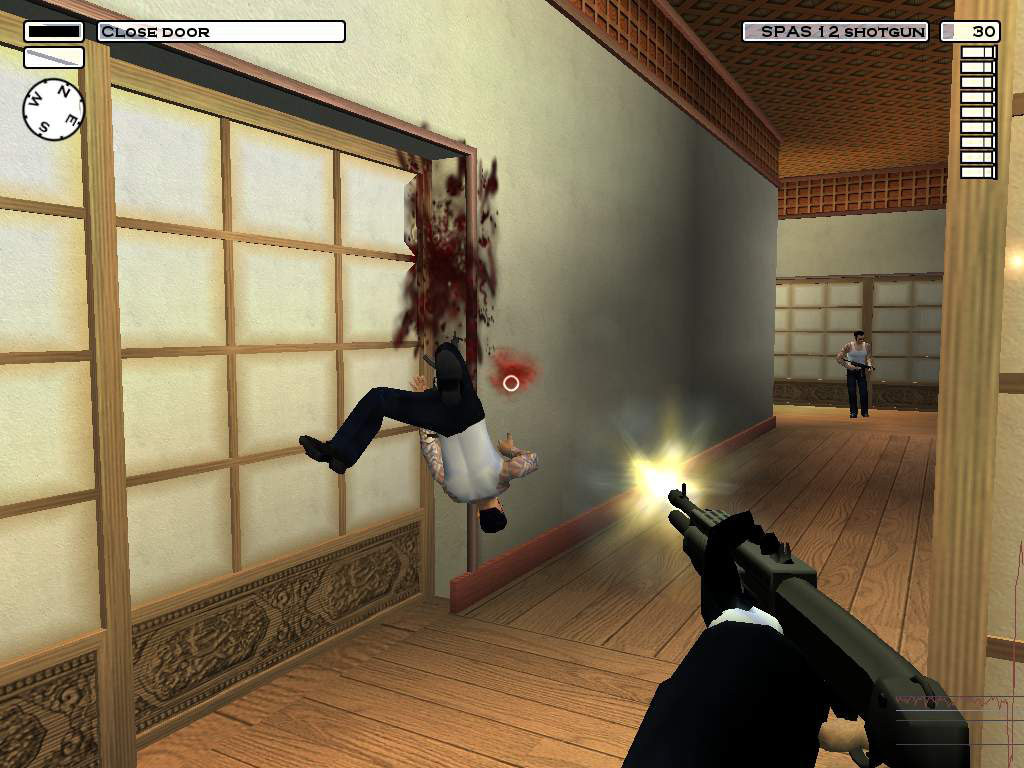
The arsenal supports quiet infiltration, close attacks and open combat. It includes pistols, submachine guns, rifles, sniper weapons, explosives, poison darts and other equipment. A scope changes the view and zoom, while the inventory lets 47 choose what to carry and draw. Rifles take up space and cannot be concealed, so bringing one affects whether he can pass through a guarded area without drawing attention. Targets are protected by enemies, but civilians and other bystanders can be caught in the crossfire, so shooting has consequences beyond the person at the centre of the assignment. Stealth and aggression both remain possible, and the game measures performance along that balance after a mission. The equipment and save system also connect one contract to the next: weapons or tools can be carried forward, letting the player prepare for a later assignment with something obtained earlier. That gives the player a reason to consider what to bring and whether to leave a mission with useful gear in hand.
Difficulty changes both the information available during a mission and the cost of a mistake. It affects 47's health, how much of the map reveals enemy positions, and how quickly and accurately guards respond. On Normal and Expert, incoming enemies appear as map blips; Professional hides those positions, so the player has to read patrols directly. Saves are capped within each level: Normal allows five, Expert allows two, and Professional allows none. A failed approach on the highest setting can therefore mean replaying the level rather than loading a recent point. After each assignment, an end-of-mission ranking measures the overall result and rewards stealth. Steam frames performance as a balance between stealth and aggression. A firefight may complete the objective, but it produces a different result from a quiet approach; the rank records the manner of completion as well as the target's death. Many contracts allow 47 to leave only the intended target dead, a discreet outcome that fits the ranking's preference for stealth. The PC menu also lets players replay completed missions.
- Developer
- IO Interactive A/S
- Genre
- Third-person stealth-action game