
About High On Life 2
After a past enemy puts a bounty on the protagonist’s sister, the famous bounty hunter and a crew of talking alien guns pursue a conspiracy threatening humanity. Shoot, fight up close and skateboard across galactic worlds, with hub areas offering side activities between focused story missions.
High On Life 2 picks up after the player character has already become a famous bounty hunter. The intergalactic cartel from the first game has been defeated, humanity has been saved from extinction, and a successful career has brought the hunter money, recognition and a personal life. That relative calm ends when a mysterious figure from the protagonist’s past puts a price on their sister’s head. The new job is to uncover an intergalactic conspiracy and stop a pharmaceutical company that wants to assign a price to human life. The setup gives the sequel a clear reason to send its returning hero and alien companions across the galaxy again, while shifting the danger from a cartel to a powerful corporate scheme. The game is a single-player first-person action adventure built around shooting, melee attacks, traversal and a steady stream of comic characters.
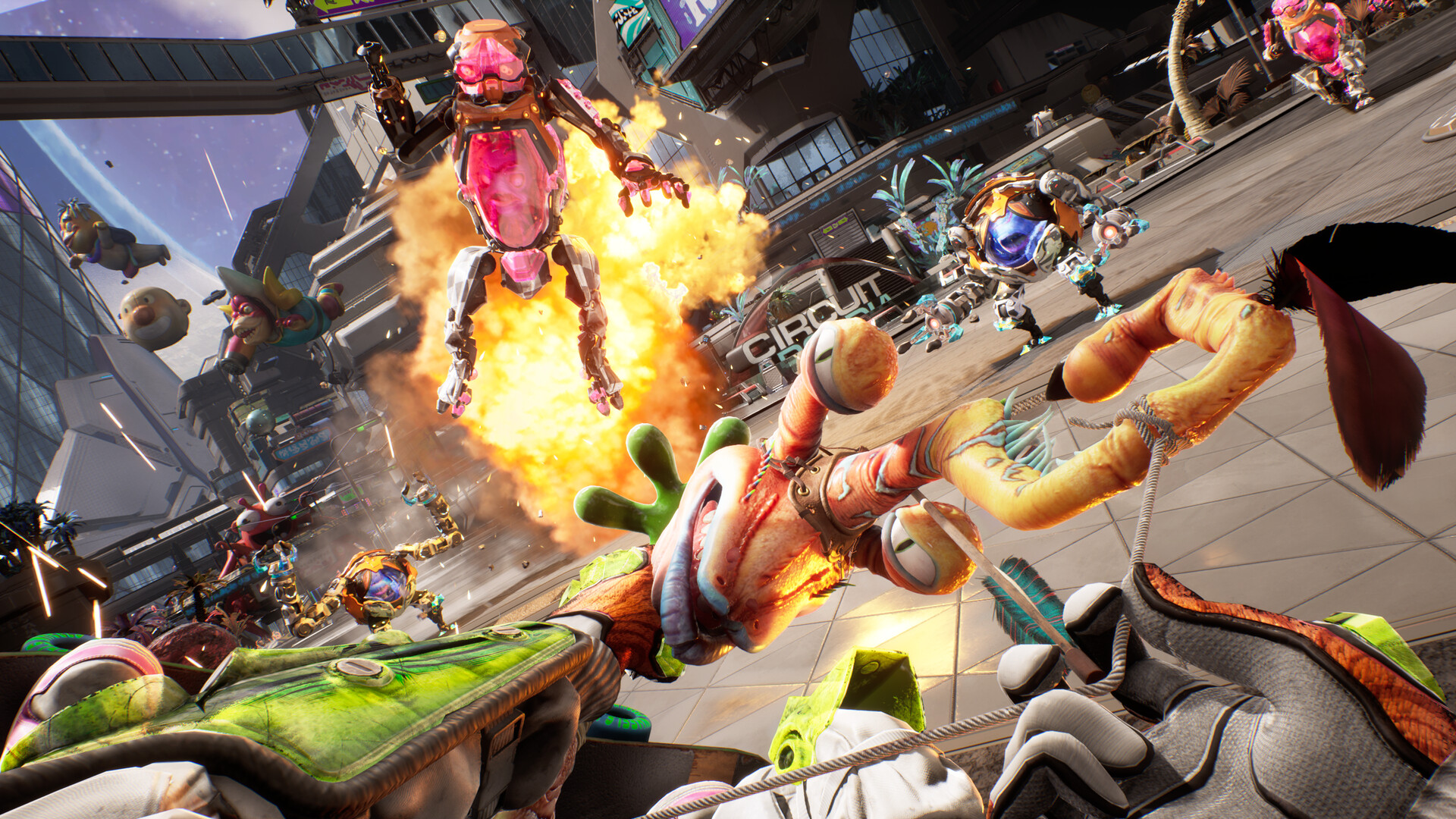
The talking alien guns return as both an arsenal and part of the cast. They provide the player’s ranged attacks, but their personalities also make them companions during the journey. The Steam description presents shooting and stabbing as complementary parts of combat, while the group’s conversational presence helps carry the game’s irreverent science-fiction tone from one destination to the next. Encounters take place across exotic locations populated by hostile aliens, and the objective is to push through opposition while pursuing the conspiracy. The first-person format keeps weapons and close-range action at the centre of the view. The comedy is part of the world’s texture rather than a separate mode: characters, environments and the stakes of the mission all leave room for absurdity alongside the straightforward goal of protecting humanity.
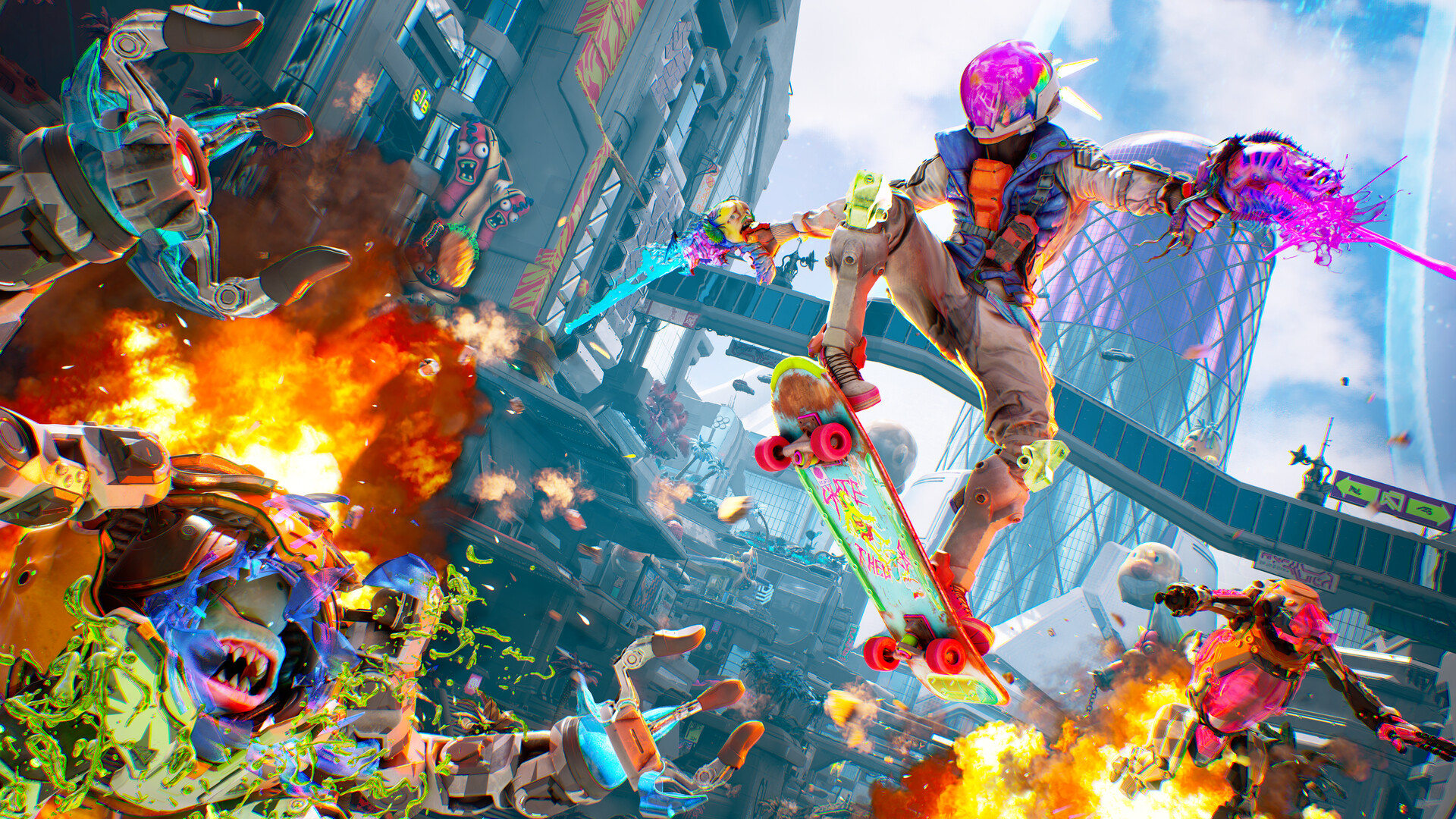
A skateboard is the sequel’s most visible movement addition. It can be used at any time, letting the player skate through the environments as part of ordinary traversal and combat flow. Squanch’s developers described the sequel as having three larger hubs, with side activities, non-player characters, collectibles and unlockable content that can be explored between more directed story missions. The hubs use ideas associated with Metroidvania design: the spaces offer more interactions as the player progresses and earns new abilities or rewards. That structure creates room to leave the main objective temporarily and investigate what the surrounding location contains. The skateboard gives these spaces a distinct way to move through them, while also supporting activities designed around riding. The result is a campaign that can alternate between purposeful mission progress and optional wandering without asking every player to follow the same pace.
The hub structure separates open-ended exploration from more tightly directed mission sequences. The development team explained that players return to a home base to talk with the crew and choose what to do next, then navigate through a hub toward a target. Reaching that target leads into a more linear stretch where the story can unfold with a clearer focus. Side interactions and discoveries are concentrated in the hubs, and progression can open additional activities there. Players who want to follow the central plot can continue from one main objective to another, while those who prefer to search can spend longer with the optional content around them. This design keeps the larger worlds available for curiosity while giving individual missions a more deliberate shape. It also means that exploration does not require repeating completed story sections just to find remaining side activities.
The locations are designed to support varied comic set pieces as well as combat. The publisher’s store description names a galaxy-wide convention, a zoo for humans and a luxury futuristic cruise ship among the places on the protagonist’s route. These settings put the human bounty hunter into environments where humanity itself can be treated as an exhibit, commodity or punchline, reinforcing the story’s conflict with a company seeking to profit from human life. The wider cast includes strange alien characters voiced by a comedy ensemble, and the worlds provide space for conversations and optional encounters between major fights. The tone is deliberately irreverent, but the main objective stays legible: pursue the people behind the conspiracy and prevent them from exploiting humanity. The mix of locations, NPCs and side content lets the game vary its jokes and situations without changing that central pursuit.
Combat and exploration share the same toolkit of weapons, close-range attacks and movement. Players can shoot enemies with the alien guns, use melee attacks, and skate through spaces while moving between threats and objectives. Adjustable difficulty is listed among the Steam edition’s accessibility features, alongside adjustable text size, colour alternatives, camera comfort options and custom audio controls. The game is single-player only, with no multiplayer mode. Its central loop joins story missions with hub exploration: speak with the crew, pursue the next target, fight through hostile areas, and return to spaces where optional activities and discoveries remain available. High On Life 2 therefore frames its sequel-sized escalation through a broader galaxy, more layered hubs and an expanded movement style, while keeping the premise grounded in the protagonist’s bounty-hunting team and their effort to stop a threat to humanity.
- Developer
- Squanch Games, Inc.
- Genre
- Action; adventure; first-person shooter