

About Here Comes Niko!
Here Comes Niko! follows Niko as they take a job with Tadpole Inc. as a professional friend, travelling between islands to help animal residents. Running, jumping and climbing connect conversations with small requests, platforming challenges and activities such as fishing and volleyball. Coins earned along the way fund rail travel, while cassettes and other finds reward exploration.
Here Comes Niko! frames its adventure as an unusual first job. Niko joins Tadpole Inc. as a “professional friend,” a role that sends them out to meet residents and lend a hand wherever a problem appears. The company’s executive manager, Pepper, is a frog, and the islanders Niko encounters are animals with their own concerns and small errands. Niko has to prove themself to keep the position, so the friendly tasks carry a light workplace frame without turning into a conventional battle against a villain. The premise turns the usual platform-game objective into a series of personal encounters: Niko learns who needs help, works out what a task involves, then returns to the resident after completing it. Coins make the work part of a larger route through the islands, but the immediate reason to move through each neighbourhood is to see what its inhabitants are doing.
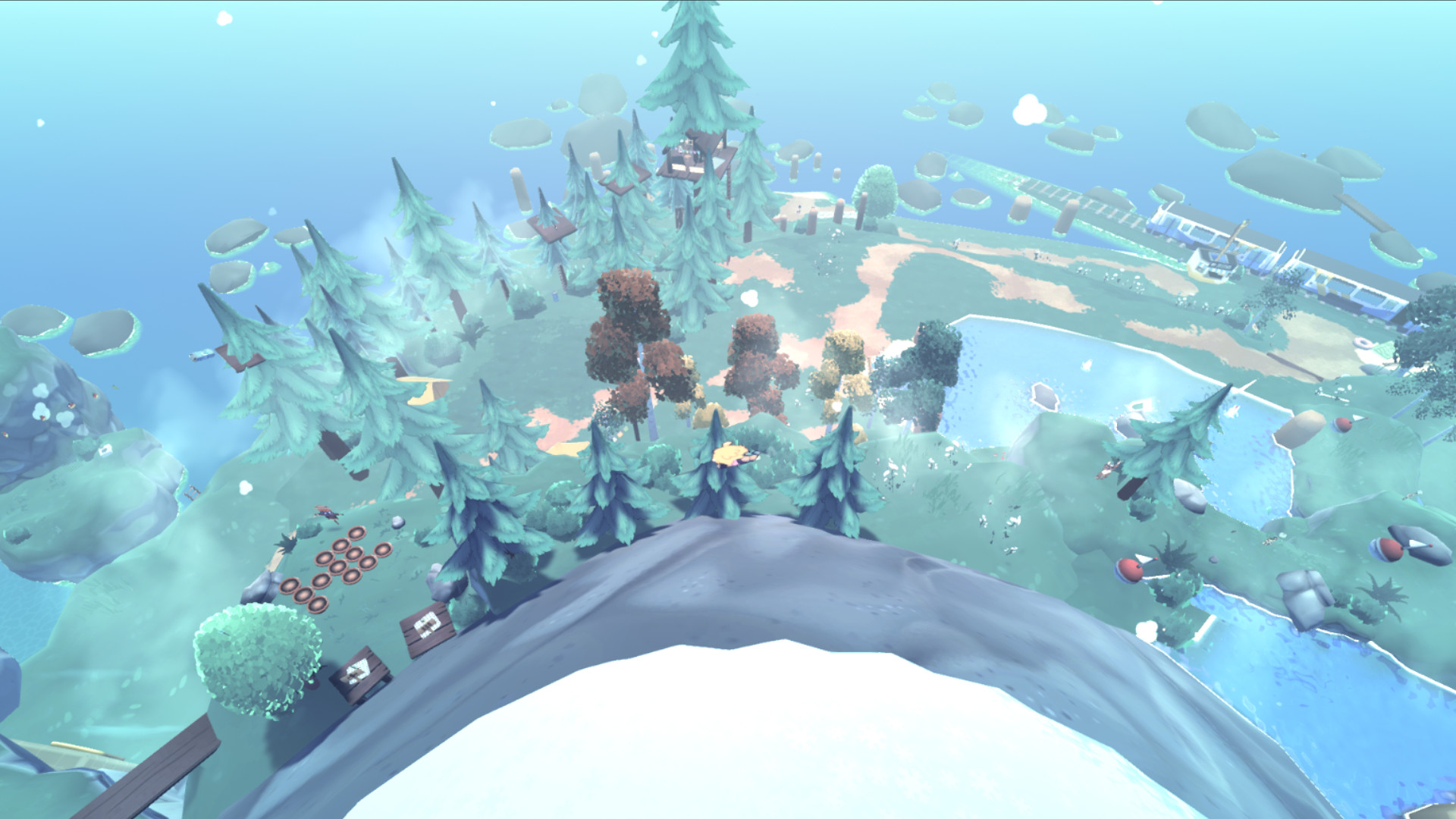
The route opens at Home, where an apartment building and a small train station sit near sunken buildings and a crane. That starting view establishes the islands as lived-in places, not just floating courses. The six-stop route then changes its terrain from place to place: Hairball City has beaches, Salmon Creek Forest has a mountain trail, and Public Pool gives Niko a place to swim. Those landmarks affect what the player can do in the environment, from moving along the forest path to entering water, and they give each stop a visual identity. The game also includes Tadpole Inc. as a workplace hub, so the railway trip links a modest home base to more varied communities. The geography supplies several kinds of space for the same basic platforming verbs, while the animal residents and their requests give those spaces a local purpose.
Niko’s movement combines ordinary platforming with small ways to recover from a missed jump. Running, jumping, climbing, diving and wall-jumping carry them across ledges and into places that are hard to reach from the ground. Air vents and large umbrellas can help Niko get back up after falling, making a drop a detour instead of a hard reset. The controls also support free exploration between jobs: the player can move around a location, test a route upward and then return to the resident who set the task. Against the three-dimensional landscapes, Niko and the animal characters are drawn as two-dimensional sprites, so the figures stand out against the scenery while the camera and platform layouts still use depth. This movement system is used for practical errands as much as for reaching collectibles; a task may ask the player to traverse the level under a particular constraint.
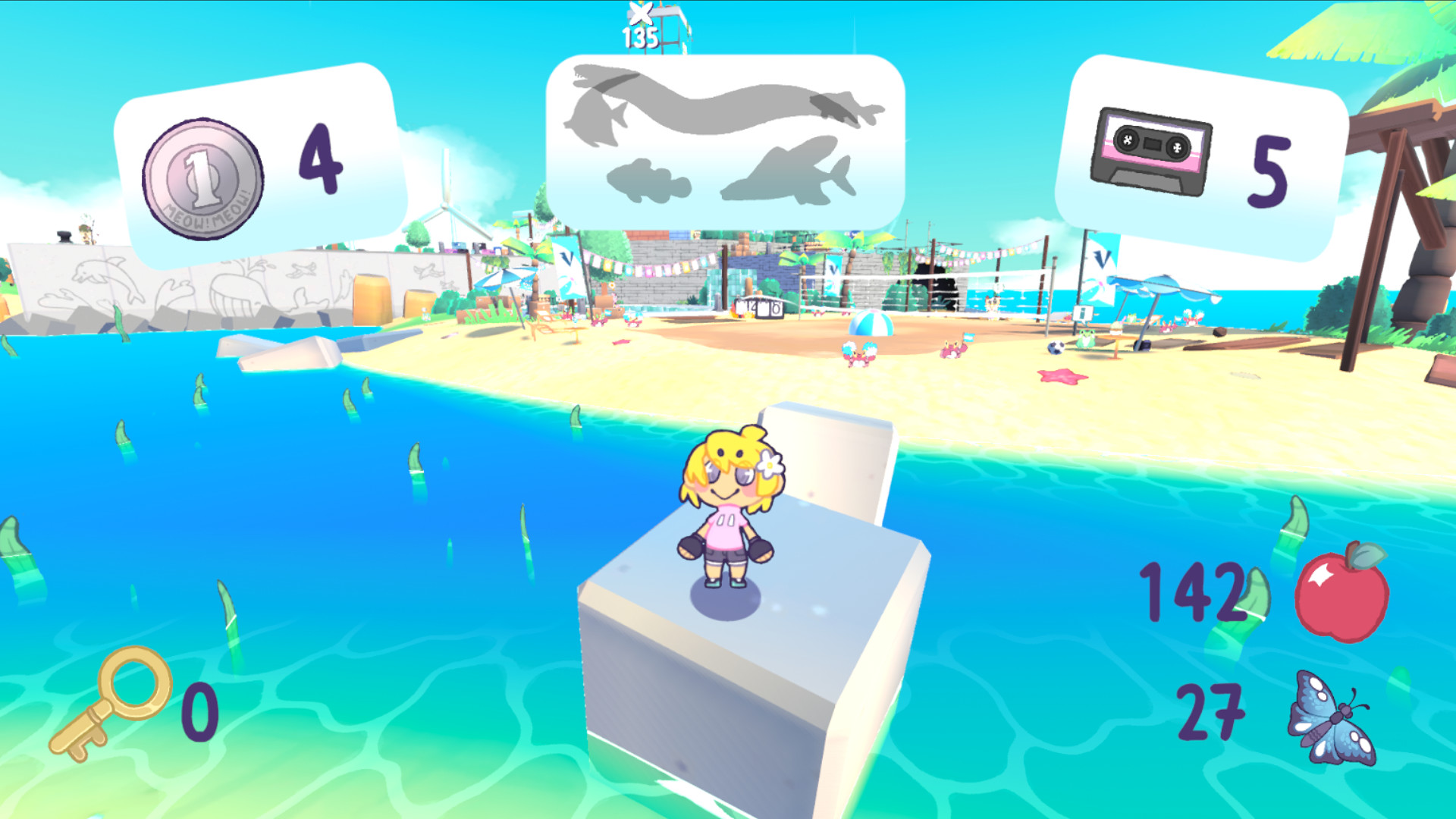
Residents’ requests give the islands their day-to-day objectives. One character needs Niko to act as a fishing hook and bring back fish; another asks for 30 bugs, while other islanders exchange cassettes found during exploration for coins. These are more specific than a generic “help someone” prompt: each request names an object, activity or problem that changes what Niko searches for. The brief can send the player into water, across a patch of an island where bugs appear, or back to a character with something collected along the way. People also ask for help with art or simply need someone to listen, so the job mixes practical errands with conversations. The coins from some favours then matter beyond that individual relationship, because the railway uses them to carry Niko onward. Meeting residents is thus both a social interaction and a route into the game’s varied small tasks.
Several jobs add a rule that changes how Niko must cross an area. A hamster-ball errand involves searching for the owner’s sunflower seeds, while another task asks Niko to carry a turtle to their husband without jumping more than three times. A separate hill challenge requires reaching the top without letting Niko’s feet touch the ground. Volleyball provides another minigame alongside these movement and search tasks. Each condition changes the way the player approaches a short stretch of the island: locating seeds, transporting a character carefully or preserving a no-jump restriction all ask for different use of the same movement kit. The tasks do not require a combat build or a chain of attacks; their challenges come from moving through spaces and interacting with residents and objects. The game has no boss fights, keeping its main tests focused on platforming, small puzzles and local activities rather than battles.
Coins connect those local challenges to the railway. Residents may pay Niko for completing a favour, and the money goes toward clearing obstacles from the tracks so the train can continue to its next stop. The player therefore alternates between getting off the train, doing work around an island and returning to the route with enough to move ahead. Progress also opens further tasks on islands already visited, which makes travel include return trips instead of a one-way sequence of cleared stages. A player can arrive somewhere new, later learn that an earlier location has another job available, then go back and see the same place with a fresh objective. Task types can recur, even for familiar characters on other islands, but their conditions vary. A returning player may recognize the kind of request while still having to notice what changed this time; revisiting adds a variation rather than asking for an exact replay. This gives the train a concrete function in progression: it is transportation through the island chain, and railway access is tied to coins earned by helping the people along it. Finishing all 72 tasks is a separate completion goal, rewarded with the Employee of the Month title. That goal gives the return trips a purpose beyond reaching the final railway stop.
Finding objects adds another layer to a visit. Cassettes are scattered around the islands, and some residents trade coins for the ones Niko has collected, turning exploration finds into another way to earn. Messages in bottles appear among the collectibles too; they provide glimpses of Niko’s own story during the trip. Bugs can be picked up for requests, and apples pop from bushes when Niko runs through them. Hidden Handsome Frogs form another discovery goal, with finding the group tied to the Hopeless Romantic achievement. These objects make ordinary movement productive: a player heading between two requests may spot a tape, a frog or a bush that yields an apple. Residents’ conversations add a different kind of discovery, with individual dialogue and longer exchanges for more prominent characters. Searching and talking can thus lead to finds and story details beyond the immediate job.
Gary’s Garden is an added area built around one clear task: help Gary recover his garden from beneath the ocean. A ghost in Tadpole Inc. gives access to the new level, and the area contains ten cassettes alongside its main quest. Those details give it its own entry point, objective and optional find set. The garden is separate from the six-island route described for Niko’s railway trip, so it expands the setting without changing how that route works. Its underwater setting sets up a different location for Gary’s problem, while the additional tapes reward players who search beyond the main objective. The task is presented as a small variation on the game’s usual pattern, with the garden recovery giving Niko a focused reason to visit rather than adding another ordinary resident errand.
- Developer
- Frog Vibes
- Genre
- Single-player 3D platform adventure with exploration, puzzles, fishing and social tasks