
About Herdling
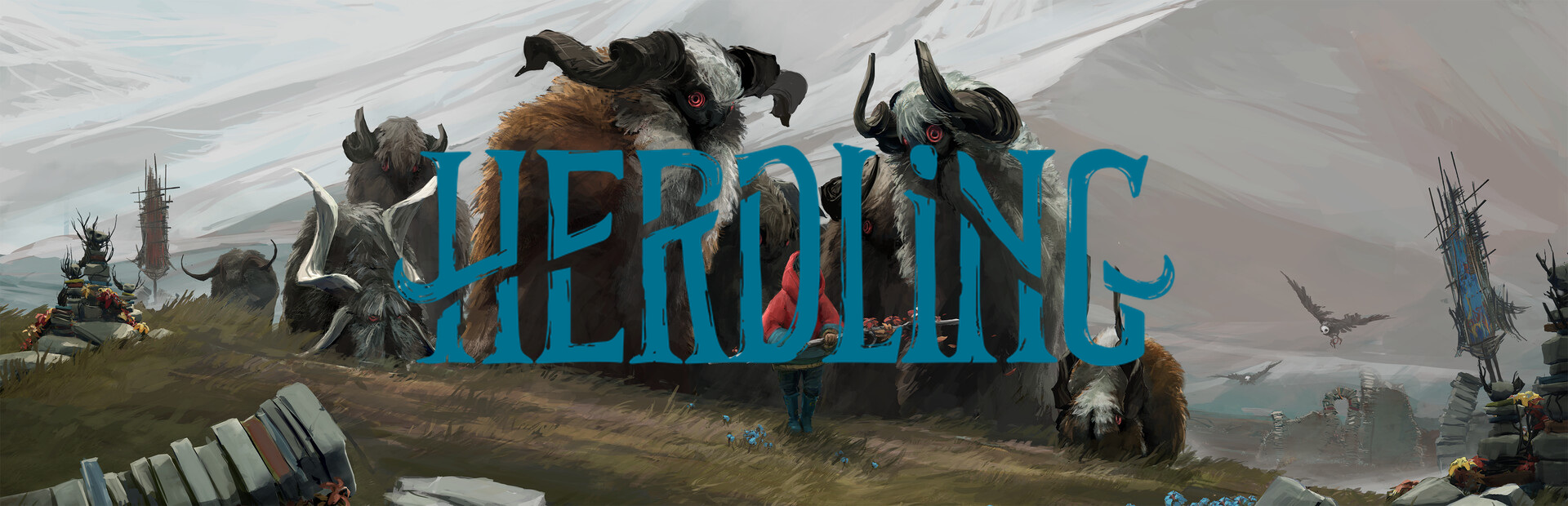
Herdling follows Via as she guides a growing group of shaggy Calicorns from the city into a mysterious mountain wilderness. Instead of commanding the creatures directly, she moves around them to steer their path, tends them at resting places and learns when a stampede can carry the herd through difficult terrain. The journey tells its story without dialogue.
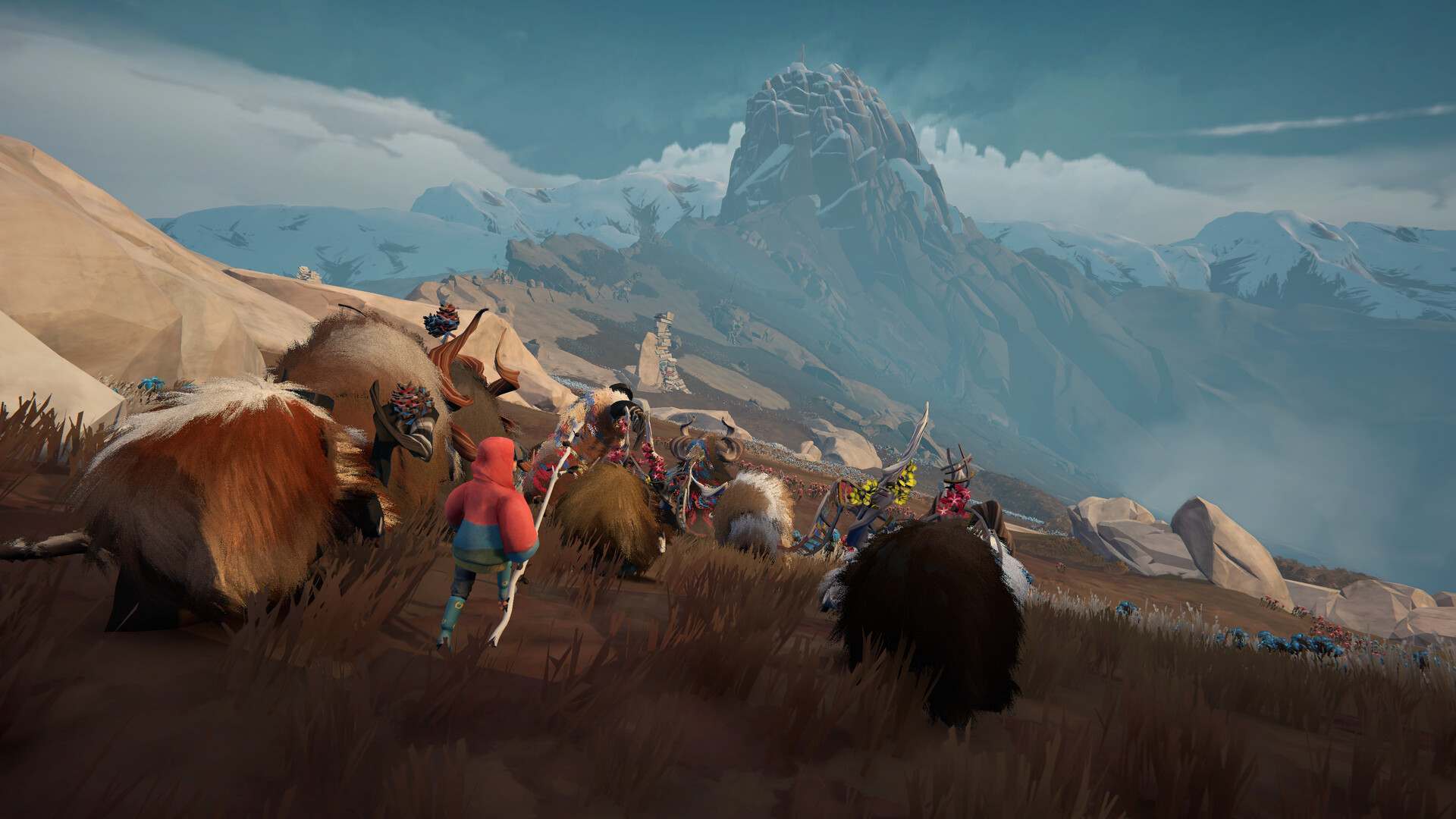
Herdling begins with a simple responsibility: get a group of strange animals safely out of the city and into the mountains. The traveller guiding them is called Via, and the creatures are Calicorns, shaggy, horned animals whose size and individual habits make them feel less like an inventory than a living company. Okomotive builds the journey around that relationship rather than around a spoken explanation of the world's history. The road leads from urban confinement toward forests, high paths, snowy ground and the mystery of a distant summit. Via cannot simply walk to the objective and assume the herd will follow in a perfect line. The animals must be kept together, steered past danger and given care when the journey allows it. As more Calicorns join, the procession becomes visually imposing, but each creature is still meant to remain recognisable. That balance gives the adventure a different centre from Okomotive's earlier FAR games: the thing the player looks after is neither a boat nor a machine. It has movement and character of its own, and crossing the landscape depends on learning to travel with it.
Herding here is indirect. Via moves with and around the Calicorns, pushing their general direction by where she stands rather than issuing a separate command to each animal. Don Schmocker of Okomotive has described the challenge of making that action intuitive without reducing the creatures to obedient machines. A player has to read the space ahead, position Via relative to the group and leave enough room for the animals to respond. A narrow path asks for careful control; an open plain gives them room to gather speed. This is why the herd's behaviour matters as much as the protagonist's. A curious animal can break the clean shape of the procession, while differences in gait and position help it look like a group of creatures rather than a single moving object. Okomotive studied real animal movement and social behaviour while making the game, then gave the Calicorns variations in fur, horns, size and manner. The player guides a collective, but can still notice individuals inside it. That is the core mechanical idea: steering a journey by attending to the animals in front of you, not by treating them as cargo that automatically appears at the next checkpoint.
The route changes what that steering requires. Forests, mountain slopes, snowfields and forgotten valleys present different widths, surfaces and sightlines, with hazards that can hurt or separate a Calicorn. The developer describes light environmental puzzles and surprising obstacles rather than an elaborate combat system. Flowers on the ground can give the herd the ability to stampede or to interact with particular parts of the environment. A stampede is not only a burst of speed for a scenic stretch; used at the right place, it helps the animals push through sturdy shrubbery, deep snow or a slope that would otherwise be too slippery. The player therefore alternates between close guidance and moments when the whole group surges ahead. It is a physical rhythm shaped by the terrain. A path that looks passable for Via alone may be less forgiving for several large creatures, so the practical question is how to move everyone through it. The game does not need a roster of weapons or enemies to create stakes. Exposure, cliffs, crevices and the creatures' vulnerability make a crossing consequential even when the next challenge is simply finding a safe line forward.
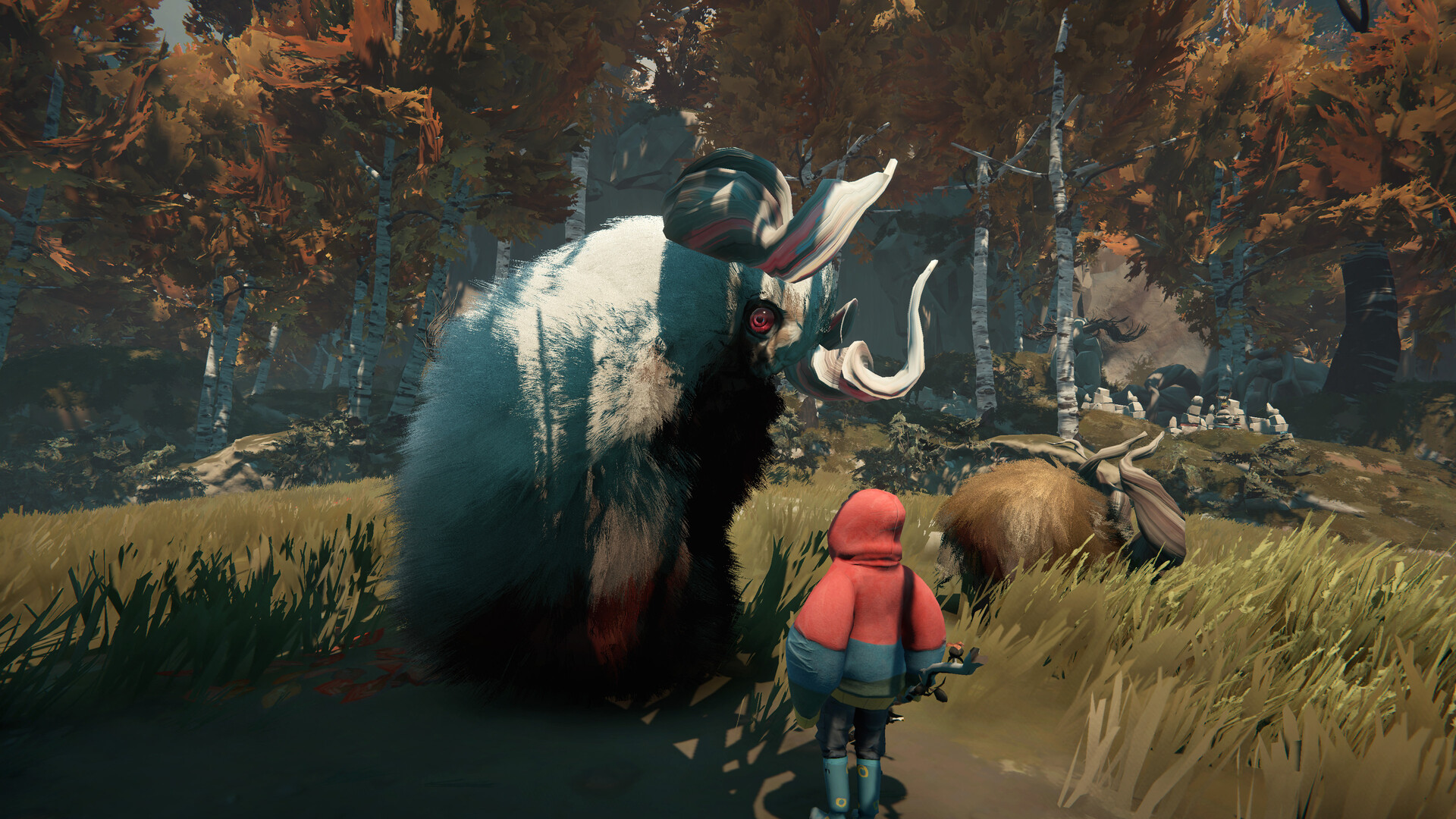
Resting places change the pace again. Via can stop beside a bonfire, tend a Calicorn's wounds, clean its fur, play with it and decorate the herd with ornaments or keepsakes found along the way. Players can give individual Calicorns names as they tame them. These actions make the animals easier to remember when the group grows, and they put a face on the risk of losing one. The variety is more than cosmetic: Okomotive wanted different colours, horn shapes, body sizes and behaviours so that a player might recognise which companion was leading, lagging or wandering. Care also makes the mountain crossing something other than a continuous obstacle course. A pause can acknowledge what the group has just survived before asking it to move again. The developer has discussed an easier setting in which Calicorns do not die; that option changes the consequence of danger without removing the need to understand the route and guide the herd. Whether the player approaches the trek with that protection or with greater risk, the rest stops underline the same point: Via is responsible for particular creatures, each of which has travelled the distance with her.
The tale is wordless, so much of its character comes from the change in surroundings and in the herd's movement. Okomotive's press materials describe foggy forests, snowy plateaus, broad mountainscapes and valleys in a fallen world. The destination is kept mysterious, while the road supplies immediate questions: how did the Calicorns come to be here, what lies beyond the next rise, and can this group cross the terrain together? The studio's first fully featured three-dimensional game lets the camera hold both Via and the animals within a shifting environment. That is a different visual problem from keeping one traveller on screen; the image must give enough information to understand the herd's shape while still showing the scale of the landscape. Okomotive's animal animation is central to the effect. The Calicorns can look familiar in one moment and slightly uncanny in another, and their collective stampede gives the quiet stretches a sharp contrast. Creative lead Don Schmocker has identified Eastern European Kukeri costumes, with their fur, bells and unnerving presence, as one inspiration for the creatures. The team also looked beyond familiar Swiss mountain scenery toward the Himalayas when imagining wilder heights. These influences help explain why the animals and landscape can seem welcoming and unsettling at once without relying on a spoken account of their origin. Joel Schoch is credited as composer, with the sound and score contributing to a story that is carried by action and atmosphere rather than narrated dialogue. The mountain becomes legible through motion, weather, distance and the changing company alongside Via.
Herdling released in 2025, developed by the Zurich studio Okomotive and published by Panic. Its original launch spanned PC storefronts, PlayStation 5, Xbox and Nintendo Switch; it is a single-player adventure, even though its central task is managing a company of animals. The game's structure is a directed expedition rather than a livestock-management simulation or an open-world checklist. Players gain a larger, more personalised herd during the crossing and develop a working sense of where to stand, when to slow down and when the landscape offers room to run. Its premise also keeps the animals' welfare visible. An injured Calicorn is not an abstract penalty when that individual can have a name, markings and decorations that the player chose. This is why the moments of care belong beside the stampedes and hazards in any account of the game: they are the other half of learning to herd. Okomotive's earlier journeys asked players to maintain a vessel through hostile territory. Herdling shifts that attention to responsive living companions and a route whose obstacles are meaningful because the entire group must make it through.
- Developer
- Okomotive
- Genre
- Wordless herding adventure