
About Hellpoint
On the ruined space colony Irid Novo, you play as a Spawn investigating the cataclysm called the Merge. Explore the station’s connected districts, fight its altered inhabitants, and adapt your weapons and abilities as the black hole’s orbit changes which threats and passages appear.
Hellpoint is a science-fiction action role-playing game set on Irid Novo, a once-grand human colony now abandoned to hostile creatures and unsettling traces of its former inhabitants. The station circles a black hole, and the event known as the Merge has left the people and systems there profoundly changed. The player takes the role of a Spawn: a being created on the station and sent to investigate what happened. The mission leads through a setting where advanced science, occult imagery and the influence of the Cosmic Gods overlap. Rather than framing Irid Novo as a sequence of disconnected arenas, the game makes the colony itself the central place to read: its ruined spaces, messages and strange inhabitants gradually give shape to the catastrophe and the forces surrounding it.
Irid Novo is built as an interconnected world of districts, with routes, hidden passages and vertical spaces linking its areas. Exploration can involve climbing or jumping to reach a ledge, noticing a wall that conceals a route, or finding how one passage connects to a larger part of the colony. Breaches act as points where the player can return to a stable location and develop the character. The layout encourages moving between spaces as new routes become available, while the station’s unsettling architecture changes from industrial or civic interiors to more alien environments. The player’s progress comes from uncovering those connections and confronting the dangers in them, not from following a single straight corridor from one encounter to the next.
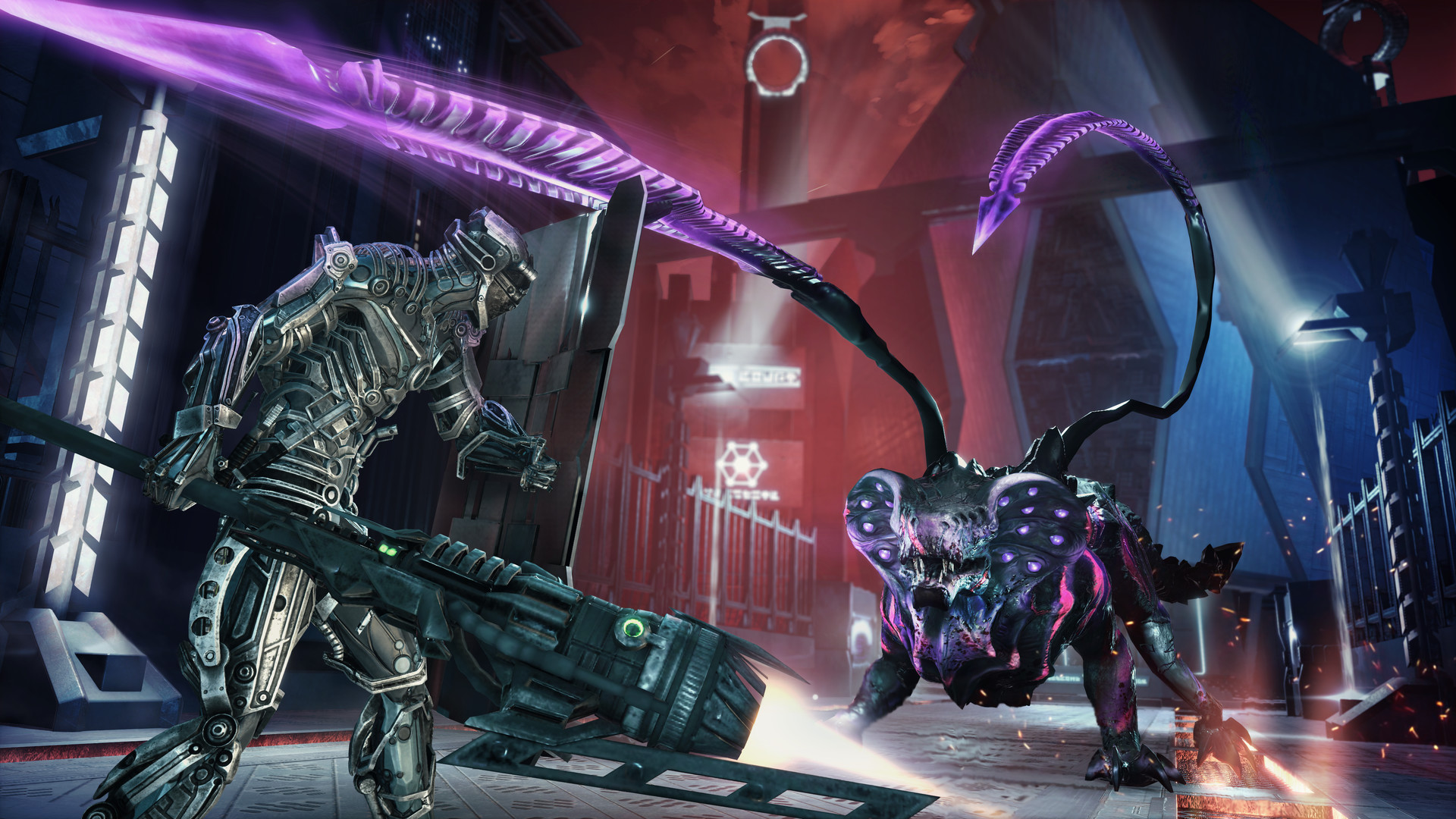
Fights combine melee and ranged weapons with movement such as dashing and jumping. Stamina governs the pace of those actions: attacks, defence and other exertions draw on it, so spending the whole bar at once can leave the character unable to respond until it recovers. This makes spacing and timing part of every encounter. The player watches an enemy’s approach, chooses when to attack, and keeps enough stamina to evade or defend against a counter. Healing has its own connection to combat: landing attacks replenishes healing uses, so engaging opponents can sustain a journey through the station. The result is a loop in which exploration, fighting and recovery remain linked, and a player cannot rely on a safe room alone to restore every resource.
Character growth uses Axions, found in the environment and earned from defeated enemies. At a Breach, those points can be invested into attributes such as health, stamina, energy, load, strength, reflex, cognition and foresight. The choices support different approaches: strength contributes to heavy weapons, reflex to faster arms, cognition to firearms, and foresight to catalysts. If the character falls, carried Axions are left behind and can be recovered by returning to the place of death; another death before recovery risks losing that reserve. That system gives each expedition a clear tension between pushing farther with a large unspent balance and returning to a Breach to turn it into lasting attributes. Equipment and statistics then work together to shape what the character can carry and how they handle combat.
Weapons develop through use as well as customization. Each weapon tracks experience from the damage dealt with it, gradually unlocking abilities associated with its fighting style, such as a special attack or an evasive technique. A weapon station can restore or alter certain weapons, changing which abilities they offer. Conductors add another layer: the player can fit one to a weapon to improve its performance according to character attributes, and transfer that conductor to a different weapon to experiment with another moveset. Ranged options and catalysts broaden the available approach beyond melee. Armour and abilities can also be adjusted, so character development is not limited to raising attributes; it involves matching the weapon, conductor and equipment to the way the player wants to engage with the station’s threats.
The black hole gives Irid Novo a changing rhythm. A clock on the HUD tracks the station’s position in its orbit, and the timing of that orbit can trigger events such as mini-boss appearances, enemy horde attacks and newly available secret passages. Some locations also respond to the black hole’s position, so observing the clock and exploring again can reveal opportunities that were absent on an earlier visit. The Quantic System adds further shifts to the station: events and enemy behaviour can vary, changing the conditions in an area. A route depends on when a passage or encounter becomes active as well as where it leads. In the Arcology, skyscrapers carry concentration rings that react to the black hole’s position; calibrating them with codes allows two rings to align and open a timed secret area elsewhere. The full game can be played alone or in split-screen or online co-op, with shared loot and saved progress for the second player. A local partner can join by pressing Start, and co-op can continue through the entire game.
- Developer
- Cradle Games
- Genre
- Action role-playing game