
About Hellblade: Senua's Sacrifice
A Celtic warrior enters a mythic Viking world on a vision quest to Helheim, seeking to recover the soul of her dead lover. The journey combines close third-person exploration, perception-based rune puzzles and sword combat, while voices and visions shape how Senua encounters its dangers.
Hellblade: Senua's Sacrifice follows Senua, a Celtic warrior who enters the world of Viking myth on a vision quest to recover the soul of her dead lover. The journey takes her toward Helheim, a realm she understands through grief, memory and the supernatural world around her. Its path moves through ruined Norse spaces, hostile wilderness, dark halls and mythic trials. Senua's goal gives the story a clear direction, while the meaning of what she sees and hears remains tied to her perspective. Gods and monsters from the story's imagined Norse setting become obstacles that she must face in order to continue.
Senua experiences psychosis, and the game presents voice hearing, visions, unusual beliefs and shifts in perception as part of her lived point of view. Voices accompany her continuously: they can warn about threats, disagree, repeat fears or react to events, and their positions in the sound mix help make them feel close to her. This is a portrayal of one character's experience, not a checklist for understanding everyone who experiences psychosis. Ninja Theory developed the subject with neuroscientists and people with lived experience, and that collaboration informs how the game connects sound, visual uncertainty and Senua's struggle to make sense of danger.
Most of the journey is experienced from behind Senua as she walks, climbs, crosses narrow routes and examines spaces for a way forward. The camera stays close, and environmental details often direct attention without a conventional map or quest list. Focus is the central interaction: Senua narrows her attention to details that matter, including marks, objects and altered views. The same ability is useful outside fights and in combat, so learning to look deliberately becomes part of moving through the story. The world does not present a free-roaming activity list; instead, the route is a sequence of connected spaces and set-piece trials.
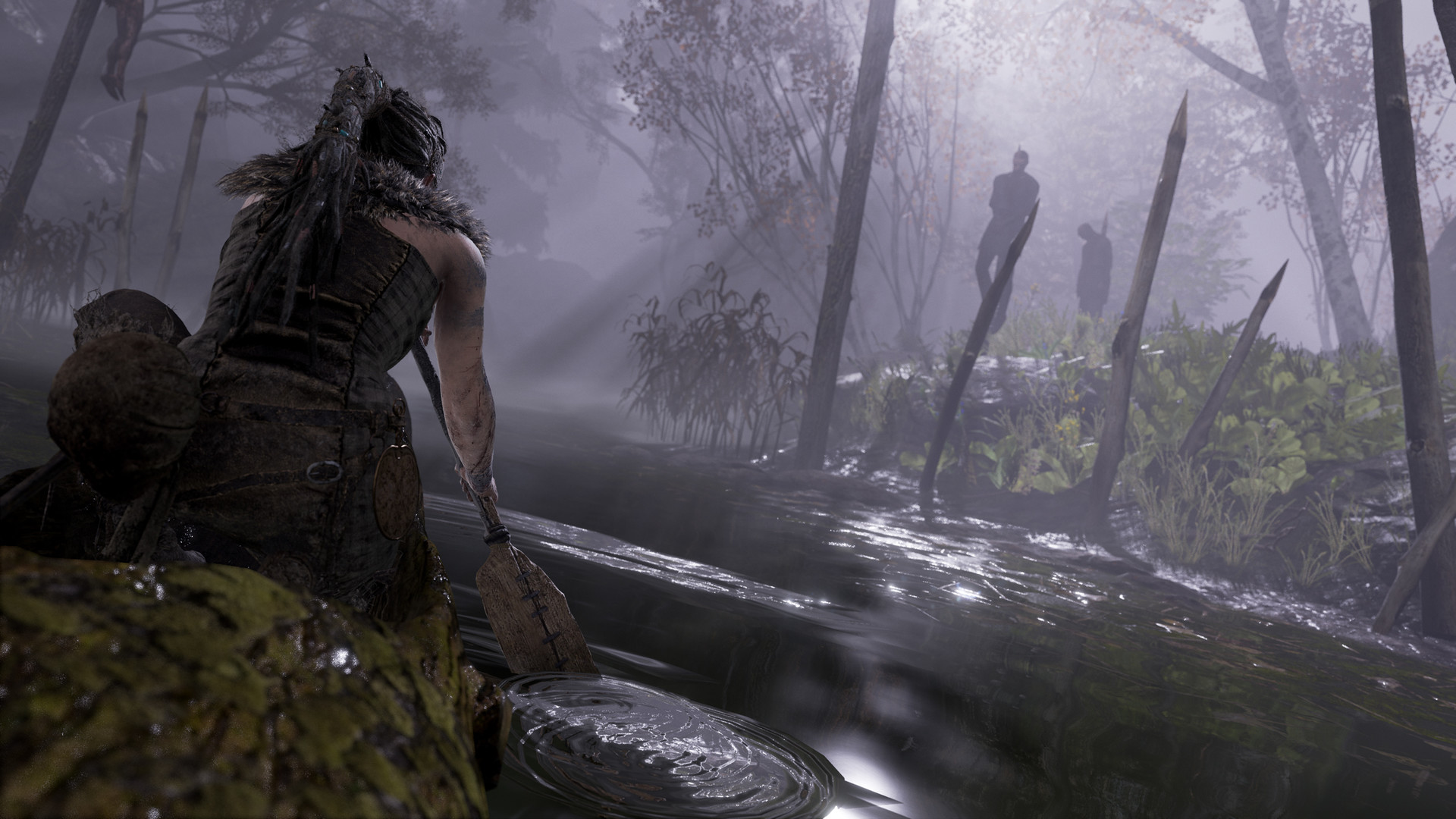
Many gates are sealed by runes, and progress depends on finding the corresponding shape in the environment. Senua's Focus makes a mark or alignment stand out, but the player must search the surrounding architecture and find the correct viewpoint where ordinary beams, gaps, branches or silhouettes form the sign. These puzzles ask for slow observation and spatial adjustment rather than inventory combinations. Some later spaces change how the player reads a room or route, extending the same perception-based idea into more elaborate trials. The puzzles also make the uncertainty of Senua's perception an active part of play, rather than leaving it only in the dialogue.
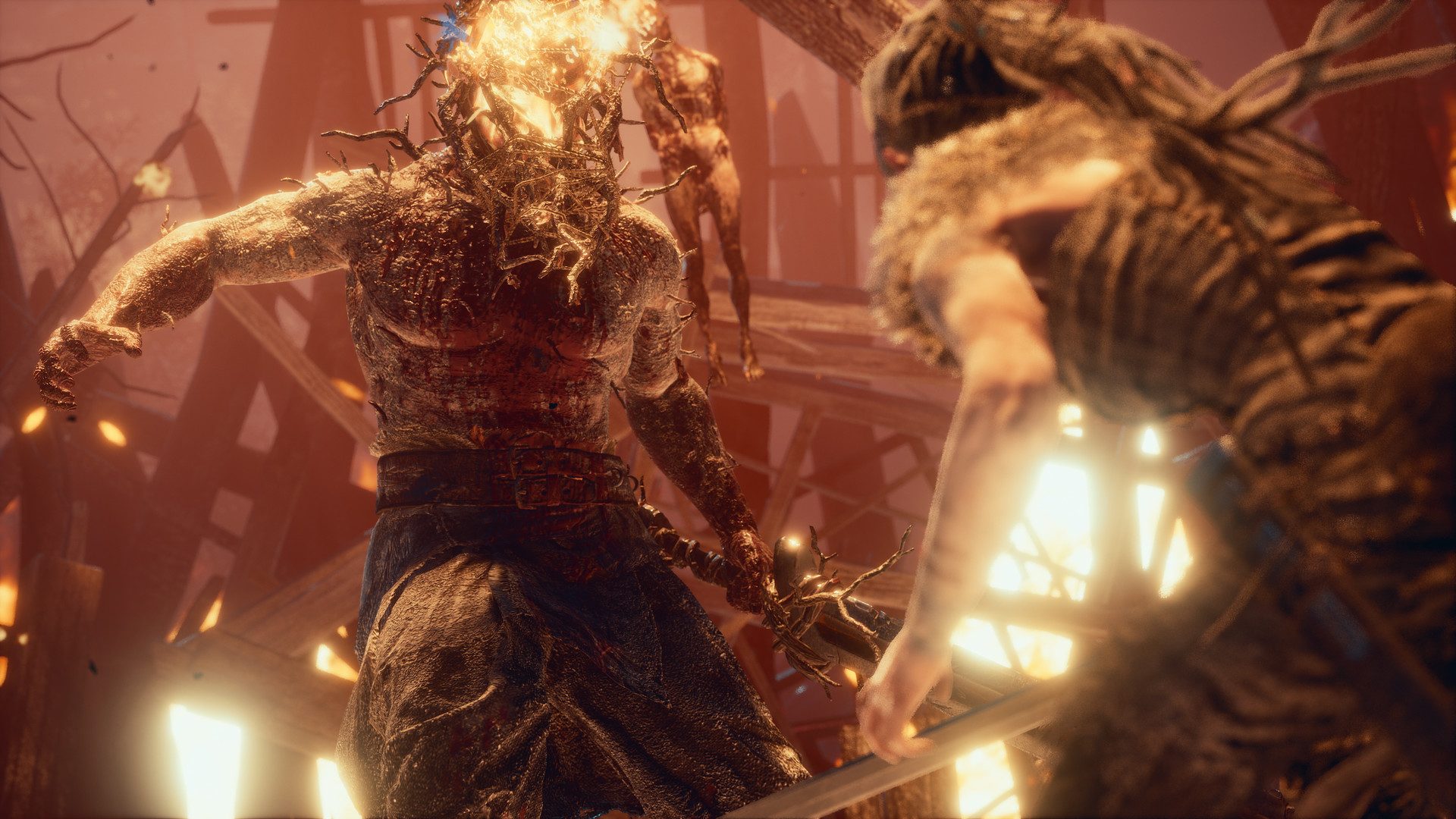
Combat centres on Senua's sword and a compact set of actions whose timing and spacing matter. Fast strikes build a chain of attacks, while heavier blows can stagger opponents or break a guard but take longer to land. Kicks and other close-range attacks can interrupt certain enemies; blocking reduces incoming damage, a precisely timed block can parry, and evasion creates space or avoids a strike. The voices sometimes call attention to danger approaching from outside the camera's centre, making them part of the fight's information as well as the story's soundscape. Named threats such as Valravn, the god of illusion, and Surt, the fire god, place these skills in larger set pieces. Encounters are staged interruptions on the journey, not a progression of equipment menus or character builds.
Focus also links Senua's perception to the fights. It becomes available early in the journey and can slow or interrupt threats long enough to create an opening; it can also help against enemies protected by shadow. Successful attacks and defensive actions build the opportunity to use it. The ability is therefore both a way of interpreting visual puzzles and a tactical resource during close encounters. Enemy types ask for different responses: a shielded opponent resists straightforward attacks, while larger foes can punish slow or repetitive swings. The combat asks the player to alternate between observing an enemy's movement and choosing a brief, suitable response.
Druth's Lorestones add optional pauses to the route. Focusing on one plays a spoken fragment in which Druth recounts stories associated with the Northmen, expanding the mythic material heard along the way. They are environmental discoveries rather than items used to upgrade Senua, and following their voices gives exploration another narrative thread. The game also includes trials that give individual regions their own rules, such as navigating spaces shaped by illusion or darkness. These episodes change what the player must notice without introducing a large catalogue of side activities, helping each new stretch of the journey frame its challenges around perception and survival.
The structure keeps its systems deliberately focused: exploration, environmental puzzles, sword fights, story scenes and optional Lorestones carry the campaign. The developer describes the design as omitting conventional inventory, skill trees, crafting and a standard HUD, and the Steam listing identifies it as a single-player game. Current Steam information for the Enhanced PC edition also lists options such as adjustable combat difficulty, subtitle controls, colour-vision filters and input remapping; those details are edition-specific. The main adventure remains a directed passage through Senua's account of loss, fear and her attempt to reach Dillion, with interpretation kept close to what she experiences.
- Developer
- Ninja Theory
- Genre
- Single-player action-adventure