
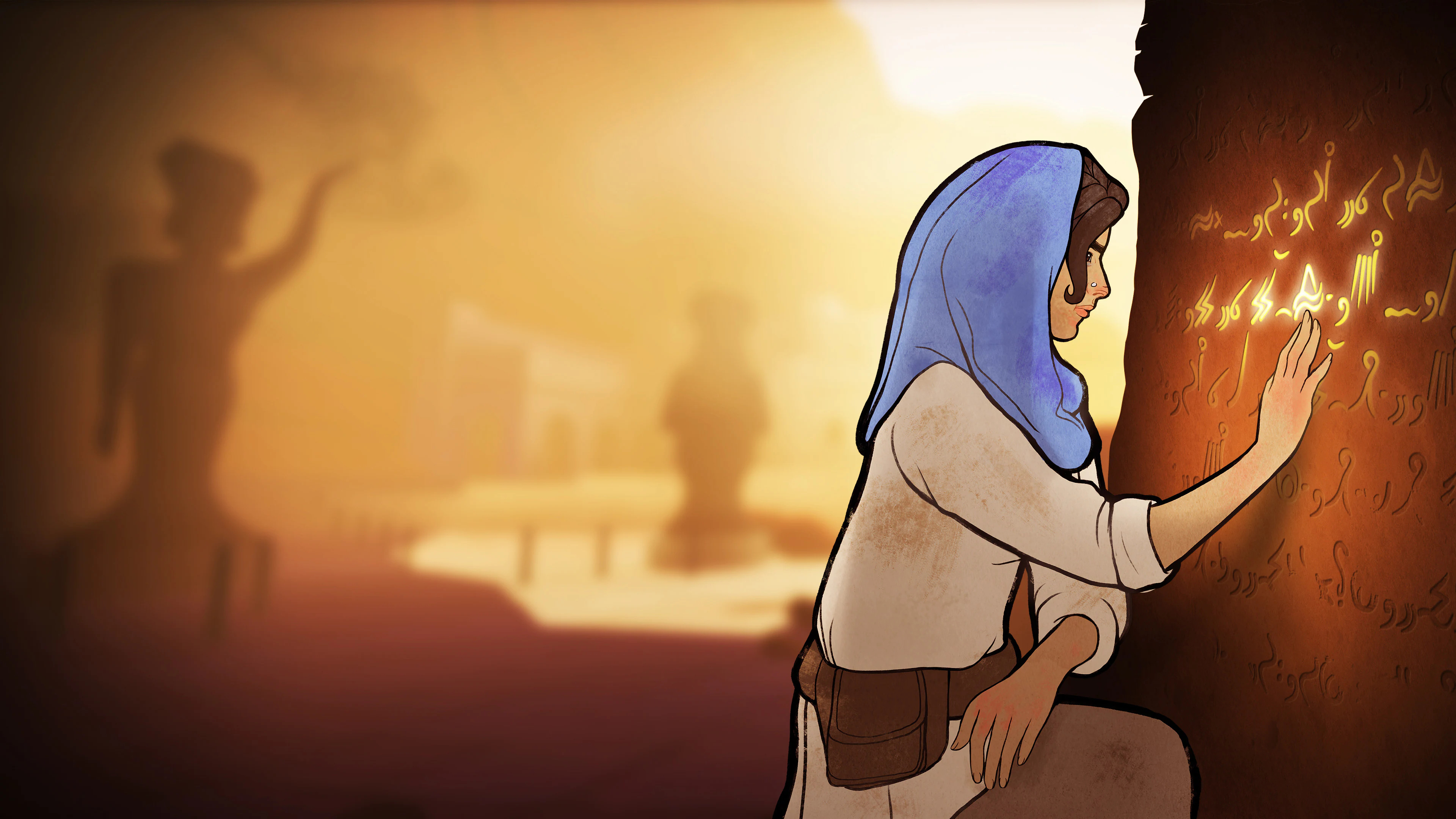
About Heaven's Vault
Archaeologist Aliya Elasra and her robot companion Six search the scattered moons of the Nebula for a missing roboticist. This narrative adventure combines third-person exploration, sailing between sites and deciphering Ancient, a constructed hieroglyphic language. Translation choices and conversations shape an adaptive story about interpreting the Nebula’s forgotten history.
Heaven’s Vault follows archaeologist Aliya Elasra and her robot companion Six as they search the Nebula for a missing roboticist. The investigation carries them from inhabited moons to ancient ruins, where objects and inscriptions offer evidence about a civilisation’s past. The setting is a network of worlds linked by rivers of space, explored aboard Aliya’s sailing vessel, the Nightingale. This is an archaeological science-fiction adventure whose central puzzle is a constructed hieroglyphic language called Ancient. The player studies inscriptions, forms hypotheses about individual words and chooses translations whose meaning can affect Aliya’s interpretation of a place and the direction of later events. At the same time, conversations and discoveries shape an adaptive story that remembers the paths taken and the choices left aside. The mystery of the missing researcher gives the journey an immediate purpose, while each site expands the historical questions surrounding the Nebula. The game’s structure allows the player to decide which leads to pursue and in what order, so the investigation grows through exploration and interpretation rather than a single fixed route. Its subject is the work of reconstructing a past from incomplete evidence.
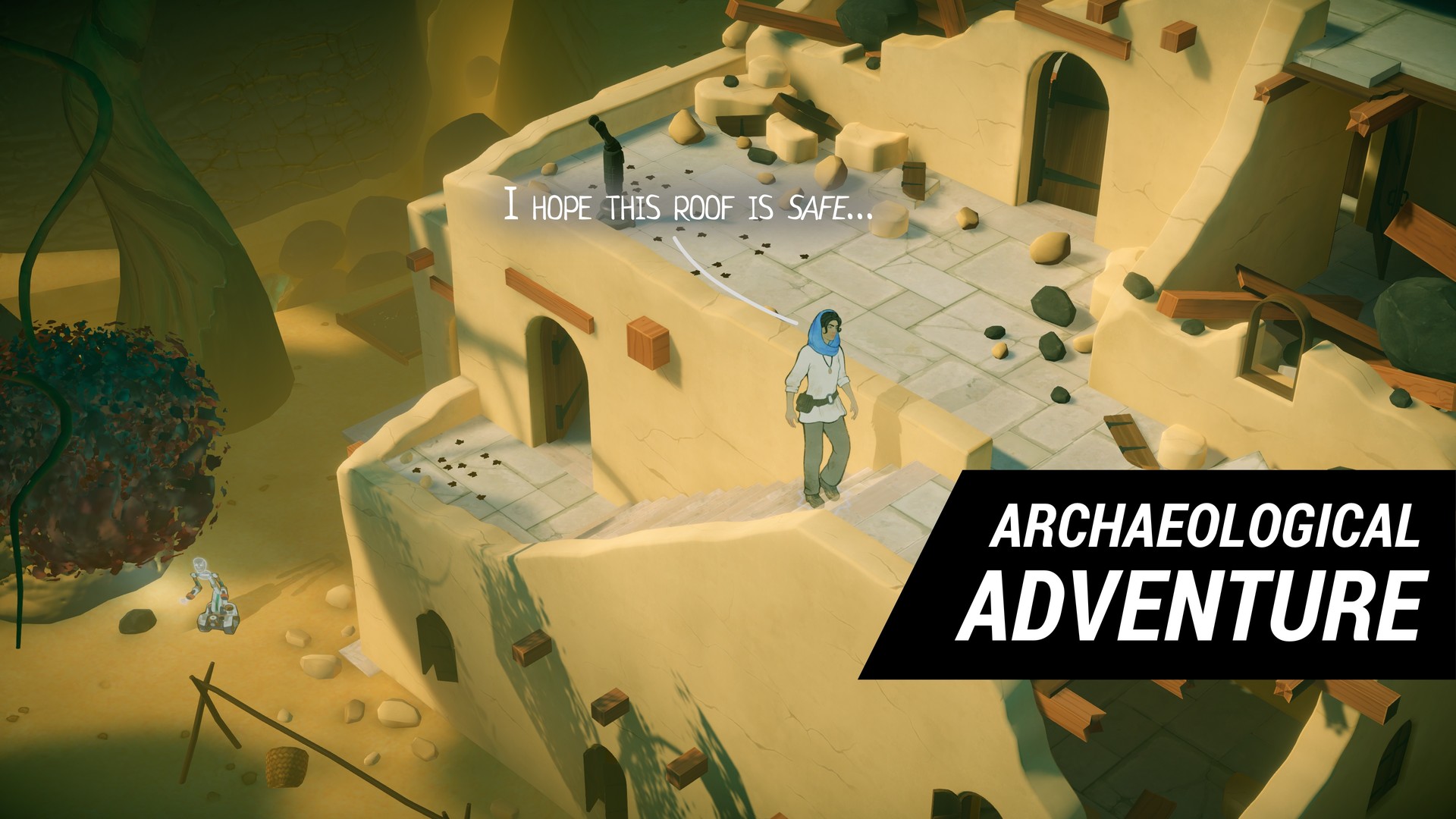
The Nebula is explored both from the Nightingale and on foot. Between moons, Aliya steers her ship along luminous space-rivers, choosing among routes that connect the different locations and discoveries. At a destination, the pace changes to third-person exploration of ruins, settlements and surrounding terrain. The player approaches characters, follows leads, searches the environment and examines objects left by people who lived there before. Sites include varied landscapes such as markets, villages and ancient buildings, each with traces that can be read in more than one way. Exploration is not limited to highlighted inscriptions: closer attention to corners and objects may reveal text or artifacts that add context. The archaeological process asks what a place was used for and how its visible remains fit with the stories people tell. Aliya can move between areas in a non-linear order, following clues from drifting ruins or choosing a site that seems relevant to her current questions. The ship’s journeys connect these separate environments and make the map itself part of the investigation, while each landing offers a new set of local details to compare with what the player already knows.
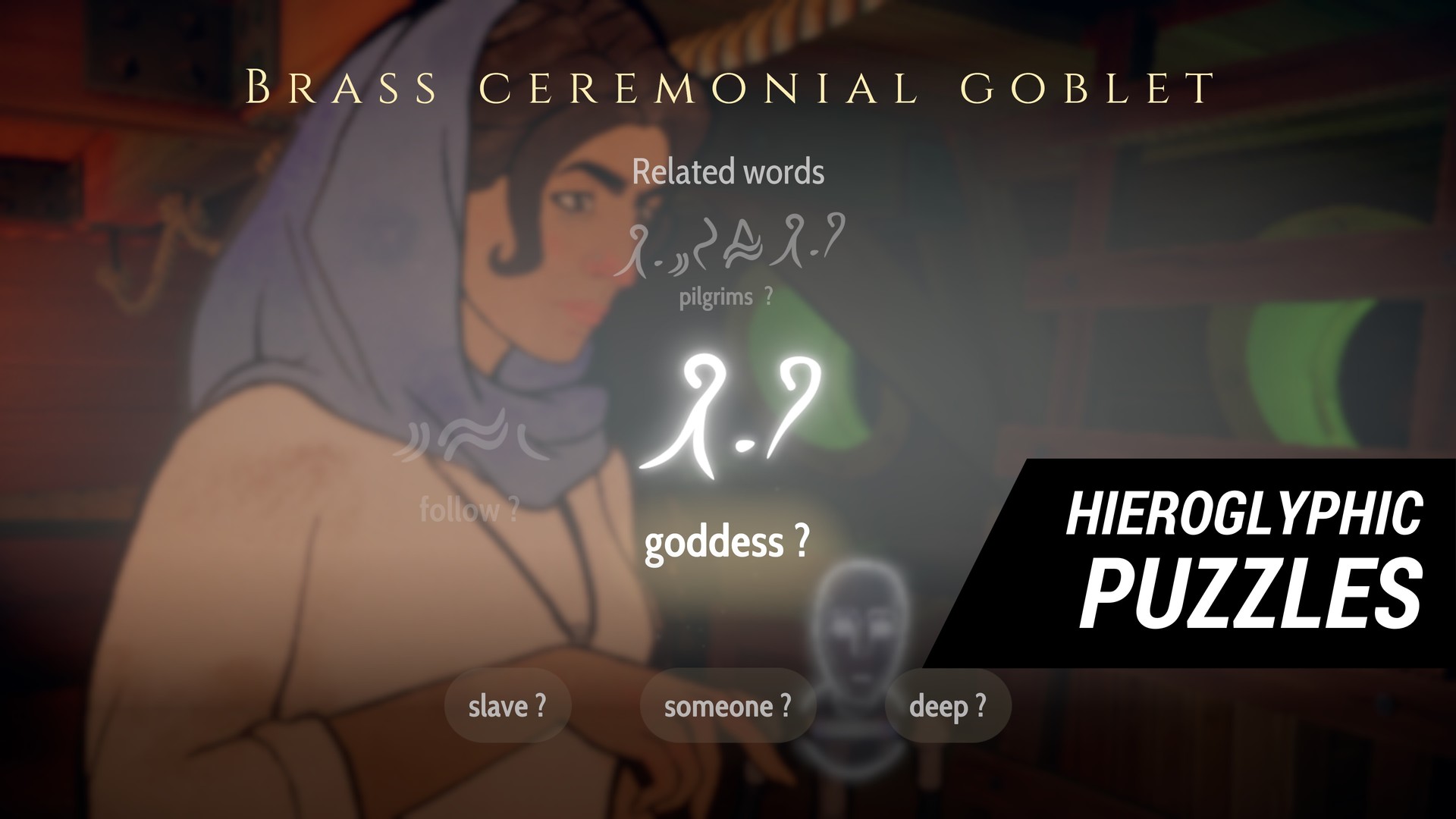
Translation is the game’s most distinctive interaction system. Ancient inscriptions appear on artifacts, architecture and other surfaces; when Aliya examines a phrase, the player considers possible meanings for its words using the context already gathered. The language is built from pictorial glyphs and smaller components, so recurring shapes and word parts can suggest relationships between concepts. The interface presents interpretive choices, but the player is never given certainty simply for selecting one. A guessed translation can become the term Aliya uses for an object or place, influencing how she interprets later evidence. If a structure is understood as a temple, for example, new findings may be considered through that reading; a different interpretation can create another line of thought. The mechanic turns archaeological uncertainty into an ongoing decision rather than a gate with one plainly correct answer. As words recur across inscriptions, earlier guesses can be tested against new examples, revised or carried forward. The player gradually builds a working vocabulary from encounters rather than consulting a complete dictionary at the outset. Translation therefore changes both what the player can understand and the assumptions that Aliya brings to the investigation.
Conversations form another important part of the evidence. Aliya speaks with people across the Nebula, and her responses can be direct, tactful, suspicious or otherwise shaped by the player’s choices. The narrative tracks these exchanges: characters remember what Aliya has said and may alter their attitude as the relationship develops. Dialogue can uncover leads or close off particular lines of discussion, and the order of sites visited influences what Aliya already knows when she arrives. This makes character interaction inseparable from the archaeological work. A local account may suggest a context for a ruin, while a translated inscription can change the questions Aliya asks about a story. Six accompanies her as both partner and robot assistant, contributing to the journey and its dialogue. The player does not rebuild Aliya into a blank role; instead, responses steer how she expresses herself within an established character. Across the wider story, the ink narrative engine records choices, discoveries and paths not taken, adapting subsequent scenes to that history. The result is a branching investigation in which small conversational decisions and uncertain readings accumulate into a particular version of the journey.
Progression is based on connecting evidence rather than accumulating combat strength or equipment levels. Finding a new inscription supplies possible words; interpreting it affects the player’s understanding of later texts and may change how Aliya describes a place. Visiting a site can reveal further destinations, historical clues or conversations, giving the player reasons to revise an earlier hypothesis. The game’s non-linear design lets leads be followed in different sequences, while the narrative engine carries forward discoveries and choices from those sequences. There is no single route through the archaeological record that provides a definitive view from the start. Instead, the player gradually constructs a timeline and a working account of the Nebula’s history from artifacts, oral accounts and environmental details. An interpretation can be productive without being certain, and the possibility of a mistaken translation is part of the design. The story keeps moving even as the player chooses what to pursue, so progress does not depend on finding every optional inscription before continuing. This approach connects the language puzzle, site selection and conversation system: each can change the questions asked of the next piece of evidence, and each can leave some possibilities unexplored on a particular journey.
The visual presentation combines free-roaming three-dimensional environments with hand-drawn two-dimensional character art and animation. This contrast gives the moons and ruins a sense of navigable space while keeping conversations visually expressive. The environments range from working settlements to places shaped by long abandonment; architecture, landscapes and artifacts provide the surfaces on which the player reads the past. The Nightingale’s traditional sailing-ship form also distinguishes the game’s science-fiction setting from a conventional spacecraft adventure. Space is crossed like a navigable sea, with rivers and routes linking locations rather than a seamless planetary map. The game’s hand-drawn glyphs, carved inscriptions and artifact designs make writing part of the world’s material culture. Text is not simply an overlay for a puzzle: it is found on objects and sites that the player has to notice, approach and interpret. The measured pace of travel and examination supports the archaeological focus, while character conversations give the historical questions a social dimension. Presentation and interaction reinforce the same premise: a past becomes legible through close attention to what remains and through dialogue with the people living among those traces.
Heaven’s Vault gives Aliya a missing-person inquiry, then lets that search grow into an argument with the past. An inscription can appear to name a temple, a market or something else entirely; whatever Aliya decides will colour the next place she visits and the next account she hears. The movement between river travel, exploration and translation makes the Nebula feel connected without reducing its history to a set of collectible facts. Some discoveries will be missed on one journey, and a character encountered after one clue may speak differently from the same person met earlier. The adventure is available on Windows, PlayStation 4 and Nintendo Switch, while its central design remains the tension between evidence and interpretation. Aliya can sail toward a promising moon, talk her way into another lead or reconsider a word she thought she understood. The story continues with those choices in its memory, leaving the player to decide how confidently any surviving fragment can speak for a vanished civilisation.
- Developer
- Inkle Ltd.
- Genre
- Archaeological science-fiction narrative adventure