
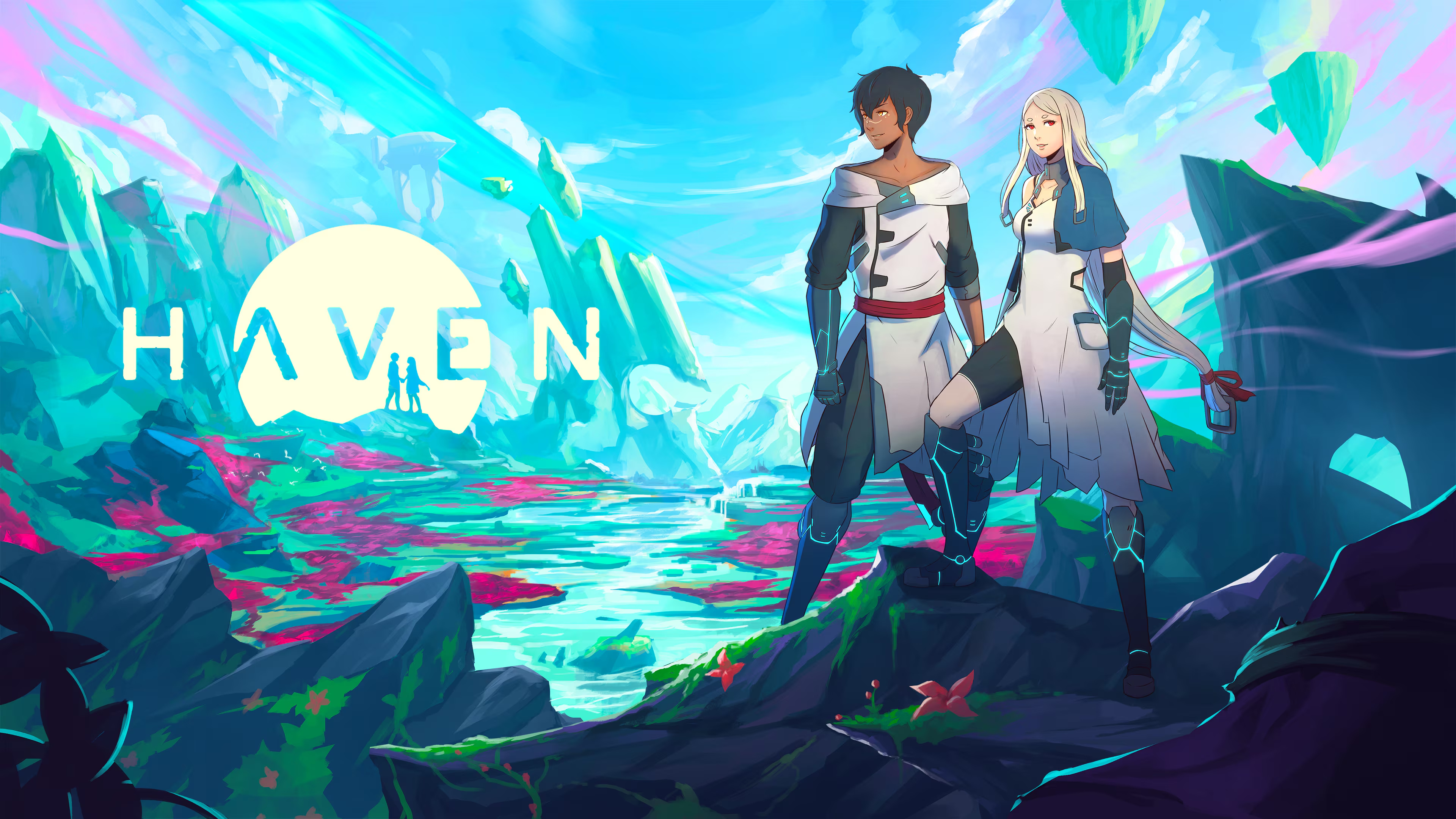
About Haven
Yu and Kay flee the Apiary’s system of arranged pairings and make a home on Source, a fractured planet whose unstable terrain and spreading Rust turn survival into a shared routine. Glide between islets, gather supplies, repair their ship, face hostile wildlife, and build a life together through cooking, rest, conversation, and optional local co-op.
Haven begins after Yu and Kay have already chosen one another. They leave the Apiary, a society that assigns partners through the Matchmaker, and escape to Source, a planet far from the life and expectations they abandoned. Their flight does not end the problem: their ship is damaged, Source is broken into suspended landmasses, and the pair must learn whether this place can become a home. Yu is the hot-headed mechanic and Kay the cautious biologist, but the story does not treat their differences as a courtship puzzle. They are an established couple whose affection, disagreements, habits and shared decisions are part of ordinary life. As they investigate their surroundings and discuss what they left behind, the game gradually adds context to their escape and to Source itself. Its central activity is not choosing a romantic partner; it is guiding two people who already love each other as they make a precarious life together.
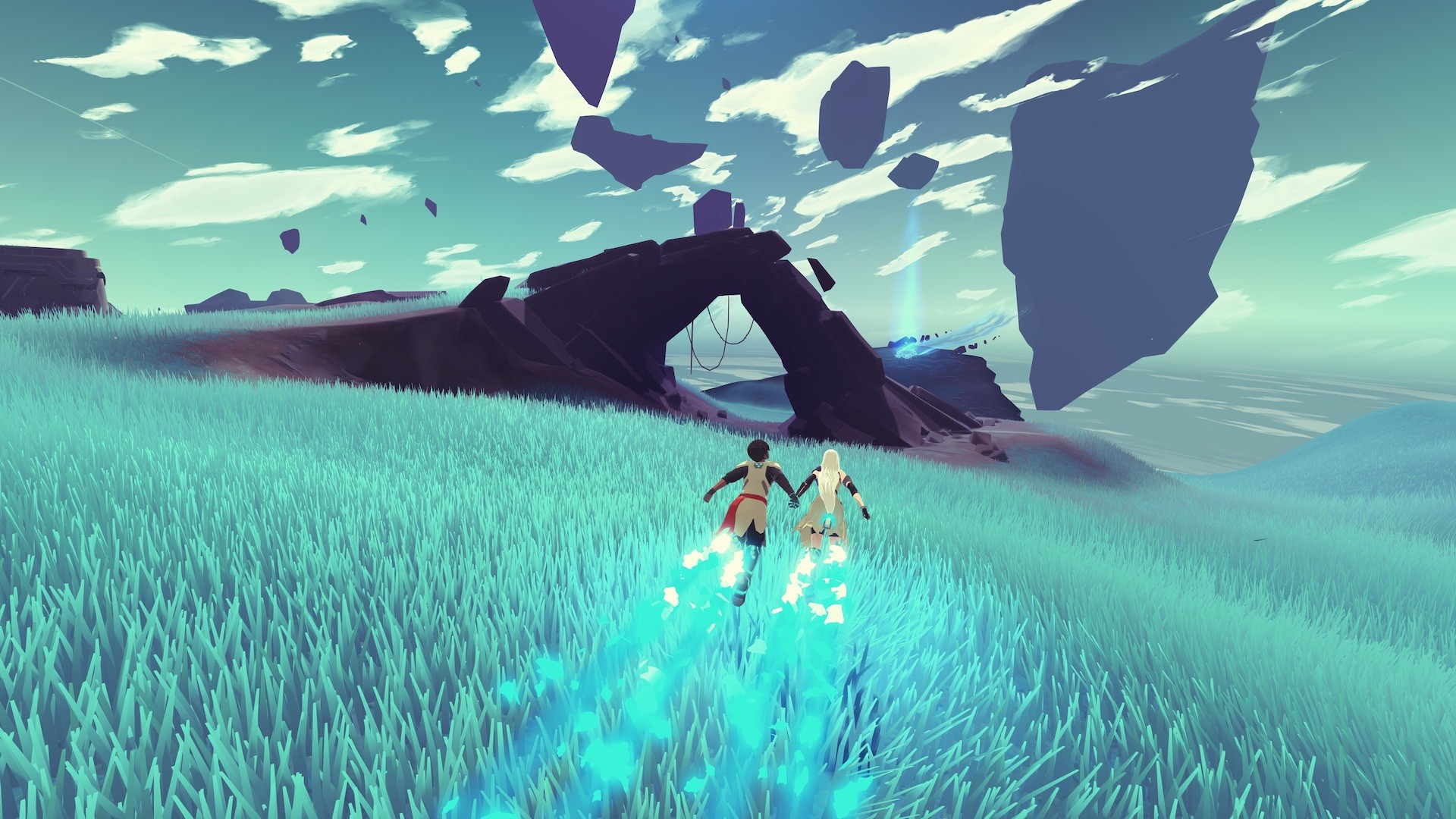
Source is explored as a chain of islets and larger regions joined by natural Flow bridges. The terrain includes grassy slopes, broken cliffs, old structures and patches of crimson Rust, with paths that are sometimes visible from a distance and sometimes revealed as Yu and Kay move. The pair search for materials needed to restore their ship and for ingredients to take back to it, while clearing contamination and checking places that the main route passes by. A map and the landscape help orient travel, but reaching a destination can require following narrow airborne Flow threads or looping around a landform. The map provides a way to check position and access to the next area, while the changing color of cleared ground gives a record of where Rust has been removed. Rather than treating every islet as an isolated level, the game links exploration to the couple’s practical goal of making the Nest, their damaged vessel, habitable again. The player alternates between going somewhere for a practical need and lingering to see what a detour contains. That rhythm makes collecting and clearing part of the journey, alongside the gradual restoration of their home.
Gliding is the main way to cover ground. Yu and Kay launch from the surface in their flow boots, skim above grass and rock, and steer along currents that connect distant points. Blue Flow threads act as aerial paths: following one can carry the pair across gaps, recharge their stored Flow and sometimes lift them to an otherwise unreachable ledge. The controls allow drifting to manage turns and tighter approaches, so staying on a thread involves steering rather than simply holding forward. The same energy also matters after landing. Flow gathered from the environment is spent to clear Rust, meaning that the resource used to travel and reach raised places also helps restore the land. In some places, Flow can be converted into a short burst that stuns an enemy or used to open a door, linking the energy system to both escape and discovery. Rust is both a visible obstruction and a source of hostility: it marks damaged ground and is associated with the creatures that attack the pair. As the player moves through an island, the choice to follow a route, collect nearby materials or spend Flow cleaning an area makes traversal part of the recovery process.
Encounters with Source’s wildlife use both protagonists at once, whether one person is playing or two are sharing control. In real-time battles, the player chooses actions for Yu and Kay and pays attention to timing and coordination. Impact and Blast provide different kinds of attack, Shield protects a character and their partner, and Pacify is used to end a fight after an enemy has been weakened. Matching the same attack between the pair can produce a stronger combined move; using one character to guard while the other attacks is another way to keep them working together. The goal is to subdue rather than kill the creatures. Battles can be postponed by using a Flow burst to stun an opponent, which makes the energy gathered during exploration useful in a tense encounter as well. If both characters are overwhelmed, they return to the Nest rather than losing collected progress. The combat has a small set of shared actions, but it continually reinforces the game’s two-character structure: survival depends on selecting complementary moves and finding a moment when both can act together.
Gathering feeds several connected forms of progression. Plants and other ingredients collected outside become meals and healing supplies, while Rust can be processed into material for equipment improvements and useful items. At the Nest, the pair can prepare food, craft remedies and upgrades, and use what they have brought back to make another excursion more manageable. The ship is also the place where they recover between trips and discuss discoveries, so returning is more than a menu transition. Repairing it provides a continuing reason to explore new regions and collect the kinds of parts or resources the couple needs. As their reach expands, Flow opens access to raised areas and Rust removal changes the condition of visited ground. These systems do not form a large class-based skill tree: much of the growth is expressed through equipment, consumables and the couple’s increasing capacity to act together. The player repeatedly weighs what to gather now, what can wait, and whether to continue exploring or bring supplies home.
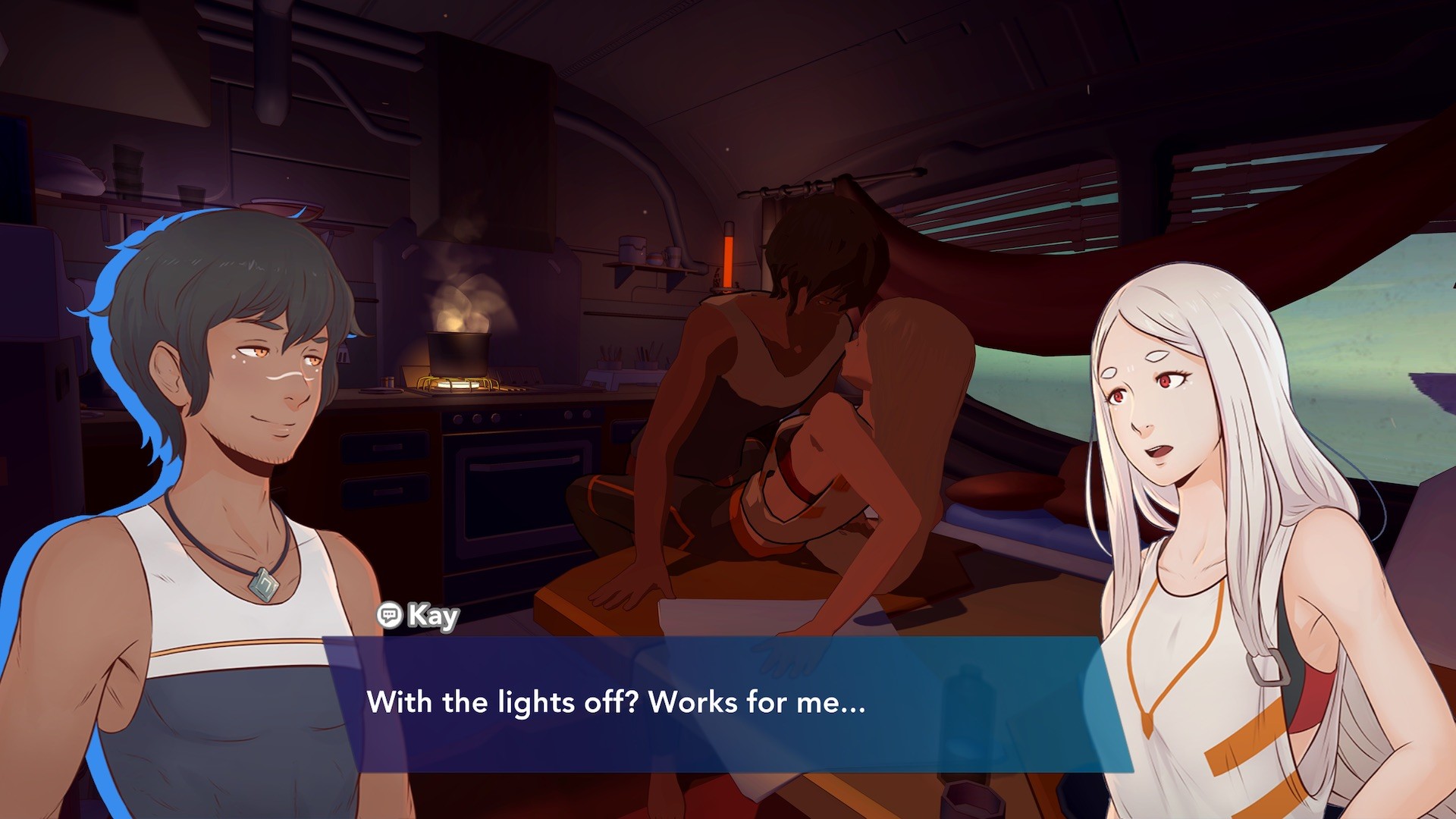
The Nest supports the smaller routines that make the expedition feel shared. Yu and Kay can cook meals from gathered ingredients, eat, rest and talk; food restores health, eases hunger and can improve the pair’s relationship. Hunger is not a separate survival campaign, but it has a practical effect on combat, where it influences how quickly their attacks charge. Rest and conversations also give the story room to unfold through jokes, disagreements, reflections and memories of the Apiary. As their bond develops, the pair can celebrate with applebrew, and relationship milestones strengthen their abilities and unlock further interactions. This makes domestic actions part of the role-playing loop: a meal is both an item prepared for the next outing and an occasion for the couple to respond to one another. The scenes on the ship supply a counterpoint to the exposed landscape, showing a home taking shape through repeated, ordinary acts rather than through a construction system. Their relationship is therefore connected to both narrative progression and practical combat growth.
Haven can be played alone, with one player directing both Yu and Kay, or in optional local co-op with a second person taking one of them. On Steam, the product supports shared or split-screen co-op and specifies that two controllers are required; the second player can join or leave during the adventure. Both characters remain central in exploration, conversations and battles, so co-op shares the same story and systems. The Steam version also reflects updates made after launch. The free 2022 Couple Update lets players choose a woman-and-man, two-women or two-men version of Yu and Kay; it preserves the story arc and gameplay, with revised character art, dialogue details and recorded performances for the alternate versions. The selected pair keeps Yu and Kay’s established identities and story, with revised presentation for each pairing. Across the Nest and Source, the intimate scale, colorful fractured landscapes and electronic score support an adventure in which travel, resource gathering, combat and domestic life all keep returning to the partnership at its centre.
- Developer
- The Game Bakers
- Genre
- Role-playing adventure with exploration and real-time paired combat