
About Half-Life
A routine shift at Black Mesa becomes a fight to survive when a failed experiment leaves the research complex under threat from hostile creatures. As research associate Gordon Freeman, move through damaged laboratories, solve practical environmental problems, and use the weapons and equipment at hand to find a way through the crisis.
Half-Life begins with Gordon Freeman arriving for work at the Black Mesa Research Facility, a sprawling research complex in the New Mexico desert. The opening tram ride carries him through laboratories, offices, industrial spaces and security checkpoints before he reaches the Anomalous Materials area. Freeman is a research associate working in that laboratory and wearing a hazardous-environment suit. During a scheduled experiment involving unusual material, something goes catastrophically wrong and hostile creatures begin taking over the facility. The story stays with Freeman's first-person view as he tries to cross a workplace that has become dangerous, fragmented and increasingly difficult to navigate.
The route out of Black Mesa is also a route through several kinds of first-person challenge. Damaged corridors, sealed doors, hazardous rooms and broken machinery require the player to read the space and work out what can be activated, moved or bypassed. Switches, lifts, ladders and machinery become part of the problem solving, while gaps, moving hazards and sudden enemy attacks make movement itself consequential. The environments communicate what has happened through alarms, wreckage, blood, surviving staff and scripted events that unfold in the same space as the player. There are chapter transitions, but the journey connects a continuous succession of locations rather than resetting the action into separate matches.
Many obstacles are framed as practical engineering problems rather than detached riddles. A route can depend on restoring a reactor or finding a way past a massive locked door, and the relevant clue is often part of the machinery and architecture around Freeman. The player alternates between checking a blocked path, testing nearby controls and dealing with threats that interrupt the investigation. This gives the facility a functional texture: equipment is there to operate, spaces have a purpose, and progress comes from understanding how those parts fit together. Some puzzles are more demanding than others, but their solutions belong to the same industrial and scientific setting as the combat.
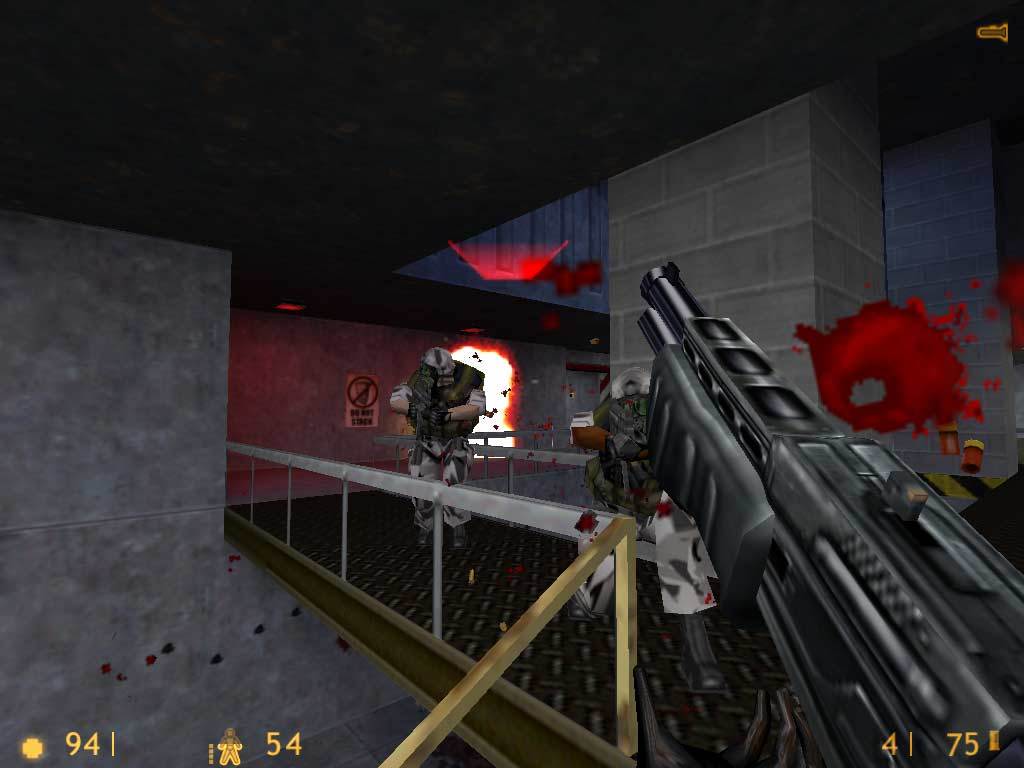
Combat grows from the same improvised escape. The crowbar gives Freeman a close-range option, while firearms and explosives provide different ways to handle creatures and armed humans. The arsenal includes pistols, a shotgun, an assault rifle, grenades, a rocket launcher and experimental weapons encountered as the route reaches research areas. Enemies do not all pressure the player in the same way: alien creatures rush or occupy difficult spaces, while human troops use firearms and can throw grenades toward cover. Choosing distance, timing and position matters because combat takes place inside tight laboratories, service tunnels and exposed outdoor sections rather than in isolated arenas.
The human opposition changes how those encounters unfold. Soldiers can answer a hiding place by throwing grenades toward it instead of simply chasing through a doorway, so cover is temporary protection rather than a guaranteed safe pocket. The wider range of weapons also asks the player to match a tool to the space: a close-range shotgun, explosive ordnance or a longer-range weapon creates different options when the next threat appears. The game supplies this arsenal through the world, including the facility's own weapons research areas, while ammunition remains a limited part of staying equipped.
Health and suit protection are managed through equipment built into the facility. Freeman's hazard suit has a charge that can be replenished at charging stations, and health can be restored at medical stations. Ammunition and weapons are placed in storage areas or found around the site, so the player has to notice and use resources rather than assume that supplies will appear whenever a firefight ends. This setup ties survival to the fiction: the suit is research equipment, and its power stations belong in work areas where hazardous materials are handled. Later areas outside the ordinary research spaces change the feel of supply, encouraging more careful use of ammunition and recovery items.
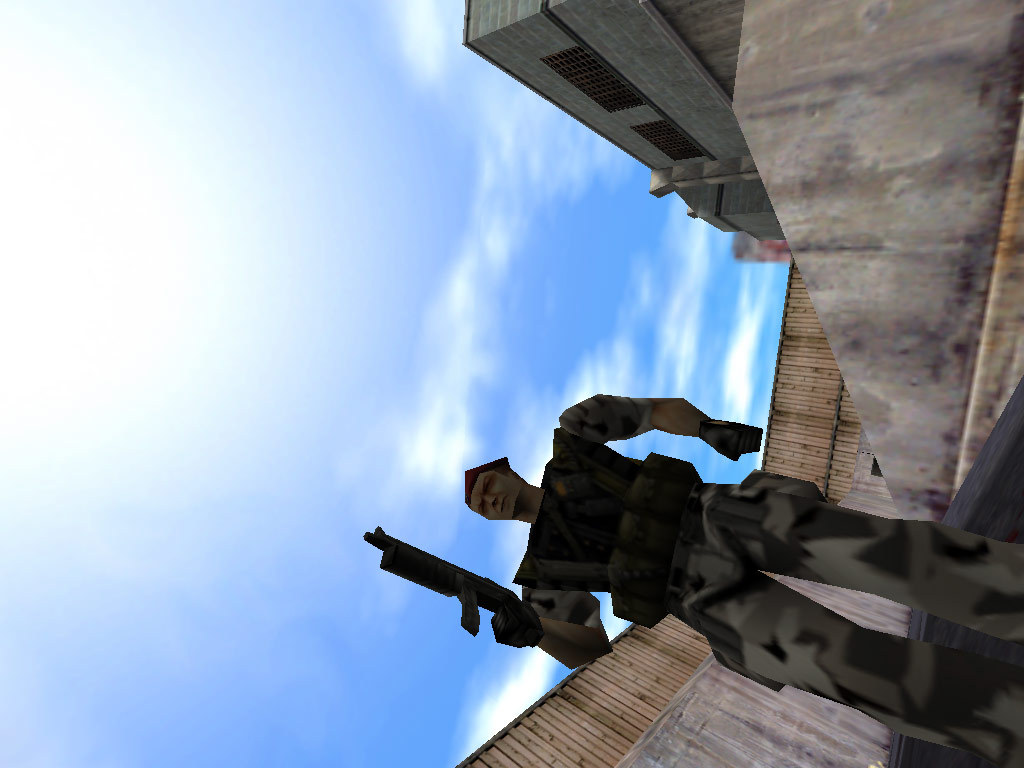
The threats also change as the escape crosses different parts of the complex. Small headcrabs and larger alien organisms make the facility feel as though it is being occupied by a living ecosystem, while human soldiers introduce a coordinated armed response. Freeman also encounters scientists and security guards who can help in practical ways: scientists may provide first aid or open locked doors, while guards can supply armed backup. They remain vulnerable during the surrounding attacks, so their presence can change how a player approaches a threatened area. Encounters are staged through what becomes visible in the environment, with sounds, enemy placement and events giving advance cues or sudden complications. The result is a story delivered through the route itself, with the player remaining in control during most of its scenes.
Beyond its single-player campaign, the Steam release also lists online player-versus-player multiplayer. The original campaign remains centered on moving through Black Mesa, handling its physical obstacles and combining weapons against changing groups of enemies. Its structure shifts between enclosed research areas, large industrial machinery, outdoor routes and unfamiliar environments, asking the player to carry forward the same basic skills while learning what each new space demands. Half-Life is Valve's original 1998 game, distinct from Black Mesa, the later Crowbar Collective reimagining that rebuilds and expands parts of the same journey.
- Developer
- Valve
- Genre
- First-person action shooter with environmental puzzle solving