
About GRIME
GRIME casts the player as the Vessel, a being with a black-hole head moving through a surreal world of living materials and hostile forms. Exploration, platforming and combat revolve around absorbing attacks and defeated creatures, consuming enemies to grow, and finding routes through an interconnected landscape.
GRIME begins with a striking premise: the player controls the Vessel, a figure whose head is a black hole, in a world assembled from bone, clay, stone and other living forms. The setting treats anatomy as architecture, with caves, deserts, settlements and creatures that seem to have grown from the same material. The Vessel crosses this interconnected landscape while encountering inhabitants, enemies and large bosses. Its story emerges through exploration and conversations rather than a conventional cast-led sequence. Different places have their own civilizations and characters, and the player uncovers secrets by moving through them. The central fantasy is physical transformation: the Vessel does not merely defeat opponents but absorbs them, carrying their influence into its own development. The world’s materials shape its visual identity and combat idea.
Combat makes absorption the central action. The Vessel attacks with weapons formed from living creatures, whose shapes and functions differ, and can switch among them as a fight changes. Its black-hole head can parry certain attacks; timing a response against an incoming strike may stagger a foe or absorb it, while absorption can destroy a weakened target. Some projectiles can be reflected, turning defense into a counterattack. Not every attack is absorbable, so enemy tells matter and the player must choose when to dodge, strike or absorb. Defense can also be offense and progression: study an enemy, time an absorb, and use its consequences to make the Vessel more capable. Bosses enlarge the same problem, asking the player to learn patterns and create openings.
Enemies contribute to growth in more than one way. Defeating them yields Mass, which can be spent at Surrogates on attributes such as health, stamina and weapon-focused stats or used for vendor purchases. Weapon attributes include strength, dexterity and resonance, so equipment requirements and scaling help determine how to distribute the resource. Players may favor a weapon whose requirements match a developing build, while a different weapon can encourage another allocation. Absorbing specific creatures also records progress toward their traits. When the required tally is reached, a trait becomes available; Hunt Points earned from particular elite or challenging creatures are spent to activate perks. This progression rewards both general combat and repeated encounters with particular prey. Choices combine attributes, weapons and passive abilities gathered through absorption.
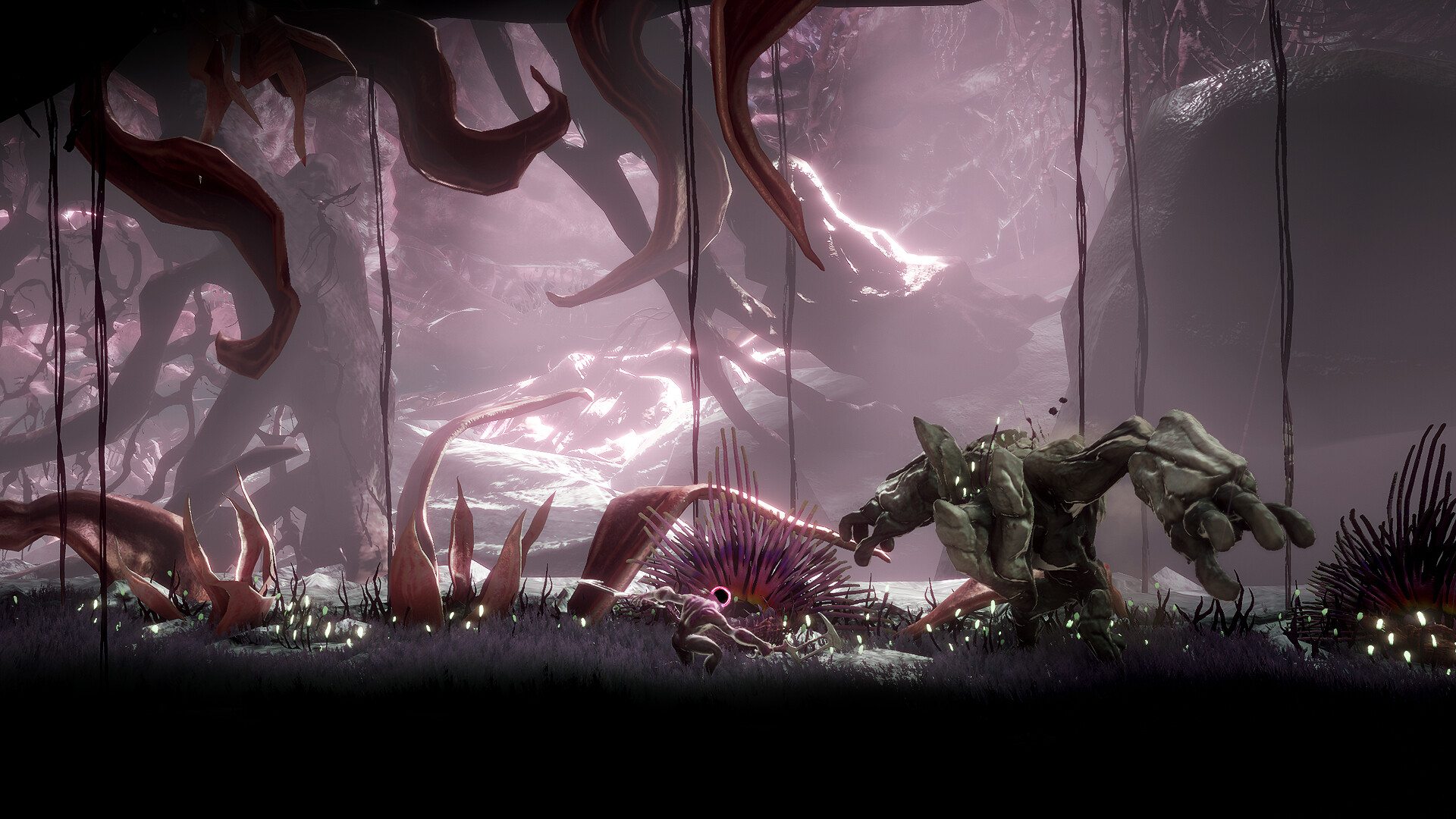
A second combat meter changes the value of maintaining momentum. After the first boss, Amalgam, the Vessel gains Ardor, a combo-like measure that increases through kills and absorbs and drops when the player takes damage. Higher Ardor increases the Mass gained from ordinary enemies, giving clean sequences a tangible reward. Taking damage interrupts that build-up, making a route through several foes an opportunity to protect a growing multiplier rather than simply clear each room. Healing uses Breaths: the player activates the available Breath resource to restore health, and it can be replenished through kills, absorbs, Surrogate interactions or certain traits. These systems make an encounter serve several purposes at once: survival, resource generation and maintenance of momentum. Players weigh immediate safety against continuing a streak.
Exploration uses a broad interconnected map with traps, secrets, shortcuts and areas that become easier to reach as the Vessel gains abilities. Movement includes jumps and platforming challenges, while defeating powerful creatures can award abilities that influence traversal as well as combat. Returning to an earlier location with a new movement option may open a ledge or passage that was out of reach. The map itself adds a navigation concern: each zone remains dark until the player finds its beacon. A marker can help remember a lead, but the player must still connect it to later discoveries. Attention to each area’s shape is useful because paths may branch, reconnect or lead toward an obstacle that needs another ability. Exploration and combat inform one another.
The Surrogate is the main checkpoint and development station, where players level attributes and restore resources. Death returns the Vessel to the last activated Surrogate; Mass is retained, while Ardor is lost, and a statue at the place of death can recover part of the lost Ardor. This changes the pressure around exploration: growth carries forward, but losing a strong combo reduces the immediate reward of continuing a run. Surrogates make routes through the world more manageable as they are discovered. Between checkpoints, the task is to assess enemy patterns, spend Breaths carefully and decide whether a detour might reveal a useful trait, item or path. Progress is measured in distance and accumulated knowledge. A daunting passage may become manageable as the player learns its rhythms and develops a suitable build.
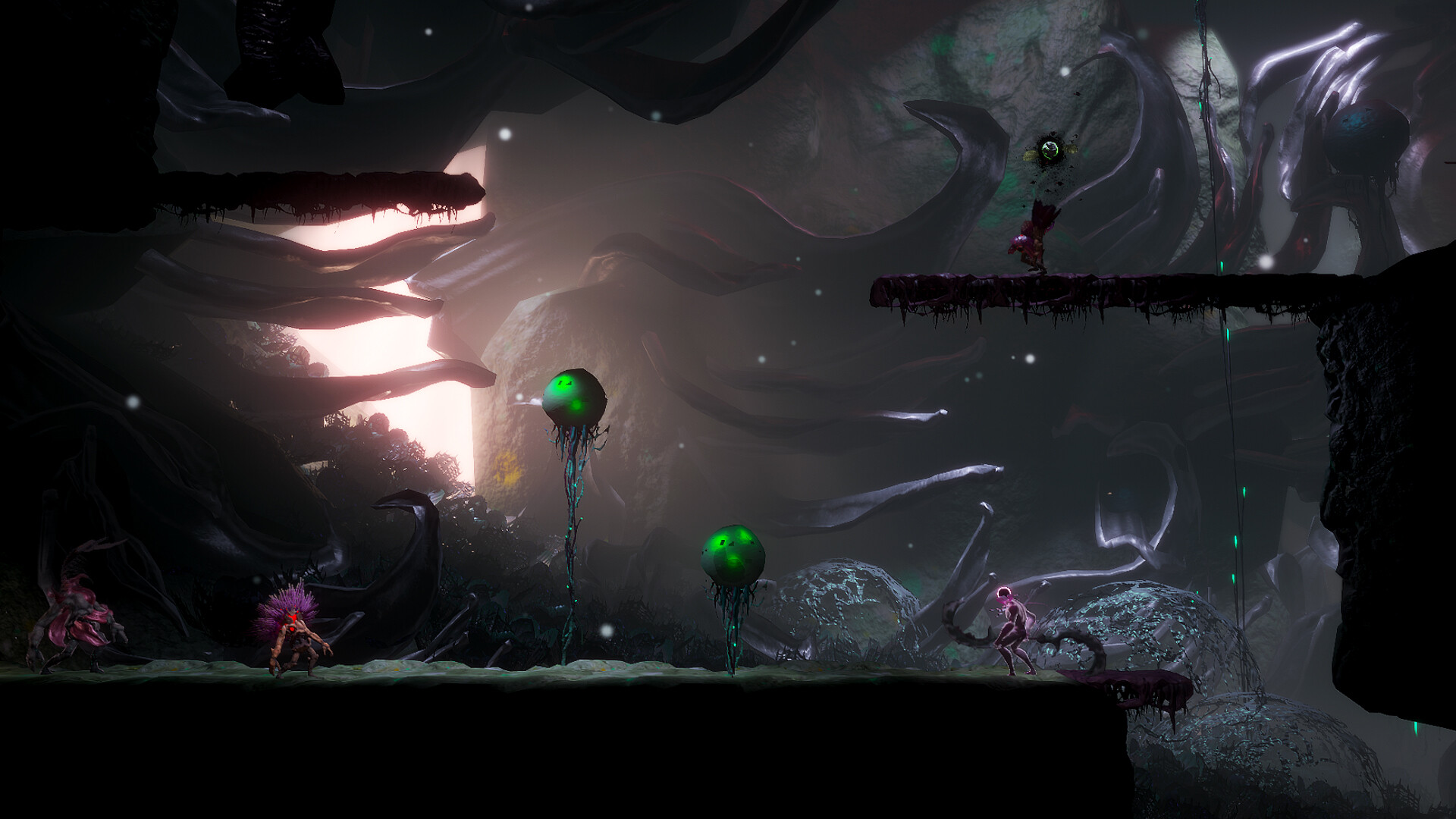
GRIME’s large bosses extend absorption to encounters that cannot be treated as ordinary fights. Players learn attack patterns, find openings and use movement to avoid damage that would break Ardor or exhaust health. Bosses can grant major abilities that reshape later traversal or combat, making victory an expansion of what the Vessel can do. Weapons, traits and attribute growth allow combinations, while armor pieces emphasize appearance rather than numerical bonuses. Post-launch updates add areas, abilities, bosses and a New Game Plus mode, but the core loop remains exploration, combat and absorption. A side passage may lead to a shortcut, vendor, beacon or creature whose absorption advances a trait. An enemy is both a threat and a source of skill progress, so players link combat decisions to the Vessel’s longer development.
- Developer
- Clover Bite
- Genre
- Action-adventure RPG; soulslike metroidvania