
About GreedFall
As diplomat De Sardet, travel to Teer Fradee to navigate the island’s rival factions and seek a possible answer to the Malichor plague. GreedFall combines questing, party relationships and real-time combat, with diplomacy, stealth, character talents and force offering different ways to handle disputes.
GreedFall begins as De Sardet, a legate and diplomat of the Congregation of Merchants, leaves the old continent for Teer Fradee, an island newly reached by foreign powers. De Sardet travels with their cousin Constantin, who has become governor of the Congregation’s settlement, New Serene. The old continent is suffering from the Malichor, a fatal plague, and the islanders have shown no signs of the illness. Finding a possible cure is one reason for the expedition, but the newcomers also seek land, resources, knowledge and influence. Teer Fradee is presented through towns, forests, coastlines and settlements where foreign communities meet native clans and the island’s unusual creatures. De Sardet’s formal position makes the player a participant in those meetings: you investigate disputes, carry messages, build working relationships and decide how the Congregation will act among groups with incompatible goals.
Six factions shape the island’s political landscape: the Congregation of Merchants, the Coin Guard, the Nauts, the Bridge Alliance, Thélème and the native clans. The Congregation is De Sardet’s own neutral trading power, while the Coin Guard supplies mercenary protection and the Nauts are the seafaring faction. The Bridge Alliance brings scientists and naturalists who want to study Teer Fradee; Thélème is a religious state seeking to spread its faith. The island’s native people are not a single centralised government: their clans have distinct leaders, priorities and responses to the settlers. These differences feed the game’s quests. A decision that helps one community can threaten another’s interests, so local conflicts sit beside the larger competition over the island and its resources.
Diplomacy is part of the quest loop rather than a separate menu. De Sardet is sent to negotiate between rival groups, hear competing accounts and pursue several objectives that may remain active at once. Conversations can present alternatives such as persuasion, bribery, calling on a companion, stealth or direct force, with available options affected by character development and party composition. The game tracks reputation with each faction and separately with companions; quests and dialogue can raise or lower those standing values. Some questlines run in parallel, and an earlier decision can change how a later encounter unfolds. That structure makes it useful to follow who requested an action, which group bears its cost and whether a companion present has a stake in the outcome.
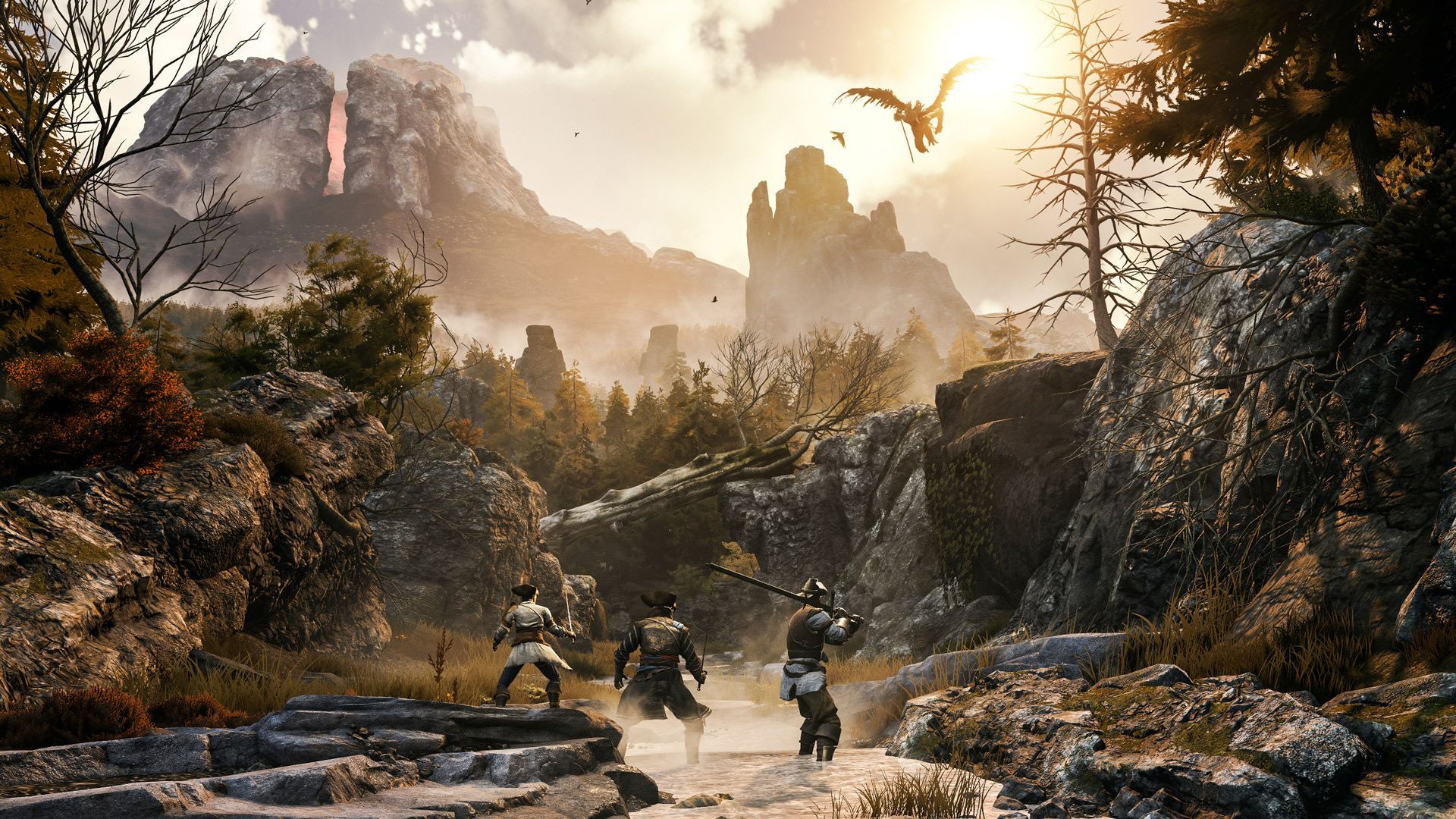
Companions connect faction politics to travel and combat. De Sardet can recruit five companions over the course of the adventure and take two at a time into the field. Each has a personal background and agenda, a relationship to one of the island’s political communities, and a defined combat role. Siora brings healing magic; Aphra supports the party with firearms and explosives; other companions contribute their own strengths and reactions. Their presence can add contextual dialogue, open a useful line in a negotiation or change how a mission is approached. Companions also comment on decisions that affect their people, so the same conversation can sound different depending on whom De Sardet brought along. Developing these relationships through their own quests matters to the party’s abilities as well as its story.
Character growth is built from skills, attributes and talents, which govern different parts of the role-playing system. Skills develop combat approaches such as blades, firearms and magic; attributes improve ability effectiveness and determine what equipment De Sardet can use. Talents support activities beyond fighting, including Charisma in dialogue, Lockpicking for secured routes, Science for alchemical preparations and Vigor for physical obstacles. These choices can alter how objectives are completed: a convincing argument may avoid a fight, a locked door may provide another route, or Science may provide ammunition, potions or an explosive option against a barrier. Gear can be tailored at crafting stations, where upgrades change both item statistics and appearance. Companion bonuses can also support particular talents, tying party relationships to exploration and conversation checks. Clothing and armour can also carry faction-associated styles, while individual pieces and fittings can be changed to adjust appearance and bonuses. That makes equipment choices relevant to more than damage and protection: the party can be dressed to reflect its route through the island’s communities while keeping the statistics suited to each companion’s role.
When negotiation does not settle a dispute, GreedFall uses real-time third-person combat with the option to pause and select abilities or items. De Sardet can use melee weapons, pistols or rifles, spells and specialised skills, with defensive timing and positioning becoming important when several enemies press the party. The player can shape a character toward a preferred weapon or combine branches to keep alternatives available, while equipment requirements and the mana pool place practical limits on those choices. Materials gathered from enemies and containers feed into crafting, which improves owned weapons and armour rather than creating a complete replacement set from scratch. Exploration therefore serves several purposes at once: following quests, finding useful equipment or crafting materials, and reaching sites tied to Teer Fradee’s history and supernatural forces.
- Developer
- Spiders
- Genre
- Action role-playing game