
About GRAVEN
An exiled priest of the Orthogonal Order awakens in a swamp with a staff, a book and a summons to confront the heresies twisting the land. GRAVEN combines first-person combat with spells, environmental puzzles and broad exploration, sending the priest through settlements and dangerous regions as he gathers tools and uncovers what is behind the spreading corruption.
GRAVEN begins with a priest of the Orthogonal Order condemned to exile after acting to defend another person. He wakes in a small boat adrift in a swamp, where a stranger brings him to shore and leaves him with a mysterious staff, a book and a direction to follow. The priest’s task is framed as a search for peace through service: relieve suffering, investigate the land’s troubles and confront the heretical sects connected to its plagues and broken seasons. The story keeps the player close to this journey rather than presenting a large party of heroes. Townsfolk, religious institutions and hostile creatures each reveal pieces of a world where faith and authority have become entangled with unnatural forces. The priest’s journal and the places he visits provide the trail forward.
The campaign opens in and around Cruxfirth, a deteriorating settlement surrounded by swamp country. Its streets, waterways and outlying districts form an explorable space where the player can talk with people, take on local tasks and find routes toward larger objectives. The full release extends beyond the first hub into Granite Watch and the Subnatural Desert, changing the landscape and the kinds of threats encountered as the investigation continues. These regions are open-ended rather than a sequence of isolated arenas, so progress can involve following a side path, locating a key, returning to a landmark or finding a connection into another area. That structure gives the world a practical rhythm: exploration reveals both the next objective and the supplies or equipment that make the journey safer.
The priest fights with a mix of close-range weapons, projectiles and spells. His starting staff can strike enemies and later gains crystals that alter its effect; a Kinetic Stone, for example, strengthens its knockback. The Cuff Arrow is a hand-mounted, fully automatic crossbow, while weapons such as the Shortsword and Fletchant broaden the options for different encounters. The player discovers these tools while moving through the world rather than selecting a fixed class at the outset. Combat takes place among hazards, destructible objects and groups of enemies, which makes the surroundings relevant to each fight. Breaking barrels or containers can uncover health, mana or gold, and destroying corpse piles can prevent undead cultists from emerging. The best route through a hostile area may therefore include inspecting the space before charging ahead.
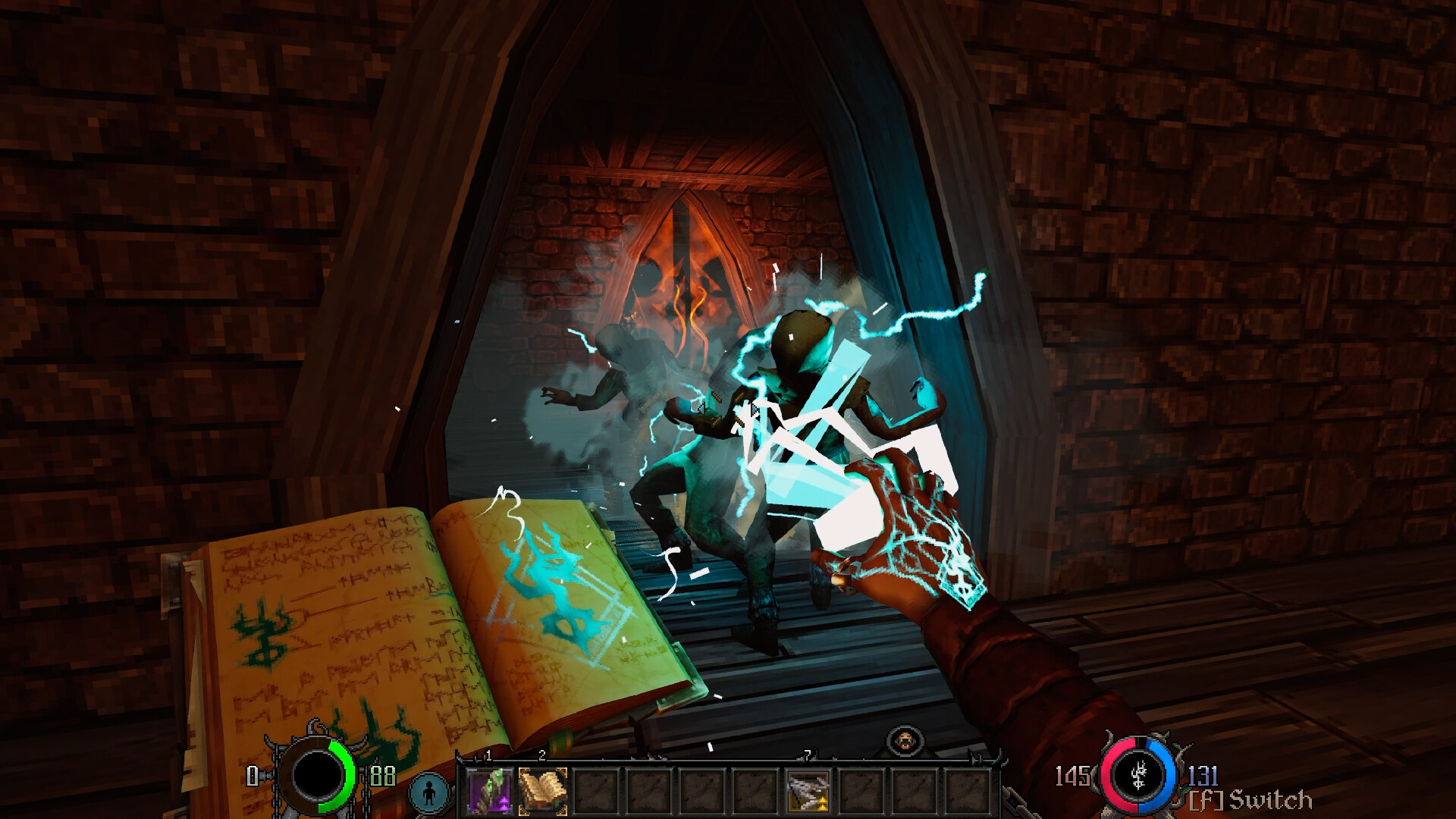
Magic also works as a way to change the environment. Inflame, a fire spell found early in the campaign, burns wooden barriers and cobwebs and can ignite red barrels. Discharge sends electricity into marked mechanisms, can stun targets and can electrify water. These powers let the player solve obstacles with the same tools used in combat: a blocked passage may need to be burned open, while a runic device or environmental mechanism responds to a charged spell. The spellbook lets the priest carry and switch between learned abilities, and separate red and blue mana pickups replenish the corresponding spell resource. Because the spells have both practical and offensive uses, using one now can affect what remains available for the next encounter or puzzle.
Exploration connects to a steady cycle of finding equipment and improving it. Gold scattered through the world can be spent with the blacksmith and alchemist in Cruxfirth. The blacksmith sells weapon upgrades, such as improved aim for the Cuff Arrow or a stronger parry for the Shortsword, and can provide armour for additional protection. The alchemist enhances spells and offers consumable potions. Orthogonal Shrines provide a permanent increase to the priest’s mana, giving shrine discovery a lasting effect on how often he can cast. These services make the settlement more than a point on the map: returning with coin or new needs gives the player a reason to revisit its merchants as the arsenal grows. Resources found on side routes can feed that progression directly.
Puzzles ask the player to interpret the machinery and landmarks in each area. The Sunken Lighthouse sequence, for instance, involves finding fuel canisters, learning Discharge through a mechanism involving gargoyle statues, and using the spell on a runic device. Elsewhere, written clues and turnable blocks point toward a symbol arrangement, while keys and locked gates establish the route into new spaces. The journal, conversations and environmental details help orient the player, but the solution often depends on looking carefully at the surrounding room. Some secrets sit on ledges or inside destructible objects; others reward returning after learning a new ability. The world’s puzzle logic consequently overlaps with exploration and combat, making a new spell or weapon useful beyond its immediate damage value.
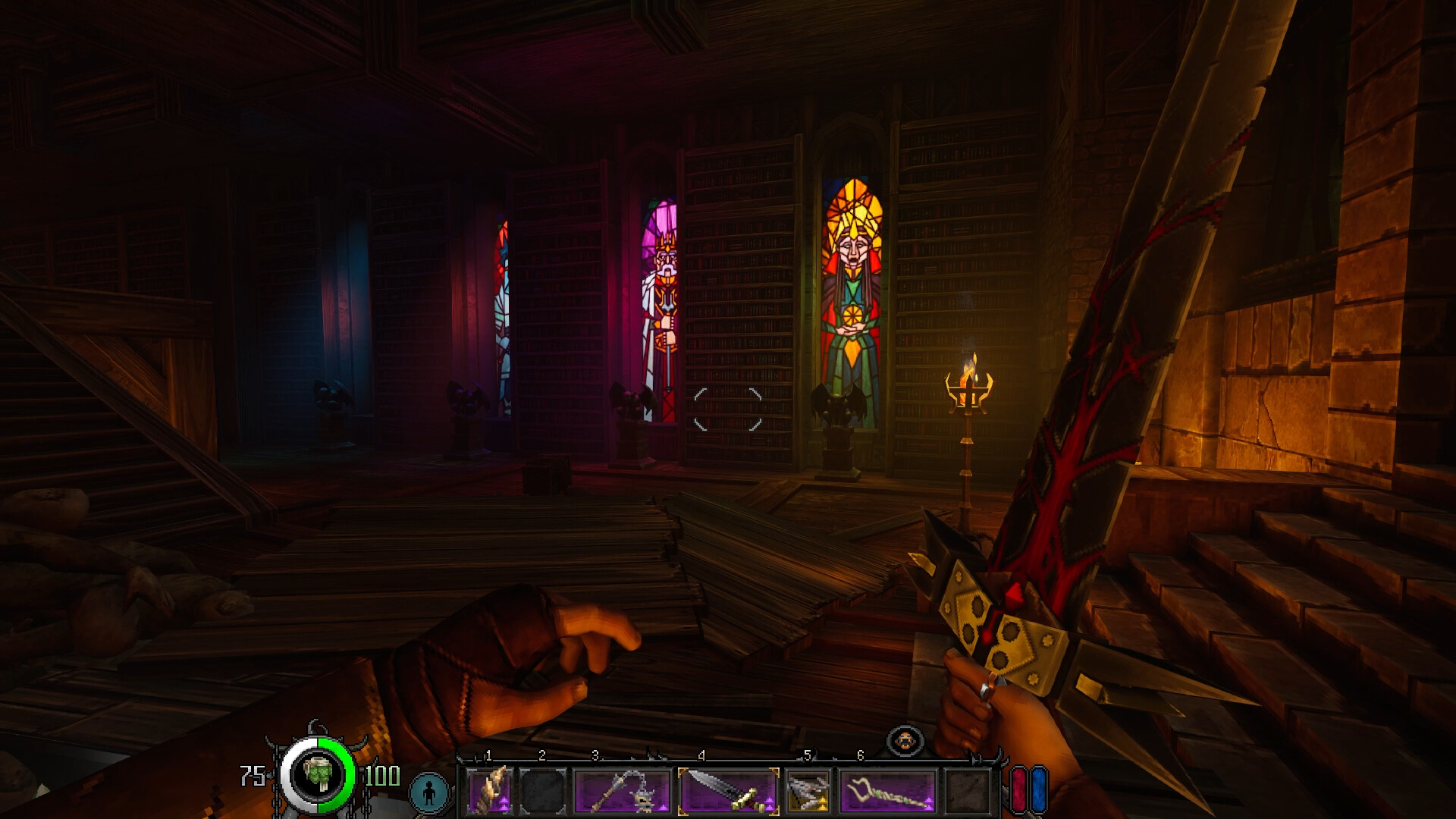
The full release supports online cooperative play for up to eight players, allowing a group to travel through the same broad campaign and face its enemies together. Solo play remains a complete way to follow the priest’s story and learn how its spells, weapons and puzzles fit together. Across both modes, the central activity stays grounded in moving through connected regions, gathering supplies, taking quests, fighting creatures and understanding how the landscape has been altered. The three principal zones add different environments to the investigation, while side routes and hidden objects reward slower searches between major objectives. As the priest’s collection expands, previously visited spaces can offer new possibilities. The campaign’s progression is therefore both outward, into new biomes, and inward, as familiar tools gain upgrades and older places reveal further routes.
- Developer
- Slipgate Ironworks
- Genre
- First-person action-adventure with exploration, puzzles and role-playing elements