
About Gothic 1 Classic
Gothic follows a prisoner cast into Khorinis’s magical Barrier, where rival camps control the ore mines and plan different futures for the Colony. The player explores settlements and wilderness, takes missions, trains combat or magic, trades supplies and builds standing among prisoners while seeking a way beyond the Barrier.
Gothic begins during a war in Myrtana, where the kingdom needs magical ore from the island of Khorinis to forge weapons. Prisoners sent to mine it are enclosed by a magical Barrier that prevents anyone inside from leaving. The convicts overthrow the guards and divide into rival camps, while the king still needs the ore badly enough to bargain with the people who now control the mine. The player character is a prisoner thrown into this unstable Colony with a message intended for the mages. Survival depends on finding people willing to help, learning how the camp hierarchy works, and deciding where to seek protection. The open territory connects settlements, wilderness and mines, but the Barrier keeps this whole society cut off from the outside. Early errands and conversations introduce its competing needs: food, weapons, ore, influence and a possible way beyond the walls.
The Old Camp is the most established settlement, built in and around the former castle and led by Gomez. Its Ore Barons trade mined ore for supplies from the king, and the camp’s guards, Shadows, diggers and mages occupy distinct positions in its hierarchy. The New Camp is organised around a different plan: Lares leads people who refuse to keep sending ore to the king, while mercenaries protect the settlement and Water Mages study the Barrier and the free mine. Outside the camps, the Brotherhood gathers in the swamp under Y’Berion and follows the Sleeper, whose promised guidance shapes its rituals and magic. Each camp has its own authority, work and expectations. The player’s standing determines which people will deal with them and what paths open, so understanding who controls a gate, mine or resource matters as much as reaching it.
Moving between camps is a cycle of exploration, conversation and practical errands. People follow daily routines, sleep at night and react if someone draws a weapon, enters private huts or takes belongings. A conversation can establish a task, reveal a contact or make a request possible; completing missions and defeating creatures provide experience. Trading happens through dialogue and a shared item interface, where the player balances the value of offered goods against what a merchant has. Ore functions as the Colony’s important trade resource, while food and potions restore health or mana. This makes scavenged equipment and provisions useful for more than filling an inventory: they can support a journey, become trade goods or help maintain the character between fights. Camps also give the player places to find trainers and learn more about the people who work, guard and govern there.
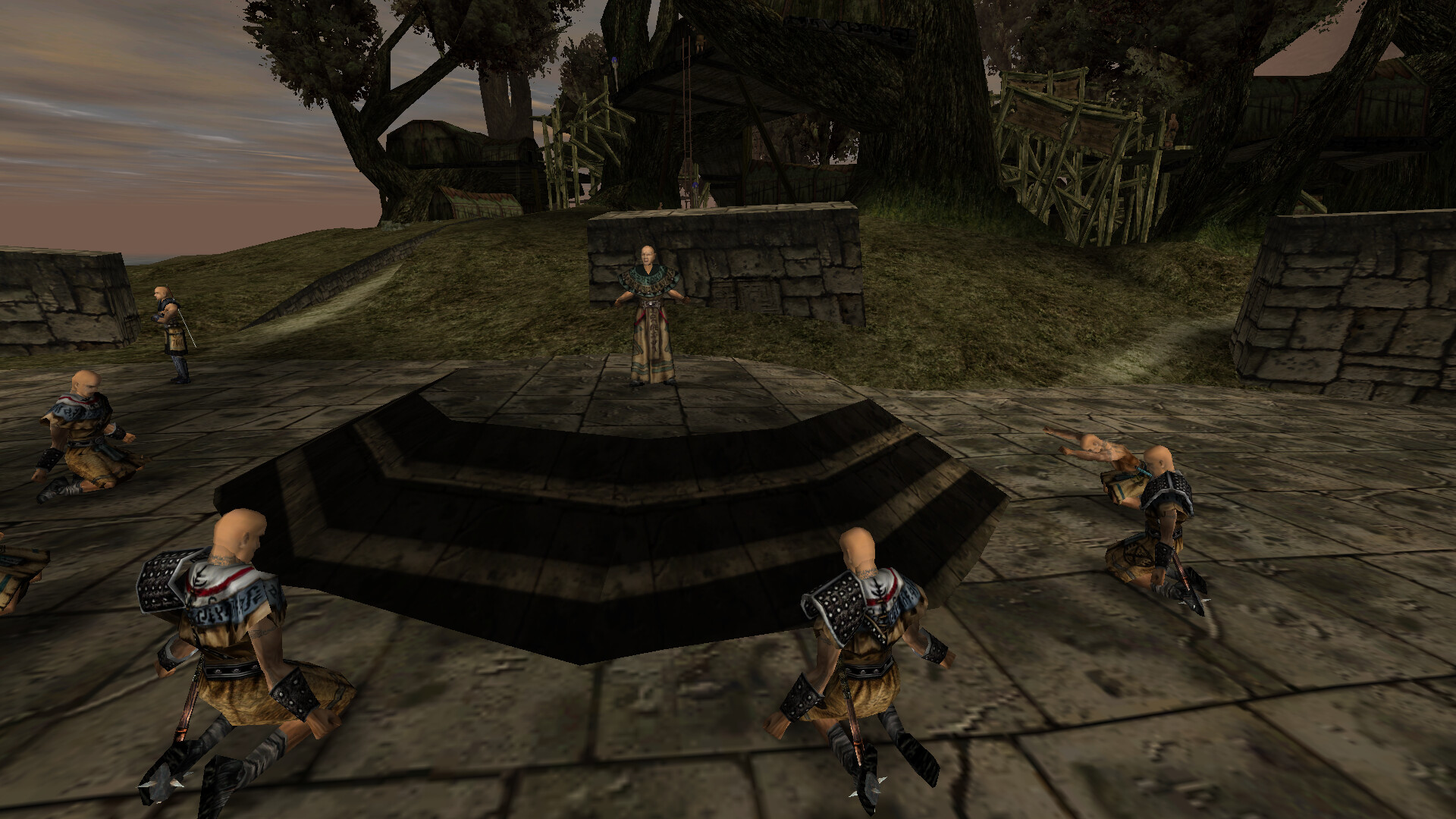
Combat uses distinct close-range and ranged modes, with the player selecting a target and timing attacks, blocks and weapon combinations. Learning a weapon talent from a trainer changes what the character can do: without the relevant instruction a sword can still be swung, but trained ranks enable more effective combinations. One-handed weapons, heavier two-handed weapons, bows and crossbows draw on different attributes and training; strength improves melee damage and the weapons a character can handle, while dexterity supports ranged aim and equipment. Experience from quests and defeated opponents raises the character’s level, granting learning points that can be spent with trainers to improve skills or attributes. The loop therefore links exploration to combat readiness: tasks and discoveries develop the character, while training affects whether later encounters can be approached directly or require another route. Enemy groups, distances and the choice to engage all matter because a low-level prisoner has limited health and options.
Magic is organised around six circles of increasing difficulty, and learning the appropriate circle allows a mage to use its runes. Scrolls provide one-use casting and can be used without first learning a circle, while runes can be used repeatedly when the character has enough mana and the required training. The camps give magic its setting: the Old Camp has Fire Mages, the New Camp is allied with Water Mages, and the Brotherhood’s spellcasters use magic associated with the Sleeper. Spell effects range from direct attacks to control over opponents, movement or transformation; some become stronger when more mana is invested. This creates a different relationship between preparation and action from weapon fighting, since a spell may need a particular rune, sufficient mana or a consumable scroll. The player’s teachers and camp position shape which magical studies become available.
Travel through the Colony also rewards attention to ordinary objects and skills. Locked chests can be tested with lockpicks by working through a left-right sequence; lockpicking training reduces the risk of breaking a pick, while some locks require a key. Sneaking lets the character approach people or enter huts without being seen, and pickpocketing depends on that ability and its own training. Food, potions, rings and talismans each have specific uses: some restore health or mana, while equipped jewellery can improve talents within limits on how many pieces can be worn. Creatures occupy different surroundings and behave in ways that affect an encounter: wolves move in packs, while bloodflies gather around water and are often encountered in groups. These connected systems make the player’s route through camps, caves and wilderness a steady process of gathering information, supplies and capability.
- Developer
- Piranha Bytes
- Genre
- Action, RPG