
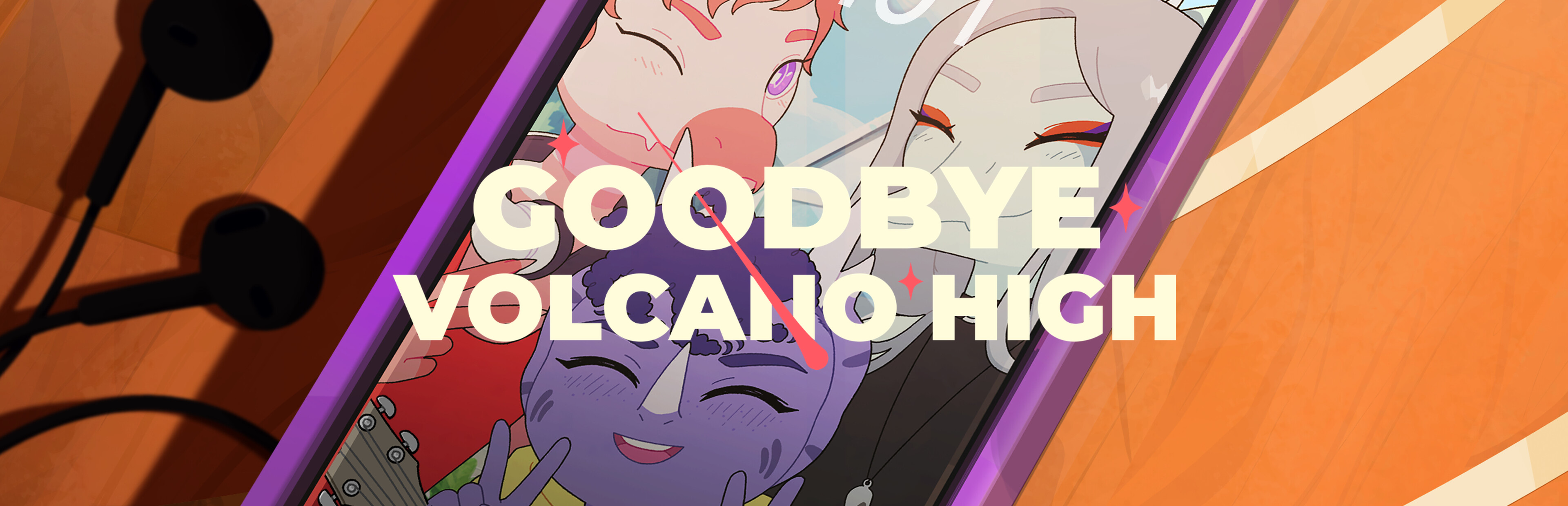
About Goodbye Volcano High
During Fang’s final year at Volcano High, an approaching asteroid hangs over school, family, and the future of their band, Worm Drama. Choose how Fang responds to friends, shape relationship affinities, write and perform songs, and take part in short activities that reveal the students’ thoughts and routines.
Volcano High’s senior year would normally be a time to decide what comes after graduation. For Fang, a non-binary pterosaur, those plans sit beneath an approaching asteroid and the possibility that the future may be cut short. Fang wants to make music with Worm Drama, the band they share with Trish and Reed, and the group has ambitions tied to a Battle of the Bands and a local festival. Those hopes exist beside the more immediate work of school, family, and friendship. The story follows Fang and the people around them as they try to understand what they want and how to treat one another during a crisis. The dinosaur cast and animated high-school setting give those questions a distinct visual world, while the conversations focus on familiar pressures: expectations, identity, affection, and the fear of losing time. The asteroid is not simply a distant plot device. Its presence changes how the characters think about their plans and relationships, even when a scene is about a song, a family tension, or a difficult thing left unsaid. Fang’s final year provides the structure for a cast-driven story where private choices happen alongside a public catastrophe.
Dialogue choices are the most frequent way the player takes part. The player selects how Fang responds in conversations with friends, family, classmates, and people they care about. The choice bubbles can show something of Fang’s internal reaction, so a selection communicates an attitude as well as the words spoken. The player may decide whether Fang is open, guarded, confident, anxious, or willing to challenge another person. Some difficult responses involve holding or combining buttons, connecting the act of choosing with Fang’s hesitation or effort. The effect is personal and relational: a response shapes the tone of a scene and contributes to affinity with the person involved. This makes the interface a view into Fang’s point of view, not a neutral menu of plot commands. Conversations often carry information about the group’s goals, but they also show how Fang interprets those goals and what they are ready to reveal. The player can pay attention to the emotional cues in the choices and decide whether Fang should follow that feeling or push against it. Dialogue remains the main route through the narrative, and these decisions give the player a way to characterize Fang through repeated interactions rather than through combat or equipment choices.
Relationships form the game’s progression system. Fang’s choices and actions build affinity with different characters, and those relative bonds affect which extra moments appear. The rewards can include additional scenes, photographs, flashbacks, or changes to scenes already on the story path. A relationship view helps show where Fang stands with the people around them. Since attention to one character can come at the expense of rewards connected to another, the player’s choices shape which parts of the ensemble receive more detail. This is an authored journey with one ending, according to KO_OP; affinity changes portions of the experience and the character moments along the way. It does not divide the game into wholly separate campaigns. Instead, the player sees a version of Fang’s final year that reflects who they spent time with and how they responded. That structure gives replay decisions a clear focus: returning can reveal material tied to another relationship, while a first route naturally leaves some scenes unseen. The system treats closeness as a narrative resource rather than a score for purchasing upgrades. It also lets the game keep one central destination while making the conversations and surrounding details respond to the player’s priorities.
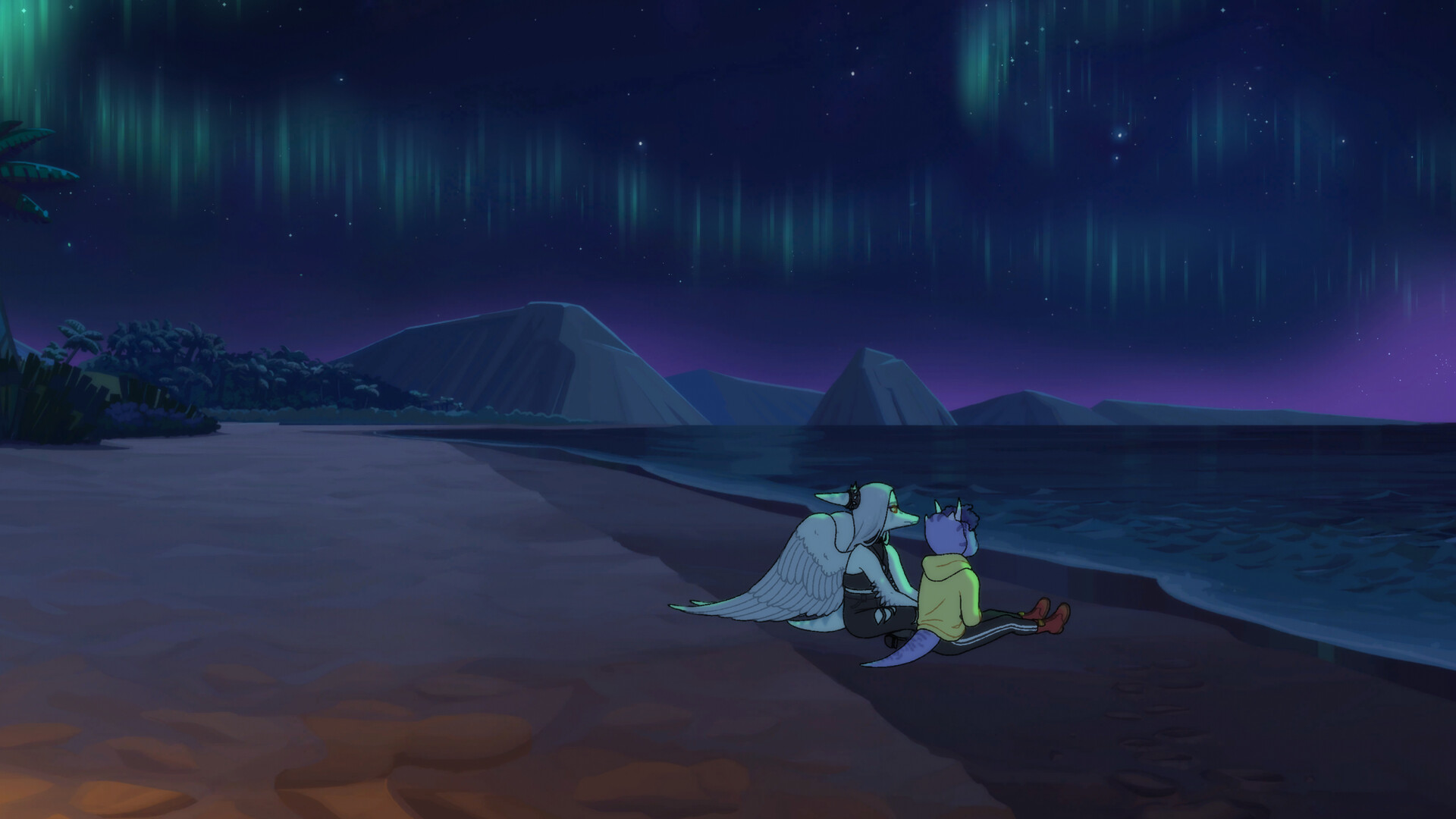
Worm Drama’s music gives Fang’s ambition a playable form. At performance points, the player joins rhythm sequences built around the band’s songs, using timing and input patterns to participate in the performance. The rhythm design is described by KO_OP as accessible and experiential, with the goal of drawing the player into Fang’s musical focus without making a specialist challenge the center of the scene. The game also lets the player choose some lyrics, making songwriting another way to express what Fang hopes to say. Performances appear at particular moments in the story and connect to Fang’s feelings and plans, so they continue the narrative rather than interrupt it with an unrelated arcade mode. Music links personal expression with the band’s shared goal. Fang’s songs are part of how they make sense of their life, and the player contributes to both the words and the act of performing them. Trish and Reed’s roles in Worm Drama keep the creative ambition connected to friendship as well as individual identity. A performance can therefore carry two layers at once: the timed interaction asks the player to follow the song, while the lyrics and context reveal what Fang is trying to put into it.
Short activities and scene interactions broaden the school day beyond dialogue and full performances. At certain moments, the player can look around at people and read Fang’s thoughts about them, or browse social media posts that help establish the students’ shared world. Other one-off activities put the player inside a specific feeling or social situation. KO_OP has described examples such as doom-scrolling when things feel difficult and playing music for friends while hoping they respond well. These scenes are brief and tied to the moment; they are not a free-roaming campus map or a separate side-quest system. Their purpose is to let the player take part in the way Fang experiences an ordinary day under extraordinary pressure. Looking at someone can expose the difference between what Fang thinks and what they say aloud. A social post can add context without turning into a new objective. A small activity can make anxiety, distraction, or the wish to connect something the player performs rather than only reads about. This variety helps the story shift its pace between long conversations, relationship decisions, and musical sequences. It also lets the player observe the gap between public posts and Fang’s more private reactions without turning either into a separate progression track. It also gives the ensemble room to appear through everyday habits, not only through scenes about the asteroid or the band’s future.
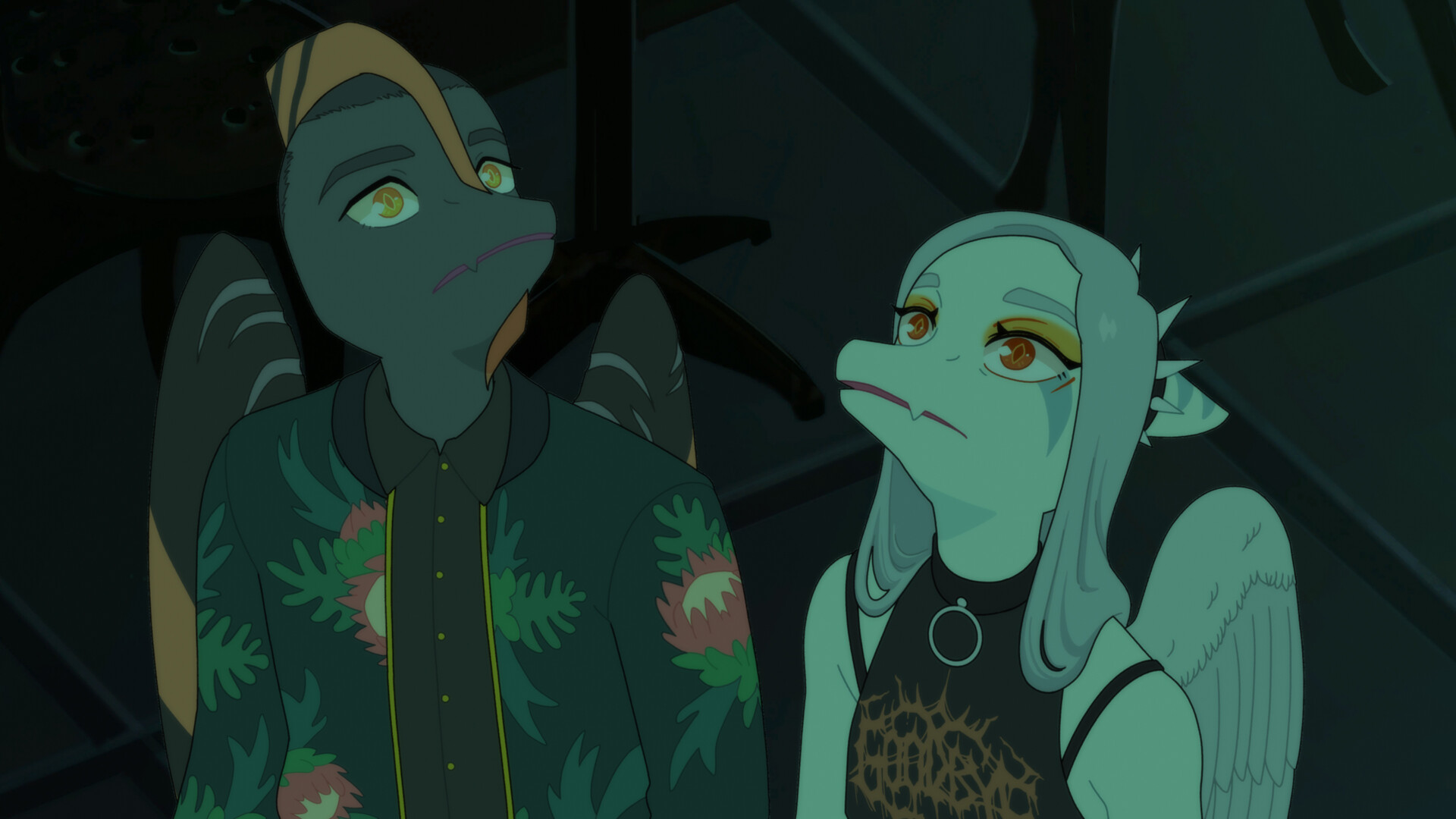
The presentation is built around hand-drawn art, painted backgrounds, character animation, voice acting, and original music. Scene-based framing keeps attention on faces, gestures, and dialogue, while the dinosaur students give Volcano High a recognizable ensemble. The game’s movement is cinematic and scene-based; it does not use free-roaming traversal, combat encounters, or a conventional level progression. Its playable systems all point back to Fang’s inner life: choosing a response, building affinity, contributing lyrics, performing songs, or taking part in a short experience. The story’s focus on relationships and a looming catastrophe also shapes its tone. School plans remain present, but they are continually reconsidered in light of limited time and changing priorities. This profile covers the standalone Steam PC game, App ID 1310330. Steam lists KO_OP as developer and publisher, identifies the product as single-player, and categorizes it as Adventure and Indie. A separate Steam bundle includes the soundtrack with the base game. The title is also available for PlayStation 4 and PlayStation 5; this profile describes the Steam release without claiming that platform-specific controls differ. Its one-ending structure and relationship-based extra scenes explain how player choice matters: the player shapes the route’s details and Fang’s connections while following the central journey.
- Developer
- KO_OP
- Genre
- Cinematic narrative adventure / rhythm game; Steam genres Adventure and Indie