
About Ghostrunner
In a cyberpunk future where humanity survives inside the immense Dharma Tower, a blade-wielding Ghostrunner climbs through its divided districts to confront Mara, the Keymaster. First-person parkour, one-hit combat and specialized abilities turn each room into a route-and-timing problem, while the Cybervoid reveals more of the tower’s digital architecture.
Ghostrunner begins in a world already reshaped by catastrophe, where the immense Dharma Tower has become humanity’s last shelter. The tower is also a vertical city divided by unequal access to resources and power. Mara, known as the Keymaster, rules it through violence, while scarcity and disorder shape the lives of people below her. The player controls a Ghostrunner, a highly advanced blade fighter who awakens with a mission to climb from the lower reaches toward the top and confront Mara. The Architect, a digital intelligence, guides the ascent and connects the tower’s physical crisis to the protagonist’s own past. The story stays focused on this climb rather than opening into a broad map of the surrounding world.
Movement is the means of reaching both routes and targets. From a first-person view, the Ghostrunner can sprint, jump, slide beneath hazards, run along walls, dash through the air and use the Gapjammer grappling hook to pull toward designated points. These actions fit together across gaps and vertical surfaces, so a path through a combat space often depends on maintaining momentum while changing direction. A jump can lead into a wall run, a grapple can carry the player to a new platform, and a dash can alter the approach to an armed opponent. Levels ask the player to read the geometry as part of the action rather than treating traversal as a pause between fights.
Combat follows a strict one-hit rule: a single successful strike can defeat an enemy, and a single hit can end the Ghostrunner’s attempt. That creates short encounters in which positioning and timing matter more than absorbing damage. Firearms make exposed movement dangerous, so the player must use walls, slides, jumps and mid-air dashes to close distance or evade shots. The katana is the central weapon, and the game also allows its blade to deflect incoming bullets when the timing and angle are right. Enemies have different strengths and weaknesses, meaning the safest route through a room depends on which threats can attack from a distance, block a direct approach or force a change in height.
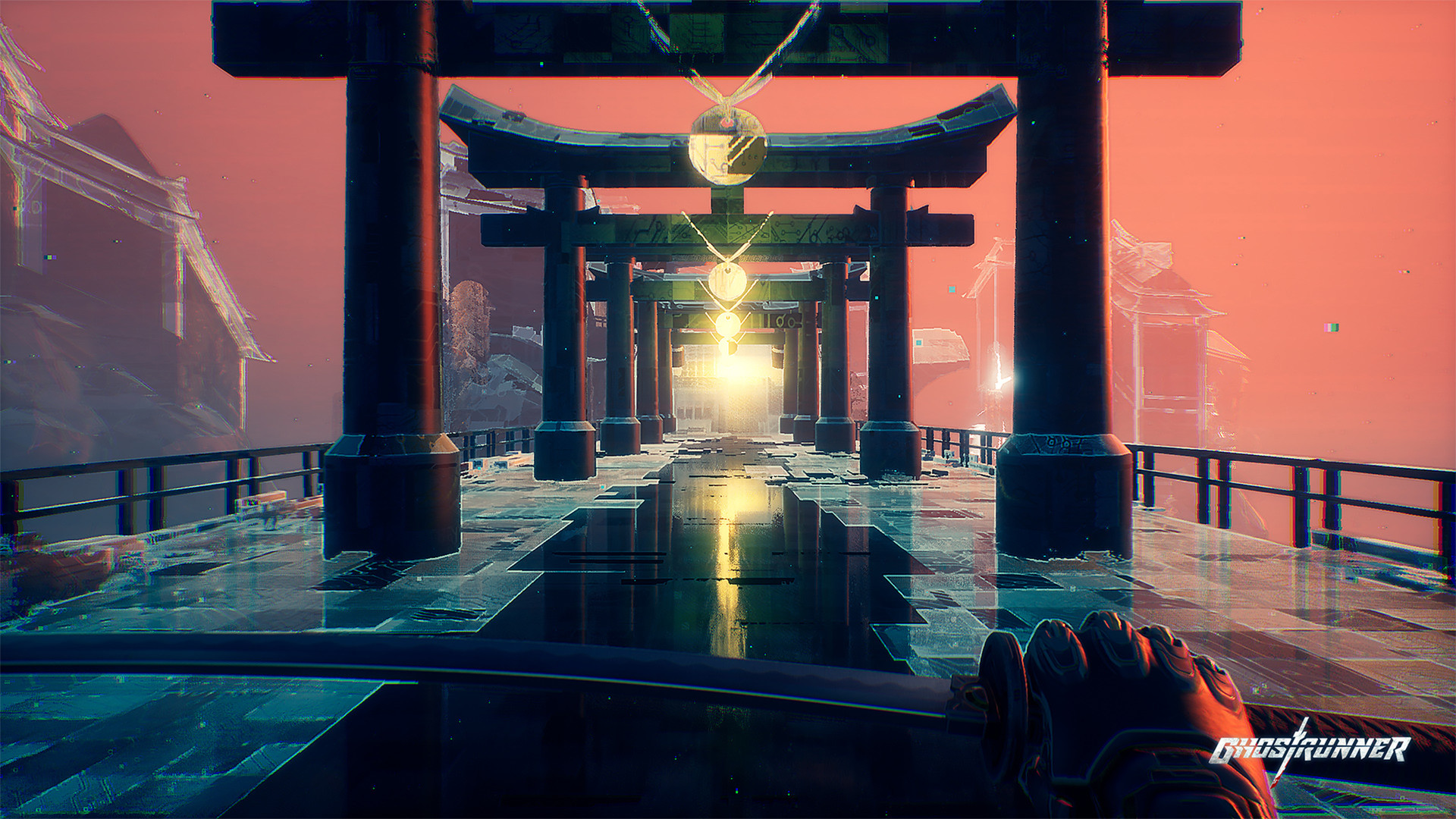
Special techniques expand the routes available in combat and traversal. The Gapjammer supplies a grapple point, while entering the Cybervoid unlocks abilities such as Tempest, a short-range concussive blast, and Surge, a horizontal projectile that can pass through a line of enemies. These tools can clear immediate threats, but their placement also asks the player to consider where a blast or beam will reach. The game presents these techniques as part of learning how the Ghostrunner can move through the tower, not as a separate menu of attacks detached from level design. Their uses vary according to the space, the enemy positions and the route that remains open afterward.
The campaign alternates between fighting, platforming and obstacle solving, with each level adding concrete features that change how the player crosses a room. Rails can be used to glide across a gap; slow-motion power-ups create a brief window for a more precise movement or attack; and shield generators protect enemies until the source of the barrier is dealt with. Those elements turn the environment into a sequence of linked tasks. A player may need to identify the shield source, reach it by a wall run or grapple, and then return to the exposed enemies. Such combinations make an encounter a movement puzzle whose solution is carried out at speed.
Some sections enter the Cybervoid, the virtual-reality space tied to Dharma Tower and the Architect. These sequences alter the immediate rhythm of the climb and are where the game introduces additional abilities. They also give the story a way to address the Ghostrunner’s identity without interrupting every combat room with a long scene. The opening ascent moves between the tower’s industrial Base and the Cybervoid, making the virtual setting an active part of the route rather than only background lore. Its puzzles and ability unlocks offer a different form of progress while remaining connected to Jack’s journey through the tower. The Cybervoid is distinct from the tower’s physical streets and connects the human conflict with the digital systems and technology that shaped the Ghostrunner.
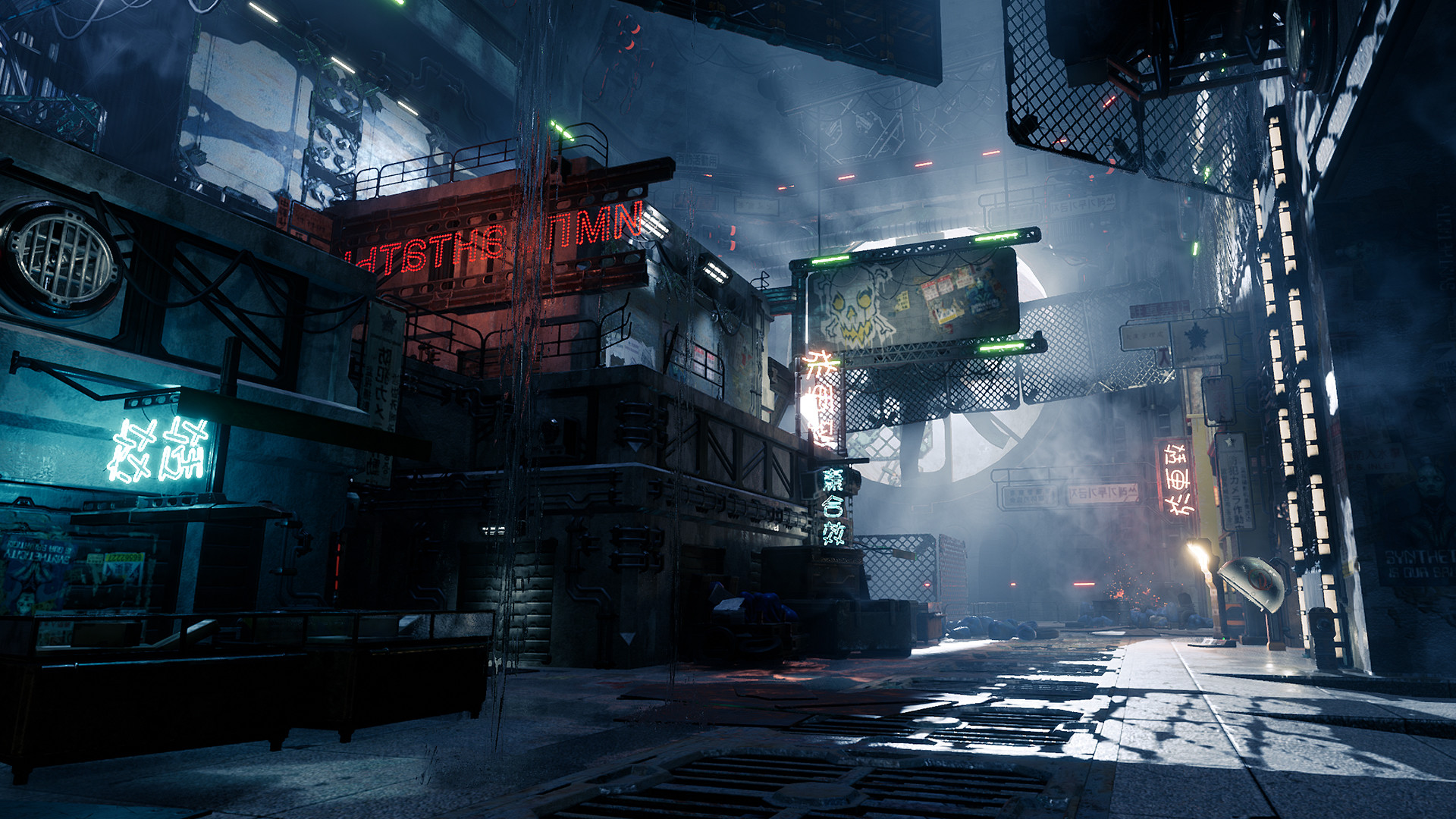
The story’s central conflict remains the ascent toward the Keymaster, with the Architect’s communications accompanying the player as the tower’s districts and defenses unfold. Narrative information arrives largely through dialogue and voiceover during the playable climb, while the player’s immediate task is to read the next gap, hazard or group of enemies. Checkpoints and quick restarts let an attempt resume near the current challenge after a fatal mistake, keeping attention on revising a route and trying it again. The resulting campaign links its plot to a series of tightly bounded spaces: each advance toward the tower’s ruler is also another test of movement, timing and how the available abilities fit together.
- Developer
- One More Level
- Genre
- First-person action platformer / slasher