
About Tom Clancy's Ghost Recon Breakpoint
Ghost Recon Breakpoint follows Nomad, a Ghost stranded on the Pacific archipelago of Auroa after hostile drones bring down the team’s helicopters. Alone or with up to three co-op partners, you investigate the Wolves’ occupation, prepare for operations and adapt your tactics to enemy forces, terrain and a configurable progression system.
Auroa is a fictional Pacific archipelago built around the research facilities of technology entrepreneur Jace Skell. When the Ghosts are sent to investigate unusual activity, their helicopters are shot down and Nomad becomes stranded behind enemy lines. The operation turns into a fight to survive and learn what has happened on the island. The setting spans settlements, industrial complexes, forests, mountains and marshes, with Skell’s advanced technology woven into the conflict. These locations serve as both places to investigate and tactical spaces: elevation, cover and visibility can affect how a patrol is approached, while the island’s hostile forces occupy roads, compounds and key facilities. The archipelago gives the campaign a distinct rhythm of travel, observation and preparation between objectives rather than presenting each encounter as an isolated arena.
The main conflict centers on the Wolves, a faction of former special operators led by Cole D. Walker, once a fellow Ghost. Walker and his forces have seized Skell’s facilities and use weaponized drones to control the island. Nomad’s work involves locating allies and sources of information, learning how the occupation is organized, and disrupting its operations while pursuing the campaign’s central threat. The story introduces members of the island community and the people connected to Skell’s company as the investigation progresses. Missions range from gathering intelligence to entering guarded sites, recovering people or data, and fighting through resistance when a quiet approach breaks down. Enemy types include riflemen, breachers and heavily armoured troops, while aerial and ground drones pose different problems: smaller flying machines are difficult targets, whereas larger ground units can absorb substantial fire. The premise focuses on being isolated and outnumbered; story details beyond the setup are left for the campaign to reveal.
Breakpoint asks players to do more of their own preparation than a conventional mission briefing might. Intel and exploration help identify objectives, targets and locations, after which the map and mission information can be used to plan a route. A scouting drone can reveal enemy positions and mark threats, and Sync Shot lets Nomad coordinate attacks on several marked enemies; deployable Sync Shot drones provide this option when playing alone. Players can infiltrate a site, use cover and suppressed weapons, or accept a direct fight. Looking for an entry point, checking the perimeter and choosing which threats to remove first can reduce the chance of an alarm disrupting the operation. If a patrol spots the team, reinforcements and heavier opposition can change the situation, making exits and fallback cover part of the plan. The same campaign can be played solo or in online co-op with up to four players.
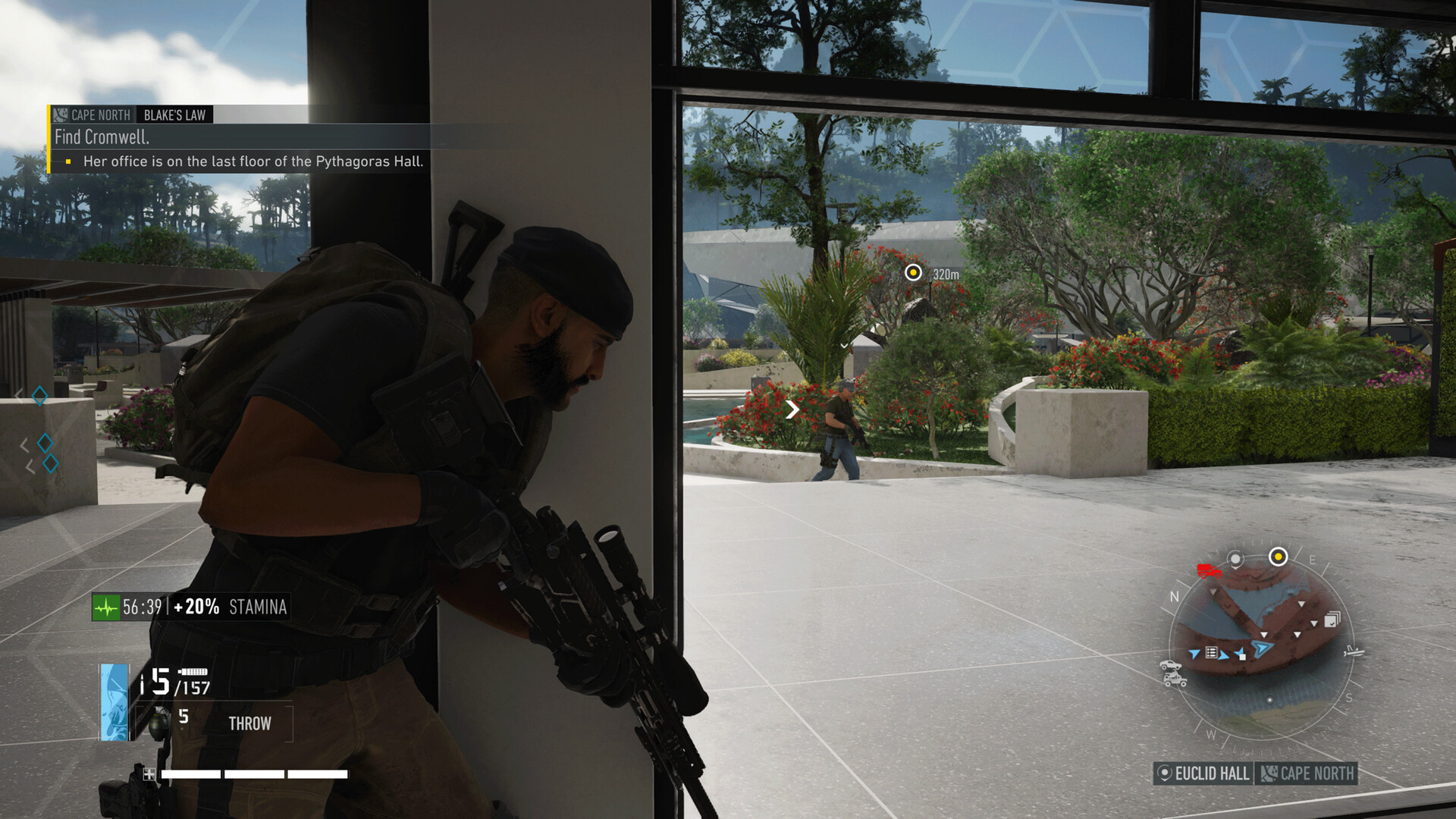
Auroa’s terrain affects more than navigation. Long climbs consume stamina, and steep or slippery slopes can cause a fall that injures Nomad or exposes the approach. In natural cover such as foliage or mud, going prone can trigger camouflage that helps conceal movement and support an ambush; bare rock or built interiors do not provide that cover. Wounds can impair movement or aiming and need treatment outside combat. The player can carry a fallen enemy away from sight, or move an injured co-op partner to safety before healing them. These systems connect travel, stealth and combat: choosing a route across difficult ground may save exposure to guards but cost stamina, while recovering from an injury can require reaching a safer place before returning to the objective. Carrying a body also lets the squad hide evidence of a takedown, helping preserve concealment after an otherwise clean approach.
Preparation happens at Bivouacs, temporary camps where Nomad can change class, adjust equipment, treat injuries and craft items such as rations and bandages. Food, plants and water gathered around the island can be used at camp for temporary benefits, and setting out from a Bivouac allows a choice of departure time and weather conditions. Classes provide different tools for a mission role, and can be changed before heading out. A shared skill tree gives the character additional abilities, while class rank advances through its own progression. This lets players reconfigure for a long-range approach, close infiltration or a squad support role as the next mission demands. The standard gear-score experience adds a loot loop: weapons and equipment found in the field can be compared, equipped or dismantled, and the loadout changes as better drops are collected. Weapon customization and character appearance let players tune their kit as the campaign continues.
The Ghost Experience gives players control over how much of that loot progression and survival detail shapes play. The Regular setting includes gear level and tiered drops; the Immersive setting removes gear level and uses a more grounded equipment approach. Custom settings let players adjust elements such as stamina, ammunition loss on reload, health recovery and injury risk. This changes what preparation means: gear score encourages frequent comparison of found equipment, while removing it puts more emphasis on choosing weapons and planning each loadout. Breakpoint’s encounters still revolve around scouting, positioning and adapting to the Wolves’ different soldiers and drones. Instead of treating every target as an ordinary patrol, players may need to reposition, use specialised weapons or avoid a fight that would consume supplies. The base campaign combines those tactical choices with Auroa’s environmental hazards and Nomad’s investigation, allowing a player or a co-op squad to move between reconnaissance, infiltration and open combat as circumstances change.
- Developer
- Ubisoft Paris
- Genre
- Tactical third-person shooter; action/adventure