
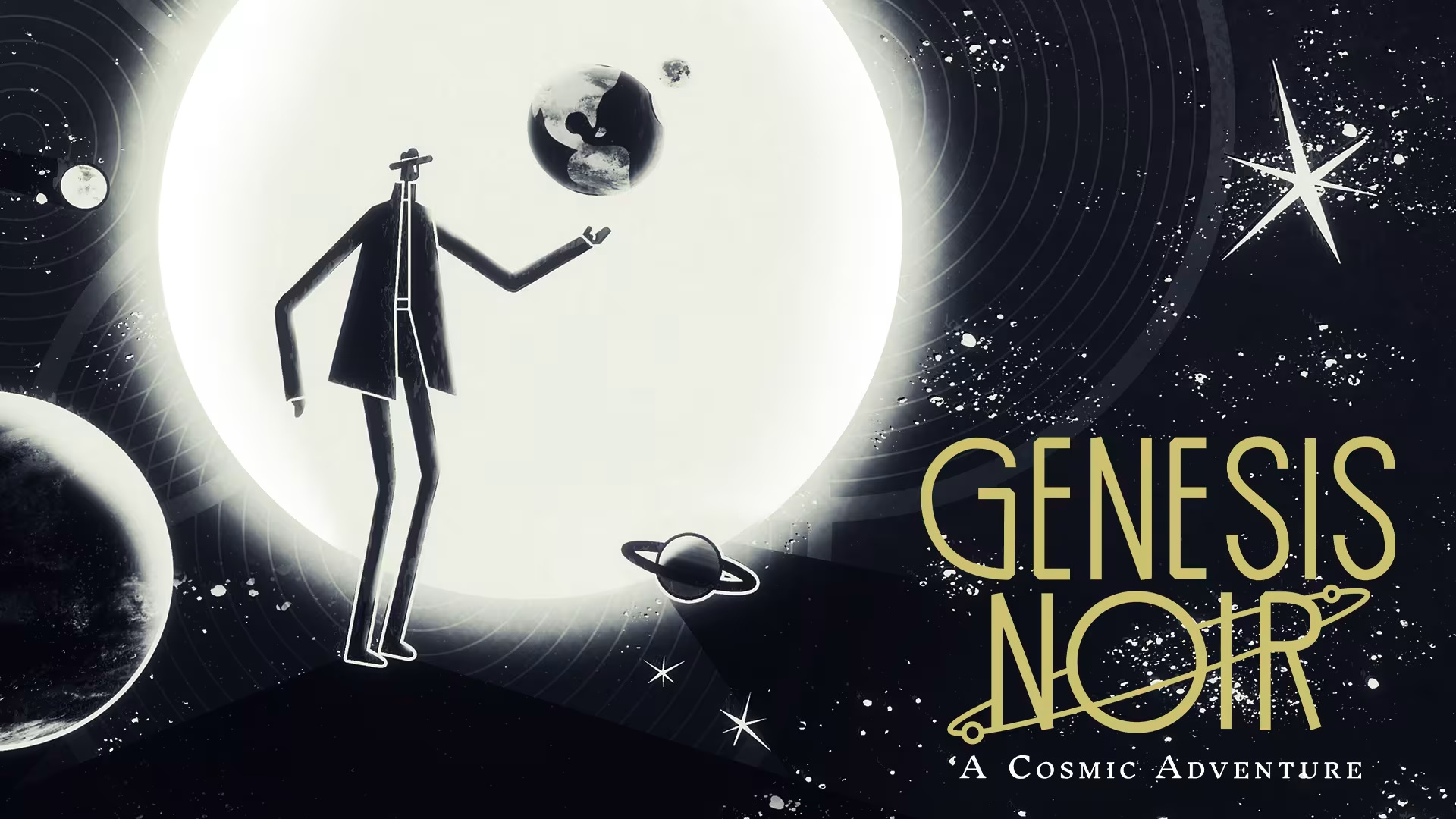
About Genesis Noir
As watch peddler No Man, players enter the expanding universe after a jealous god’s gunshot becomes the Big Bang, searching for a way to save jazz singer Miss Mass. This point-and-click adventure moves through moments in cosmic history, where tactile object puzzles and small interactions let No Man alter scenes and follow clues across an abstract noir world.
Genesis Noir turns a love triangle into a journey through the creation of the universe. No Man, a watch peddler, is caught between Miss Mass, a jazz singer, and Golden Boy, an artist who is also a cosmic being. When their conflict reaches a fatal confrontation, a gunshot becomes the Big Bang: the beginning of creation and a force moving toward Miss Mass. No Man enters the expanding universe to find a way to stop or change it and save the person he loves. The premise draws together detective-story imagery, romance and cosmology, but its scale does not leave the characters behind. Their relationships give the player a reason to move through scenes that span vastly different moments, from the first beginnings of life to distant futures. The game treats the origin of everything as an event that can be entered and investigated, giving a personal crisis an unusual setting without revealing the final answer to No Man’s search.
The player chooses fragments of the expanding Big Bang to explore, then enters compact scenes that function like small worlds or interactive vignettes. These spaces can represent natural processes, human history or more abstract places, and their visual details often suggest what can be touched or changed. Exploration is mostly deliberate rather than based on fast movement across a continuous map. The player moves No Man around a scene, looks for points of interest and tries available actions on people, objects and parts of the environment. A clue may be a pattern, a musical phrase, a machine or an ordinary object placed in an unfamiliar cosmic context. Scenes are linked by the search through time and by the changing universe, so exploration involves both reading each local space and noticing how one discovery leads into another. The result is a point-and-click structure with direct movement and simple interactions, rather than a large inventory adventure built around collecting many objects and combining them later.
Interaction is the main way the player makes progress. Genesis Noir uses tactile puzzles that ask the player to manipulate objects and watch how a scene responds. The publisher describes examples such as dialing a rotary phone, planting a garden, improvising with a musician and creating life. Each action belongs to its particular fragment of the universe, so the puzzle is often about understanding what this place invites No Man to do. Small gestures can change a pattern, set an event in motion or reveal another clue. Rather than relying on long dialogue trees or a large stock of carried items, the game puts emphasis on trying an action and observing its effect. The objects themselves can carry both practical and thematic meaning: a phone connects people, a garden grows, and a musical exchange depends on responding to a pattern. These interactions make the cosmic setting tangible. The player’s inputs are modest, but they turn each environment into something that can be examined and altered instead of a sequence of purely cinematic scenes.
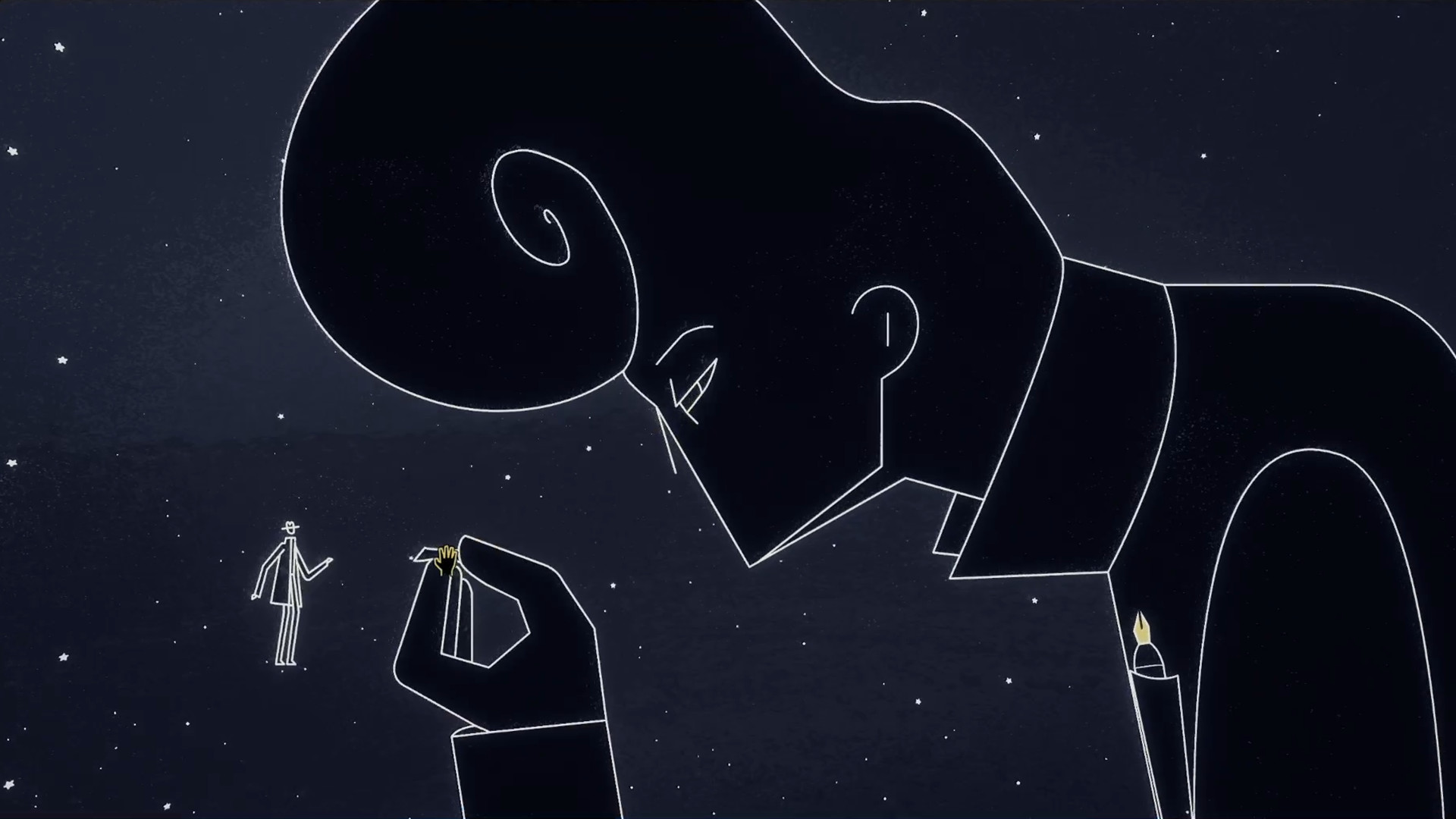
The game’s progression follows the chain of discoveries across these selected moments. No Man enters a fragment, searches for clues and experiments with its available interactions; once a scene has advanced, the larger journey carries him to another pocket of time or space. The site describes this as selecting, entering and altering parts of the Big Bang, and the distinction captures the broad loop: choose a place to inspect, find what matters inside it, then see how an action changes the event. There is no combat system, character leveling or equipment upgrade track described for this adventure. The challenge comes from reading a scene and recognizing what to do, with the interactions themselves serving as puzzles. Some of them invite repetition or experimentation as the environment reacts. Progress therefore feels less like accumulating power and more like learning how the universe’s separate pieces relate to No Man’s purpose. The story unfolds through this sequence of actions and encounters, with new locations widening the scope of the search while keeping the underlying goal in view. Each solved interaction acts as a small change in the world and as a clue about what kind of event No Man has entered. This gives the player a reason to inspect the outcome before moving on.
Genesis Noir’s interaction scale shapes how it presents movement. No Man can be guided around the scenes, but travel is local and purposeful: he reaches an object or person, then the player uses a contextual action to engage with it. The scene itself often supplies the important movement, changing as the player triggers an interaction or watches a process unfold. This is not a platforming game with jumps, hazards or a combat route; the site and store describe exploration and tactile puzzles as its central activities. Instead, progression comes from entering new scenes and changing something within them. The player may make a call, work with an instrument or affect a growing environment, then follow the result into the next part of the journey. Because the spaces can shift from recognizable earthly details to higher dimensions, familiar actions become a way to connect with surreal surroundings. Moving No Man is simple, while the meaning and result of each interaction provide the main point of attention.
The presentation combines high-contrast noir imagery with animation and scenes that change in response to touch. The visual world moves among silhouettes, stars, planets, objects and small pockets of human life, treating cosmic scale through selected images rather than a continuous realistic universe. Feral Cat Den describes its practice as bringing animation and interactivity together, and the game’s interactions make that connection visible: the player’s input can alter an animated pattern or transform the state of a scene. Music and sound are part of this expressive approach; the developer identifies Skillbard as the team responsible for the score and sound design, and musicianship also appears as something the player can engage with in the world. The resulting tone is noir-inflected but not limited to city streets or crime scenes. A watch, a telephone, a garden and a cosmic event can all become part of the same investigation. The interface keeps attention on the scene and its available actions, while the imagery shifts between intimate objects and vast stretches of time. These shifts let a close-up action sit beside an image of creation without requiring a conventional map between them.
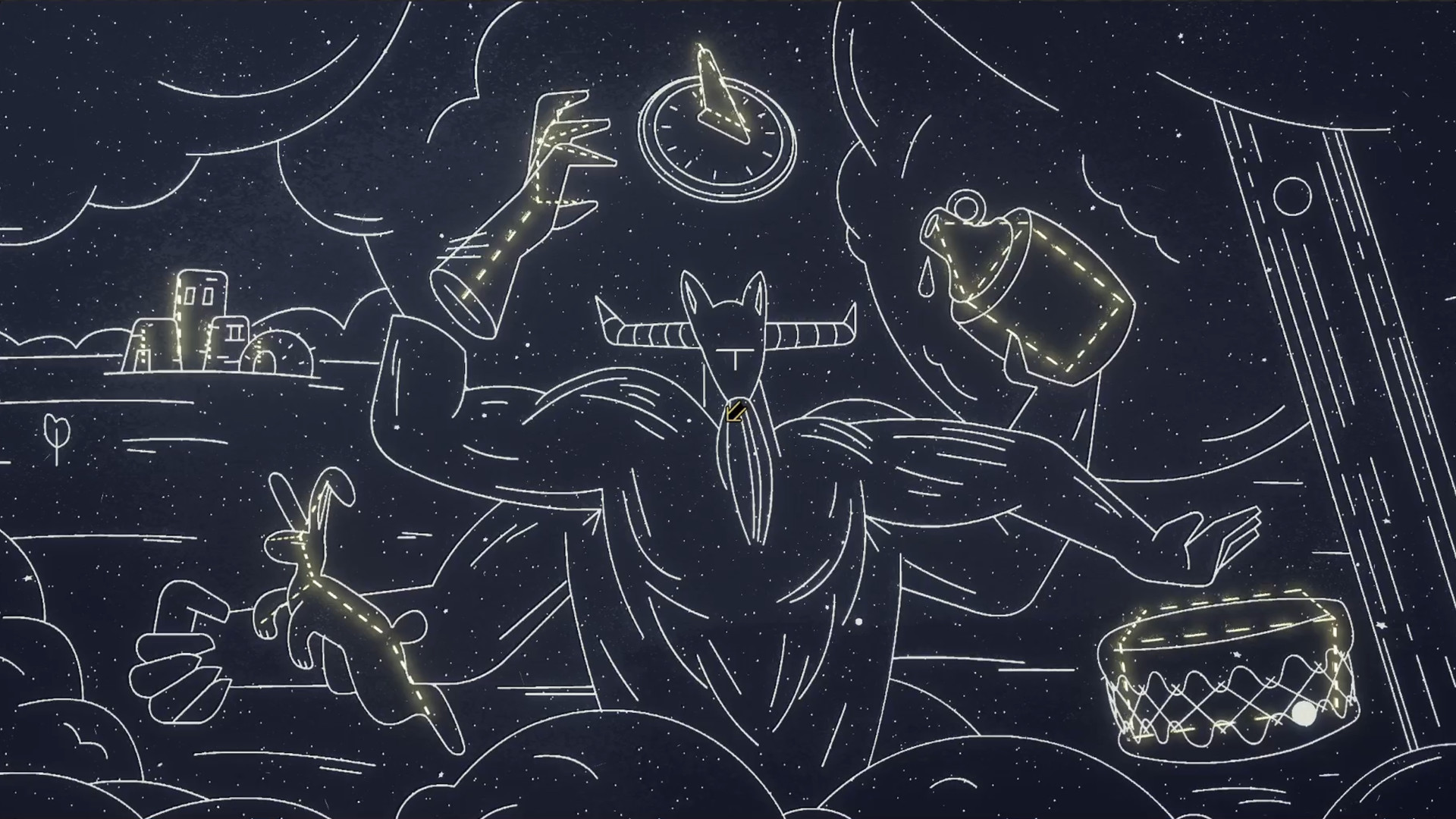
Feral Cat Den builds the adventure around a remarkably simple contradiction: No Man must enter the Big Bang to stop it, even though the explosion has already set everything in motion. His watch-peddler identity suits a story that moves among moments and scales, from a single gesture in a room to the development of life across immense spans of time. Miss Mass and Golden Boy give those abstractions human faces, while the changing scenes ask the player to respond through touch, pattern and observation. The publisher later added Astronomy Update material, including constellations linked to the central trio and further moments in the timeline; these additions sit within the same cosmic adventure. Genesis Noir is available on PC, Mac, Nintendo Switch and Xbox. Its point-and-click form remains intimate despite the subject: the player often changes a small thing and watches an impossibly large consequence unfold.
- Developer
- Feral Cat Den
- Genre
- Single-player point-and-click adventure with exploration and tactile puzzles