
About Frogun
When Renata’s explorer parents disappear inside the dangerous Beelzebub ruins, she sets out after them with their latest invention: the Frogun, a frog-shaped grappling tool. Cross colorful platforming stages, use its tongue to reach surfaces and interact with objects, race rival Jake, and search for coins, notes, secrets, and level challenges.
Frogun begins at the Beelzebub ruins, where Renata’s parents have gone on an expedition. They are explorers, archaeologists and inventors who have taken Renata on earlier journeys, but this site is considered too dangerous for her. After three days without their return, she leaves the base camp to look for them and show that she can manage an expedition of her own. Her parents’ latest invention comes with her: the Frogun, a frog-shaped device whose long tongue can latch onto things at a distance. Renata is the central playable character, while her parents’ disappearance gives the journey its immediate purpose. Jake, her rival, appears in race challenges, and the Hatter runs a shop that gives collected coins a use. The story moves through a sequence of ruins and other themed areas rather than a large hub of towns or a cast of quest-givers. Notes found along the way add accounts from Renata’s parents and other adventurers, giving the places a history beyond the rescue mission.
The adventure is arranged as compact, colorful stages with routes built from platforms, ledges, traps, enemies and objects that can be reached with the Frogun. The environments include pixel-textured ruins, snowy heights and lava-filled swamps; each theme changes the look of the route and supplies its own hazards and targets. The camera presents these spaces in a three-dimensional, angled view, so a platform that appears close may sit at a different depth. Players can adjust their view while checking where a ledge, target or opening sits before committing to a jump. Falling platforms, moving targets and timed hazards ask for attention to the route as it changes, rather than only a single jump calculation. The obvious path carries Renata toward the stage exit, but optional branches hold coins, notes, secrets and challenge goals. Some of those detours connect back to the main route as shortcuts, while others test whether the player can reach a small side platform or hidden area. Moving through a stage therefore involves both forward progress and scanning the surrounding space for places the Frogun can reach. Different zones change the obstacle mix as well as the colors and textures, so the same grappling tool must be used against new arrangements of platforms and targets.
Renata’s basic movement is built around running, jumping and aiming the Frogun. Ordinary jumps handle the gaps between nearby platforms; the longer crossings ask the player to judge both distance and height, then use the Frogun to pull toward a reachable surface or object. It can also attach to larger enemies, letting them act as temporary anchors when the level places one over a gap. Some sections ask for a quick sequence of grapples, with one landing setting up the next shot before Renata drops. Other routes allow a more deliberate approach: look across the space, identify a safe target, move into position and fire. The tool can reach objects placed away from the normal walking path, which is why grappling serves exploration as well as traversal. Levers and buttons provide explicit interactions, while movable or throwable objects can help with obstacles. The platforming and the device are tied together: a jump gets Renata into position, and the tongue changes which parts of the level are reachable from there.
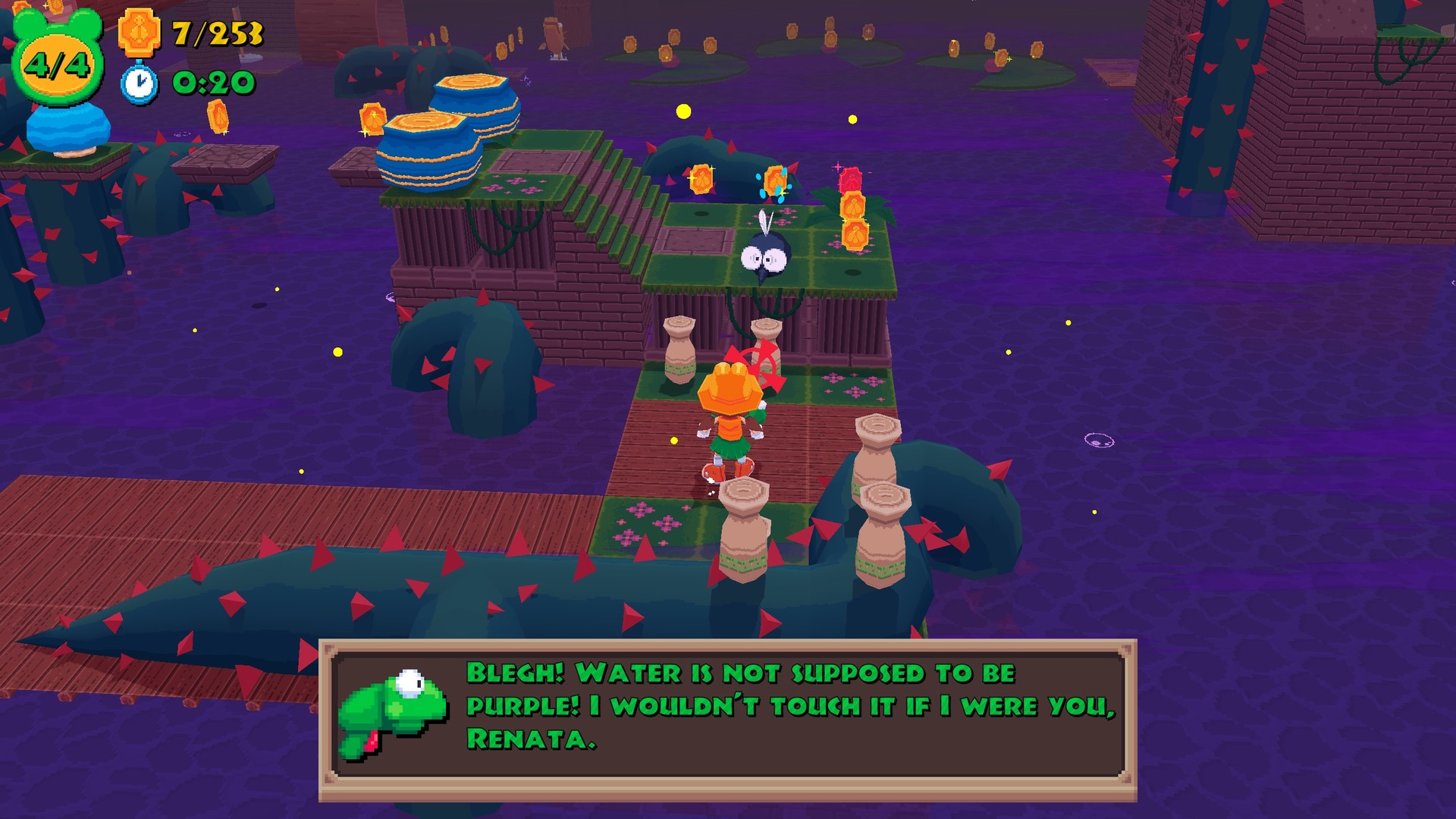
The Frogun also handles encounters with the creatures and traps inside the ruins. A shot can catch an enemy with the tongue, pulling it toward Renata, and some objects can be picked up and fired as projectiles. That gives the player a way to clear a target or deal with an obstacle from a distance instead of treating every enemy as something to jump over. Other enemies become footholds or grapple targets, so their role depends on where they appear in the stage. Large bosses interrupt the ordinary platforming with dedicated fights; reading their attacks and finding a chance to respond changes the rhythm from crossing hazards to surviving an encounter. Jake’s appearances create another kind of set piece: in his race stages, the goal is to reach the finish before Renata’s rival. These races emphasize keeping momentum through jumps and grapples, while boss encounters focus on timing around an opponent. Both use the same movement and Frogun controls as the regular stages, but give them a clear, immediate objective.
A stage can contain several optional goals alongside its exit. Coins are scattered along the route and in less obvious corners, while hidden diary notes provide written pieces about other adventurers and the history of the ruins. Emblems are earned by completing stage challenges, giving skilled or thorough runs a separate completion target. Searching for a secret area may also reveal a shortcut, so exploration can change the route rather than only add an item to the tally. The player can choose to leave a stage after reaching its goal or spend longer checking branches and trying its challenges. These objectives make the same platforming spaces serve different purposes: a direct run prioritizes the exit, while a completion-focused attempt asks the player to notice side paths, collect items and meet the level’s conditions. The notes are a world-building collectible, whereas coins feed into the Hatter’s shop and emblems record challenge completion. They are separate reasons to explore rather than one interchangeable currency.
Coins can be traded with the Hatter for cosmetic hats, bestiary entries, game art and other extras. The hat collection gives Renata a visible change, while the bestiary and art unlockables reward players who gather more currency across stages. This creates a simple link between optional exploration and a growing collection outside the immediate level: picking up coins along a route contributes to shop purchases later. The game also includes unlockable two-player duel arenas, which turn its platforming into a head-to-head activity for friends. These arenas are an additional mode rather than part of Renata’s search through the ruins. A posable photo mode offers a separate way to arrange and capture scenes, using the characters and settings as subjects. The result is a set of optional activities around the main stage sequence: collect coins to visit the shop, finish level challenges for emblems, or return for duels and photographs. Each gives the player a different reason to continue after reaching a stage exit.
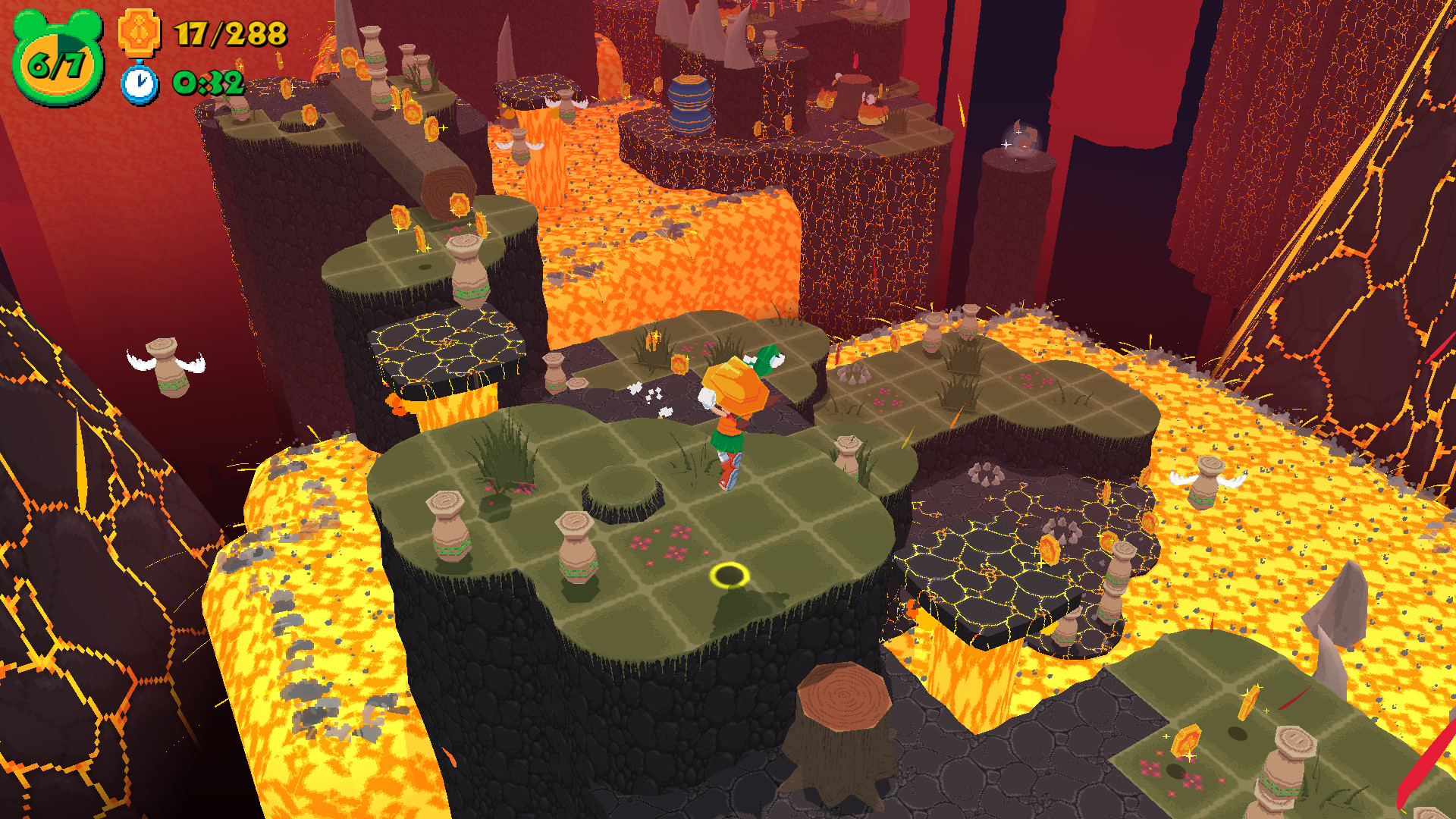
Frogun uses low-polygon 3D environments with crisp, pixel-like textures and bright colors, building its presentation around the look of early console platform games. The contrast between the blocky geometry and detailed surface patterns helps separate platforms, traps and targets within the angled view. Ruins, snow and lava settings each give stages a recognizable palette, while enemies and Renata use rounded, cartoon forms against those environments. The soundtrack and sound effects support the retro presentation, with music that shifts its energy as the stages move between distinct zones. The game’s movement is shown clearly through jumps, tongue shots and grapple pulls, so the tool remains visually legible as it links Renata to a distant surface. The 2022 release is a single-player platform adventure developed by Molegato and published by Top Hat Studios. Its listed platforms include PC, PlayStation 4 and 5, Nintendo Switch, Xbox One and Xbox Series consoles. Across the original adventure, Renata’s search in the Beelzebub ruins ties the platform challenges back to the mystery of her missing parents. The changing zones give her Frogun new surfaces, hazards and enemies to contend with while the rescue remains the reason to press deeper.
- Developer
- Molegato
- Genre
- 3D platform adventure