
About Frog Detective 3: Corruption at Cowboy County
Frog Detective 3: Corruption at Cowboy County sends the Detective and Lobster Cop to a western county without a sheriff. Residents’ missing hats give the investigation its central question. The Detective questions the townsfolk, follows their requests and uses found objects, while a scooter connects the county’s locations.
Frog Detective 3: Corruption at Cowboy County is the third and final case in a short comedy-mystery series. A call from the Detective’s supervisor sends him west to a county without a sheriff, with his celebrated colleague Lobster Cop joining the assignment. Mary the rhino provides a playful recap before the journey, giving returning characters an entrance while orienting somebody who begins with this case. By the time the Detective arrives, Lobster Cop has helped appoint Mason Mole as sheriff. That apparently easy solution leaves the Detective with another question: the residents’ hats have disappeared. The shift from a vacant office to a missing-object mystery introduces the county through its people rather than through a crime scene full of forensic equipment. Cowboy County borrows western signs such as outlaws, a saloon and a sheriff’s office, but its inhabitants speak in the absurdly polite language of Frog Detective. The sheriff appointment does not settle the story: an apparently harmless town still has secrets to disclose, and the Detective's cheerful approach is tested by the next conversations. The case begins by giving him a job that sounds substantial, then shifting his attention to a question as peculiar and personal as the missing hats.
The county’s cast gives the missing hats more texture than a single list of suspects could. Dusty is a koala with cowboy poetry on his mind, while Rhonda Dynamite is an outlaw mouse who had hoped to become sheriff. Craig, a bull, is preoccupied with joining a ghost-hunting society; Sherman is a sloth whose attention to the Detective becomes a joke in its own right. The panda artist Pistol and a squirrel named Wendy bring another set of interests into the web of favors. These details matter because a resident’s request tends to reflect their personality: somebody wants a poem, somebody wants a portrait, and somebody else has an ambition that changes how they speak about local authority. The outlaws are not an enemy faction to defeat in combat. They can be helpful, and the Detective learns about them by talking instead of chasing them across the desert. That choice turns the western setting into a social puzzle. The player has to remember who knows what, who wants a particular object and who might be able to help with another resident’s problem. The hats remain the central mystery, but the local characters give the inquiry its route through town. The contrast between Rhonda's wish for the sheriff role and Mason's appointment also gives local politics a comic edge without turning either character into a conventional villain.
Investigation happens mainly through first-person conversation and object use. The Detective approaches a resident, reads what they have to say, and may discover a request that can be met elsewhere in the county. Objects can be collected, given to people or used on parts of the environment. The notebook keeps a character log, current tasks, items and the Detective’s observations, allowing the player to trace how one person’s need might connect to another. It is a practical memory aid, but also carries bits of characterization in the Detective’s own notes. A magnifying glass lets him inspect people, posters or scenery more closely, continuing the series’ idea that even an ordinary detail is worth examining through detective equipment. Most progress is not a choice between complex theories. It comes from noticing the relationship between a request and a concrete object, then returning to the right person when that object is available. Some favors form chains: assisting one resident may be necessary before they can help somebody else. The game therefore rewards following the town’s social connections, without requiring a formal evidence board, interrogation timer or combat encounter. The notebook helps hold those connections together as the list of residents grows. Before the case begins, the notebook can even be decorated with stickers, making an instrument of record-keeping another small expression of the series' sense of humor.
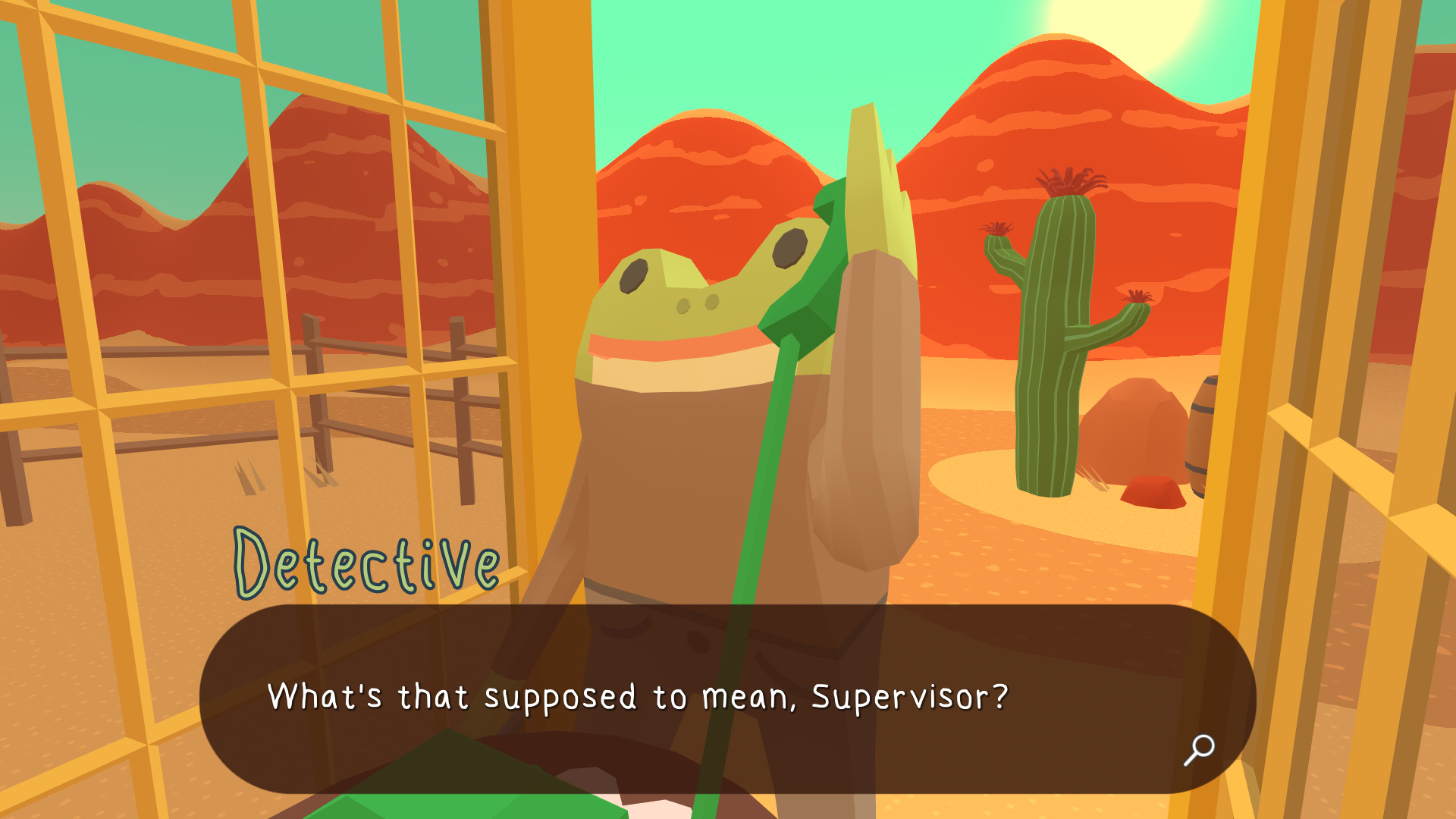
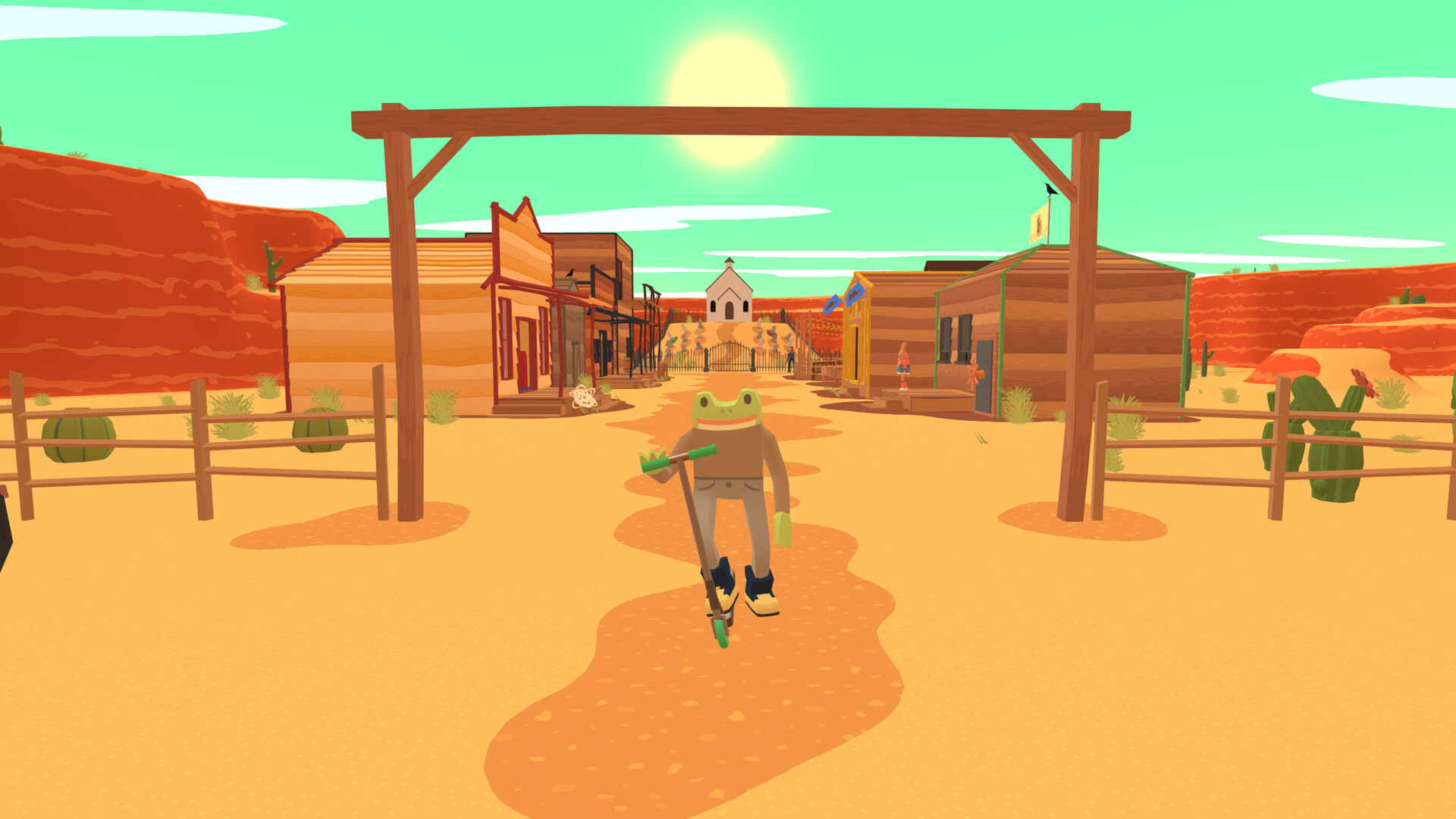
Cowboy County spreads its conversations across a broader setting than the earlier cases. The Detective can walk, but a scooter makes travel between the town, its buildings and the surrounding orange desert quicker. It can hop over rises and gaps, lending a physical joke to a western landscape where a horse might have been expected. The scooter is useful for reaching some objects and for crossing the county, yet the moment it stops the game returns to close observation and conversation. The sheriff’s office and saloon are identifiable places rather than interchangeable backdrop pieces: a return trip can be prompted by a new object, a notebook entry or another resident’s request. Travelling through the county is therefore a way of linking people and places, not a separate racing campaign. Sound helps distinguish those modes. Western-style strings become prominent on the scooter, while exploring on foot or entering a building changes the musical backdrop; the saloon has its own piano flavor. The bright, sparse geometry and toy-like animal models keep the surroundings readable, so the player can recognize a resident or building at a distance and then approach for the actual exchange. A wanted poster or storefront can also be inspected through the magnifying glass, so the trip between errands is an opportunity to notice jokes and visual details outside the central exchange.
The individual favors give the investigation small, concrete challenges. A request for four cactus flowers asks the player to distinguish the desired blooms from similar ones growing nearby. A panda artist offers to illustrate the Detective’s adventures for an absurd sum of in-game money, turning a financial conversation into part of the joke. Poetry and portrait-making connect other requests to the hobbies of Dusty and Wendy; helping one character can make it possible to satisfy another. These are not elaborate mechanical puzzles, but they are more specific than a generic instruction to collect clues. An item’s use depends on who asked for it and on the order in which related favors become possible. The missing hats provide a reason to interview the county, while the residents’ side concerns keep those interviews from sounding like identical witness statements. The player can follow the notebook when a chain grows hard to remember, then return to a person whose situation has changed. Progress comes in such small social exchanges instead of weapon upgrades, leveling systems or boss fights. The humor works because the Detective approaches even a trivial request with the seriousness of a professional case. Wendy's wish for a portrait illustrates the chain particularly well: the Detective cannot simply paint it himself, but the artist may be able to help once his own concern is addressed.
Frog Detective 3 tells its story mostly through text rather than voiced performances. The first-person camera brings each oversized-eyed animal close, while the minimal animation leaves room for the written exchanges and pauses to carry the jokes. Steam lists the game as single-player but also suggests taking turns reading the dialogue aloud with friends. That describes a way to share the script in the room, not an online multiplayer mode. The creators' credits name Grace Bruxner for creative direction, art and narrative, Thomas Bowker for design and code, and Dan Golding for the soundtrack across the three cases. Olivia Haines contributed 3D object design to this installment. Those roles help explain why the county can be visually simple while still giving its residents distinct shapes, conversations and musical surroundings. As the series finale, this case also has relationships and callbacks for someone who has followed the Detective before, while its sheriff and hat problems establish an immediate premise for a newcomer. The case takes a further turn after its obvious opening solution, and that change works through the county's established people instead of introducing an unrelated action system. Dialogue remains the main delivery system for character, even when a little musical or visual flourish briefly takes over.
- Developer
- Grace Bruxner, Thomas Bowker
- Genre
- Adventure, Casual, Indie (Steam listing)