
About Fran Bow
After her parents are killed, ten-year-old Fran Dagenhart wakes inside Oswald Asylum, separated from her cat, Mr. Midnight. She seeks escape and a way back to Aunt Grace. This hand-drawn point-and-click adventure uses a red medicine to reveal a second reality, where hidden clues and objects change how its puzzles can be solved.
Fran Bow follows ten-year-old Fran Dagenhart after a violent loss leaves her separated from the black cat Mr. Midnight, her closest companion. She wakes in Oswald Asylum, an institution for children, and sets out to escape, find the cat and return to Aunt Grace, her only living relative. The search also has a second threat: the demon Remor tries to keep Fran trapped in her trauma. That combination of a concrete personal goal and a hostile supernatural presence guides a story told through a child’s perspective, where fear, fantasy and curiosity shape how places and events appear.
The main play is point-and-click exploration. Fran examines rooms, objects and people, gathers items, and combines observations to work out what to do next. Characters can provide clues or create complications, and the game includes more than fifty distinctive people and creatures across its worlds. Puzzles are tied to the story rather than detached riddles: a found object, a conversation and a change in perception may all become relevant to one obstacle. Players inspect scenes and remember details as Fran moves onward. The design encourages trying sensible interactions and reading their results instead of relying on action combat to clear a path. Puzzle difficulty varies across the journey. Their story basis means obstacles are connected to the people and places Fran encounters; the player must draw on information from the scene at hand instead of assuming one interaction pattern solves every problem.
Duotine, the red medication Fran can administer to herself, changes what she can perceive. Taking it reveals the Ultrareality, a bloody and macabre alternate world containing hidden clues, objects, puzzles and shadow creatures. The same location can therefore offer different information depending on which state Fran sees. The player uses this shift to discover what ordinary perception conceals and to find solutions tied to the environment. This is the defining rule of the adventure’s puzzle design: medication changes access to clues and objects, making the perception mechanic part of how Fran examines a scene and finds a way forward.
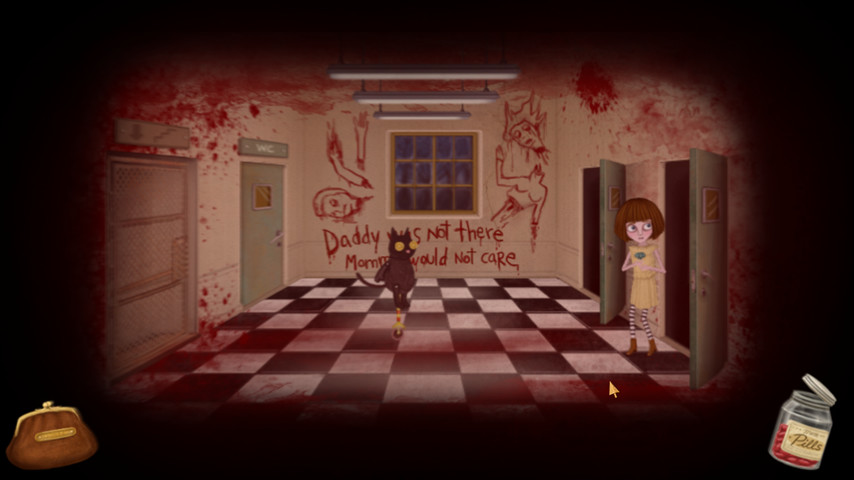
The Ultrareality also gives the adventure a cast of threats and allies distinct from its puzzle objects. Shadow creatures inhabit this other reality, while Remor tries to keep Fran confined within her trauma. Other unusual beings can be loyal allies or strange personalities whom Fran meets across magical and eerie realms. These characters make conversation another form of exploration: the player learns who is present and how that person relates to Fran’s journey, rather than treating every encounter as a barrier to remove. The game presents more than fifty unique characters, giving its surreal settings a social dimension as well as an uncanny one.
Mr. Midnight remains central to Fran’s search. He is the cat she received from her parents, and finding him gives direction to her escape from Oswald Asylum and attempt to return to Aunt Grace. He is not only a goal mentioned in dialogue: the cat is interactive and occasionally playable. This shifts the player’s relationship with him from looking for a companion to sharing parts of the adventure with him. Fran’s efforts to find Mr. Midnight link the supernatural journey back to the loss that began it, so the story’s strange detours remain connected to her need for safety and family.
The full adventure is arranged across five chapters, and its three arcade-inspired mini-games appear as transitions between parts of the story. These sequences use different art styles, so the interludes alter the game’s presentation as well as its immediate activity. Between them, Fran returns to the point-and-click pattern of examining a place, speaking with its inhabitants and using what she has learned to solve story-based puzzles. The chapter structure lets new settings and characters enter the journey while the main search continues, and the mini-games break up that steady investigative rhythm without replacing it.
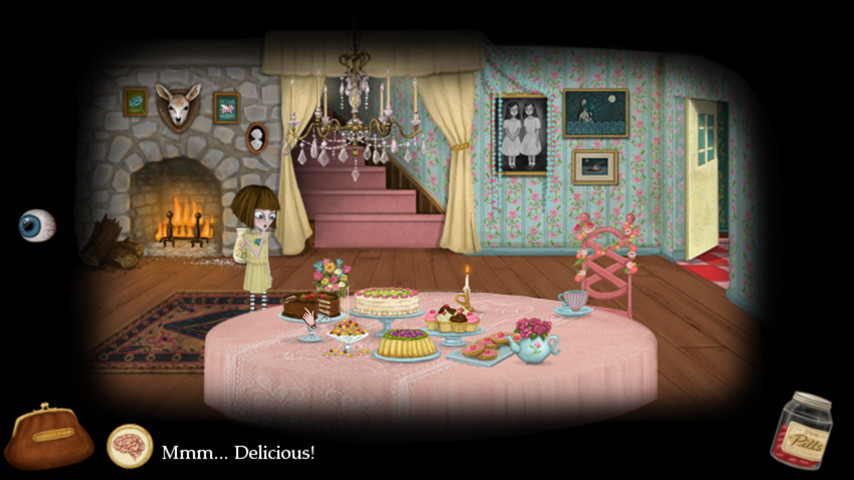
Fran’s journey moves beyond the asylum through places such as the Hallway, the Twins’ cottage and Itward’s Ship, and brings her into contact with the Queen. The changing surroundings give the player new rooms, objects and characters to interpret while keeping the point-and-click approach in place. An apparently ordinary hallway or cottage can sit alongside a vessel from a stranger world, so each new location asks the player to learn its particular visual cues and puzzle logic. The Queen adds another relationship to understand amid the journey’s unusual inhabitants. Exploration stays tied to discovering how these places and people fit Fran’s search, rather than returning to one repeated backdrop.
The hand-drawn 2D art and animation give these shifts in place and perception a consistent visual language, even as the game changes settings and sometimes introduces a different style for its mini-games. Its original soundtrack accompanies a story that moves between ordinary surroundings and an unsettling alternate reality. The presentation helps distinguish the worlds Fran encounters, while the puzzles remain rooted in finding clues and objects rather than in combat. This mix of a recognizable illustrated style, contrasting imagery and story-linked interaction supports the adventure’s psychological horror without separating its visuals from the practical work of exploring.
- Developer
- Killmonday Games AB
- Genre
- Point-and-click psychological horror puzzle adventure