
About Forgive Me Father
A priest or journalist enters Pestisville, where a plague-like affliction, an ancient cult and creatures from beyond threaten ordinary life. This Lovecraft-inspired first-person shooter pairs hand-drawn comic imagery with fast combat, two distinct character paths, a shifting Madness gauge, upgradeable weapons and hidden spaces to explore.
A Lovecraft-inspired investigation begins in Pestisville, a coastal New England town unsettled by a strange plague and an ancient cult. The player selects a priest or a journalist, then enters the town in search of answers and relief from the spreading supernatural horror. The story follows that investigation through streets, buildings and hostile places where ordinary life has become difficult to recognize. Notes, photographs and other story objects provide fragments about the people and events behind the crisis, so looking around can add context to the action. The premise draws on cosmic horror, but the immediate task remains clear: move through the environment, survive the creatures in the way and find where the route continues. The two protagonists offer distinct perspectives and development trees within the same broad mystery, encouraging players to consider how character choice will shape combat as well as narrative viewpoint.
The central loop is built around movement and combat. Rooms and outdoor areas put the player against groups of possessed inhabitants and stranger monsters, so staying mobile matters as enemies close in or attack from a distance. The game uses a familiar first-person perspective, with direct aiming, firing, dodging and collecting ammunition and health as the player advances. Weapons have different functions and can be improved as the character develops, letting a preferred tool become more effective or take on a more unusual form. Hand-drawn figures sit within three-dimensional spaces, giving enemies and objects a comic-panel quality while preserving the spatial movement and weapon handling of an old-school shooter. Combat encounters are the main way forward, while the surrounding environments supply alternate paths, useful supplies and clues. Players are encouraged to keep moving rather than treat each room as a static firing position.
Madness connects aggressive play to supernatural abilities. The gauge rises through combat and other in-game actions, and available Madness can be spent on active skills. These powers help control a dangerous crowd or recover health, adding a tactical option alongside the conventional arsenal. Using a skill at the right moment can create breathing room when several enemies threaten at once; holding the resource for later means keeping that option available for a harder confrontation. The gauge also has an audiovisual role: as it changes, the presentation reflects the protagonist’s unstable state. This makes the mechanic more than a separate magic meter, linking the story’s concern with sanity to the rhythm of fighting. The player balances immediate survival, ability use and the desire to keep moving, while learning how each skill fits the pace of an encounter. Madness is both peril and a source of power.
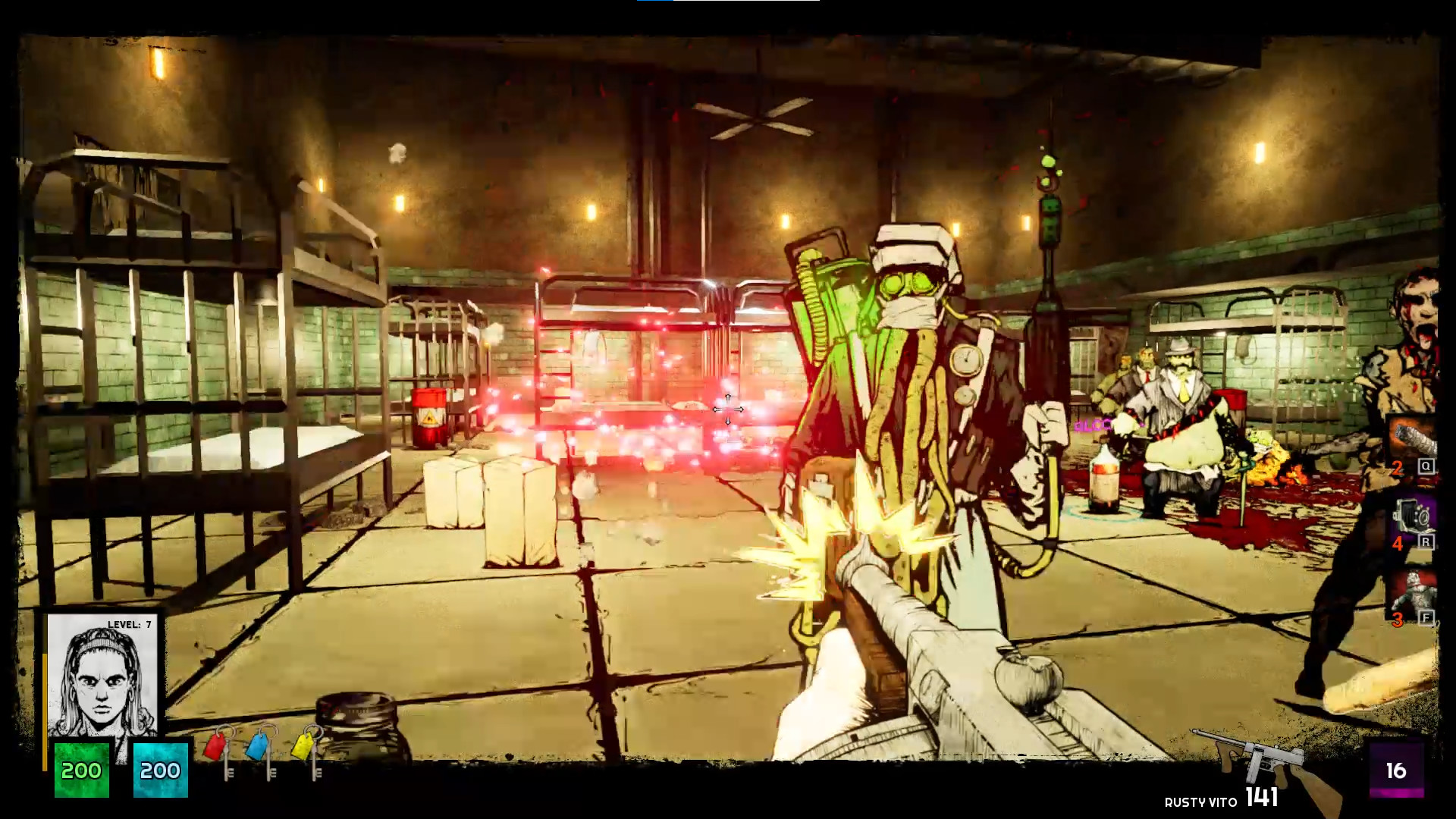
The priest and journalist each have a unique development tree, giving character choice a mechanical consequence as well as a narrative one. Their active skills differ, so choosing a protagonist affects which kinds of support are available during combat. The game invites players to shape a build by spending progression points on abilities and equipment instead of treating every weapon as a fixed tool. Weapon improvements can strengthen familiar firearms or push them toward stranger, corrupted variants, while skill upgrades change what the protagonist can do when Madness is available. These choices gradually give a run its character: one player may emphasize a dependable gun and use abilities sparingly, while another may invest more heavily in supernatural support. The two heroes encourage replay from a different angle without implying unrelated campaigns. Their separate trees underline that the same town and threat can be approached through different capabilities and preferred balances between weapon power and special skills.
Exploration provides a quieter counterpoint to firefights. Pestisville and its surrounding spaces contain tucked-away and hard-to-reach areas, which can reward a player who checks side passages and looks beyond the obvious route. Supplies found away from the main path can help with later encounters, while story objects add context to the town and its strange transformation. Interactive material includes documents and visual scraps such as pages, photographs and newspaper clippings; they are brief fragments rather than a separate investigation interface. The player must decide whether to pause and inspect a clue or keep moving while danger is near. This arrangement lets environmental details deepen the mystery without replacing shooting, and makes route reading useful for survival as well as understanding the place. The levels include varied locations, from cemeteries and woods to factories and enclosed spaces, each bringing a different atmosphere to the same search.
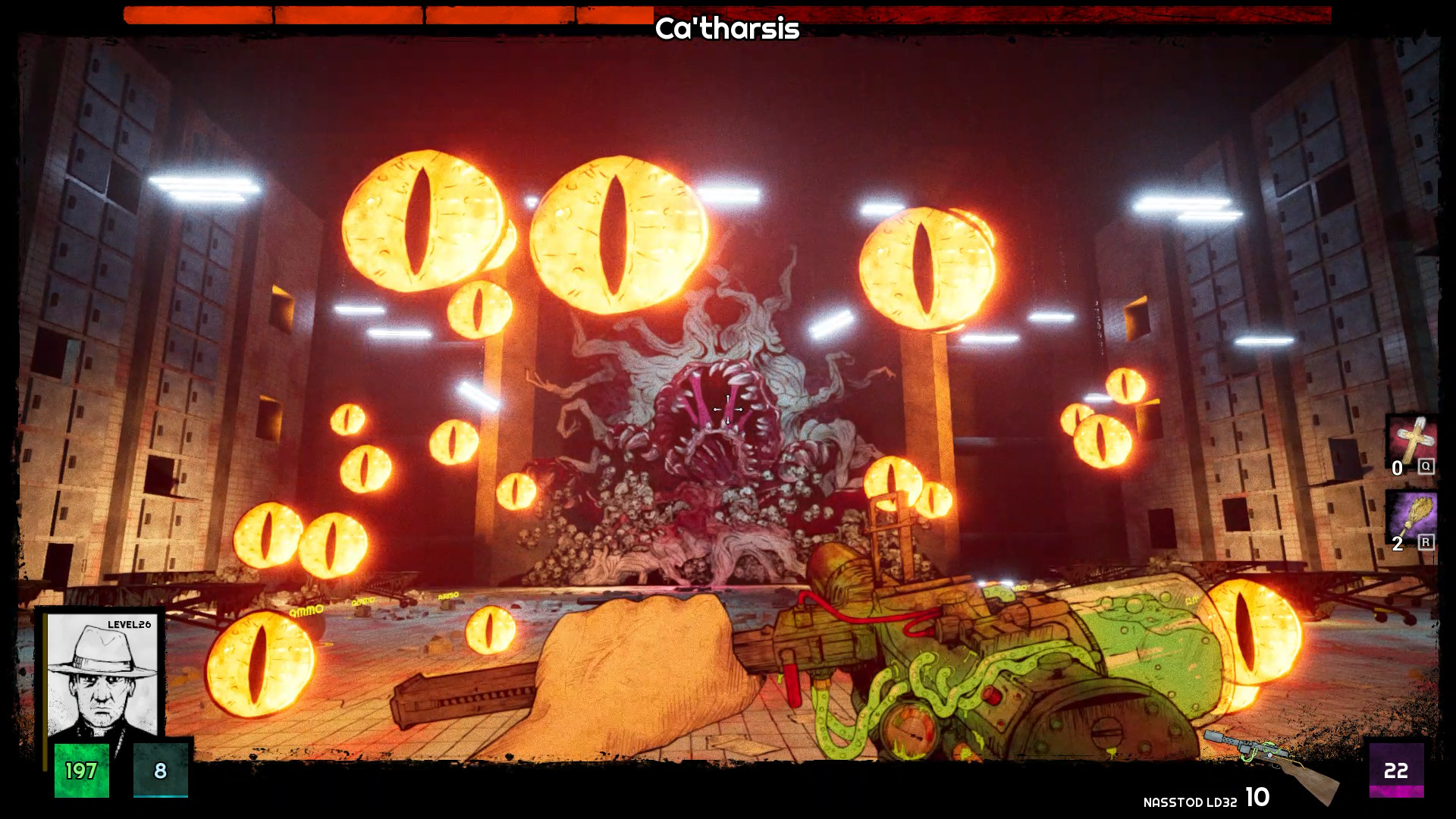
Weapons range from familiar firearms to equipment shaped by an unknown substance and occult forces. The game’s description emphasizes a changing arsenal, non-reloading weapons, power-ups and combat against numerous opponents, giving fights a steady forward pulse. Instead of planning around a reload cycle, the player can switch among available weapons and use pickups found in the level to sustain pressure. The scripture carried by the protagonists and the otherworldly character of the arsenal reinforce the conflict between faith, human identity and the forces invading the town. As equipment evolves, the visual style makes those changes legible through increasingly strange forms. New enemies and different spaces ask the player to adjust weapon choice and active skills, so progression is expressed through a growing set of answers to combat problems. Power-ups offer short-lived advantages, rewarding awareness of the arena and good timing as groups of enemies converge.
- Developer
- Byte Barrel
- Genre
- First-person action shooter; retro horror