
About Firewatch
In 1989, Henry takes a summer job as a fire lookout in Wyoming’s Shoshone National Forest, with supervisor Delilah as his only contact over the radio. He leaves his tower to investigate events across the wilderness, navigating on foot while their conversations and discoveries shape a mystery unfolding around Two Forks.
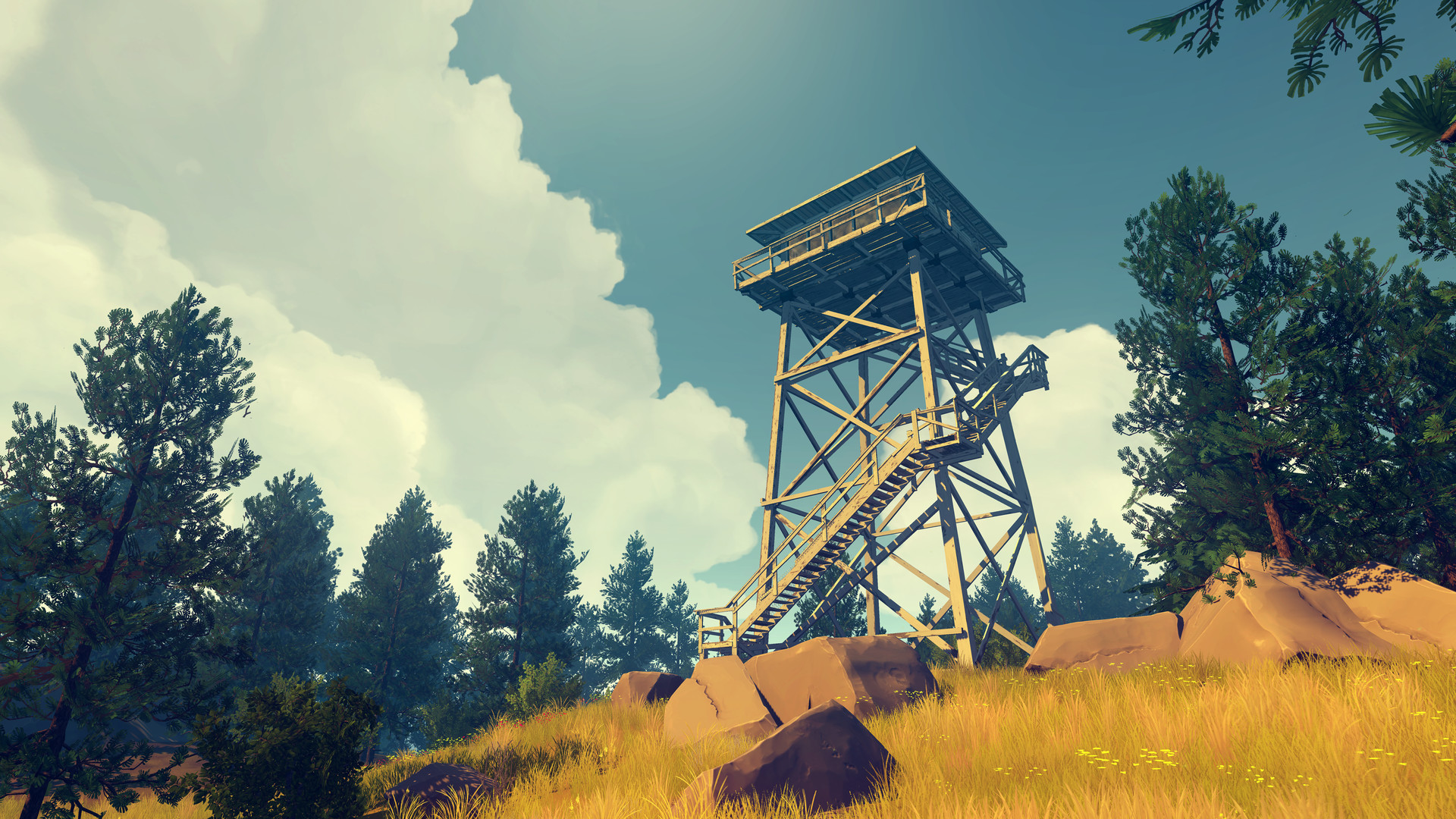
Firewatch is a single-player, first-person adventure set in the Wyoming wilderness in 1989. Henry has taken a seasonal post at the Two Forks lookout tower, leaving a complicated life behind to watch for smoke during a hot, dry summer. His supervisor, Delilah, works from another tower and speaks with him by handheld radio. She is his only regular human contact in the forest. From the lookout, Henry scans the surrounding land for signs of fire; when incidents draw him away from the tower, the player follows trails into the woods to check what has happened and report back. The official premise frames the job, the isolation and the relationship over the radio as the central elements of the mystery.
The radio makes conversation part of moving through the landscape. Delilah calls with assignments and observations, while Henry can answer, ask questions or respond to what he encounters. During many exchanges, the player selects from short dialogue options; choosing silence is also possible in some conversations. The wording and timing of replies shape the immediate tone of the exchange and which subjects Henry raises. The narrative continues through these conversations alongside what Henry sees in the forest. The radio is an object Henry carries and uses, so dialogue occurs while travelling or examining the surroundings, rather than in a separate menu or a sequence of detached cutscenes. Delilah’s responses can also help orient Henry when a search leaves him unsure where to go.
Navigation uses a paper map and compass rather than a persistent objective arrow. The player can bring up the map to compare trails, landmarks and Henry’s position, then use the compass to match directions in the world. The forest has connected paths, slopes, landmarks and routes that become accessible as events progress. Cache boxes and discovered details add to the information on the map; some things Henry finds can be discussed with Delilah, and the map can reflect what was found or what the player named in conversation. That link between spoken choices and handwritten map marks makes the map a record of the pair’s work as well as a navigation aid. Later, a handheld wave receiver adds a different task: Henry follows its signal into the wilderness without knowing its source in advance. The player moves between explicit assignments and local exploration, choosing how to orient through the area.
Progress comes from reaching places, investigating objects and responding to story events, not from building character levels or managing survival meters. Henry walks, runs, interacts with objects and climbs or descends at marked obstacles. Climbing is deliberately simple: when a route calls for a mantle, the player uses an interaction prompt and Henry completes the movement. Ropes provide another way to cross steep terrain; their placement can open connections between parts of the map, and Henry can climb or slide along them. Supply caches are locked boxes found in the forest. Opening one is a close-up object interaction, and the cache contents can include practical items such as rope that support traversal. These tools affect which paths Henry can take, while the main progression remains tied to the next task and what he learns along the way.
The work of the lookout leads Henry to examine signs left in the landscape. A route may be suggested by trail markers, telephone poles, smoke, objects or sounds rather than a glowing waypoint. The player can inspect items, pick them up, read notes and use the radio to tell Delilah what has been found. Small details may appear to point toward one explanation, while later discoveries add context; the game asks the player to notice and interpret, rather than solve a collection of formal puzzles. Searching off the direct route can reveal extra places and objects, and opened paths can make it possible to approach some areas from a different direction. The plot advances through the combination of assignments, travel, environmental evidence and Henry’s conversations with Delilah.
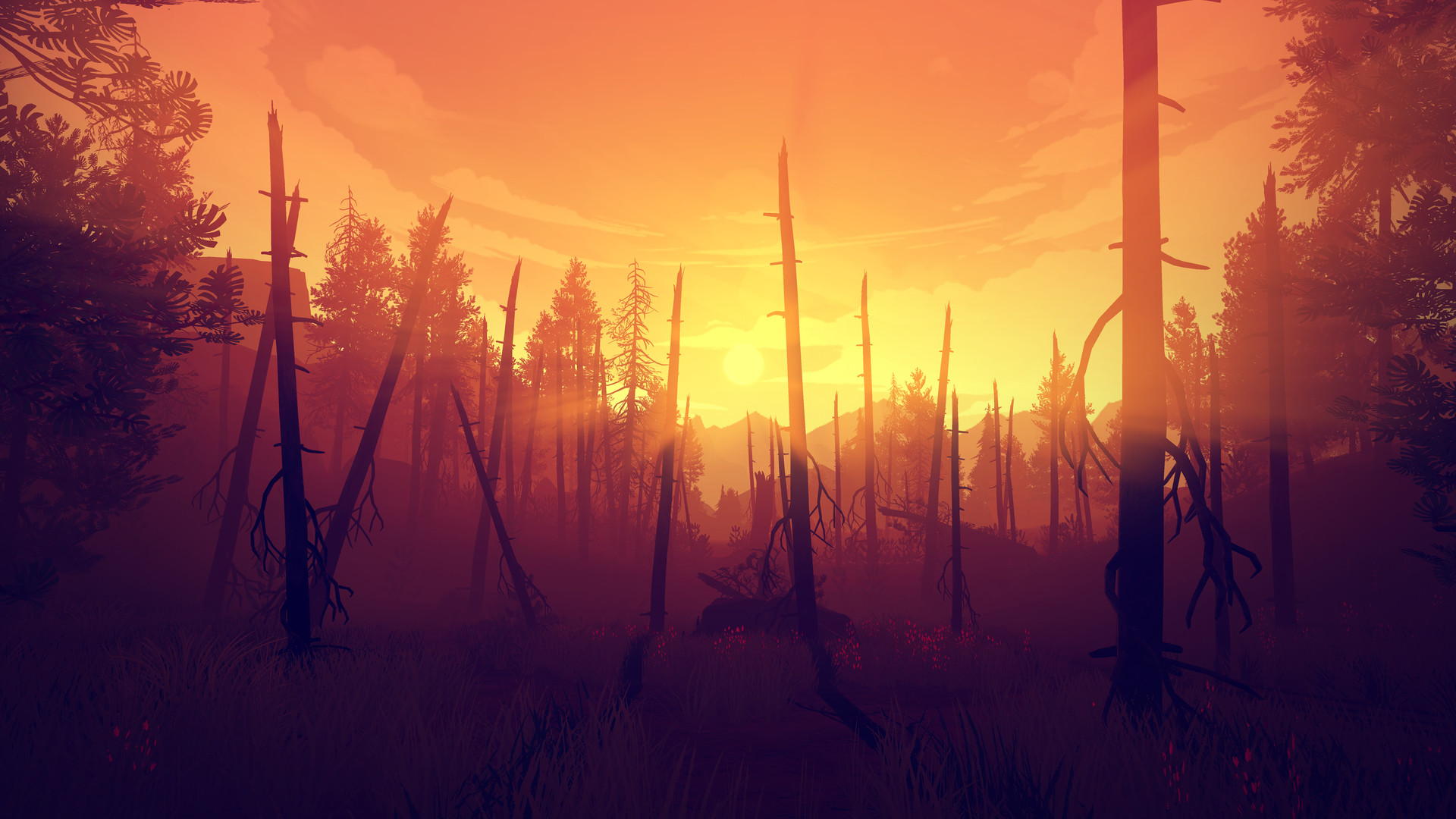
The wilderness is presented as a continuous outdoor space whose visual landmarks help the player keep bearings. Trails pass through forest, open clearings, lakesides, rocky passages and areas where fire has changed the scenery. The art uses broad color fields, angular silhouettes, distant haze and changing light to make the terrain readable from different elevations. Climbing over a ledge can reveal a new view, while a bend in the trail or a gap between trees can conceal what lies ahead. The developer commentary describes a day structure that moves the story forward in distinct intervals, and a dynamic lighting system that changes the sky, fog, sunlight and shadows. These shifts change the look and mood of familiar locations as Henry’s summer progresses.
Several carried objects add personal details to the exploration. Henry can use a disposable camera to take a limited number of photographs while travelling. Each picture requires him to wind the camera before taking another, making photography a deliberate choice about what to frame. Other everyday objects and notes invite inspection, and Henry’s hands and movement keep him present in the first-person view. Together with the radio, map, compass, caches and ropes, these interactions give the player a set of concrete ways to engage with the forest.
- Developer
- Campo Santo
- Genre
- Adventure / Mystery