
About FINAL FANTASY VII
In the original FINAL FANTASY VII, mercenary Cloud Strife joins AVALANCHE in its resistance to Shinra, a corporation exploiting the planet’s life force as mako energy. Their conflict expands beyond Midgar when Sephiroth returns and the planet faces a greater threat. Build a party, explore connected regions, and customize abilities with Materia.
FINAL FANTASY VII is set on a world where Shinra Electric Power Company has built its reach around extracting mako, energy drawn from the planet’s life force. The story begins in Midgar, a vast industrial city shaped by Shinra’s reactors and the neighborhoods beneath its elevated plate. Cloud Strife, a former member of Shinra’s SOLDIER military unit who now works as a mercenary, accepts a job with the anti-Shinra group AVALANCHE. Barret Wallace leads the cell and Tifa Lockhart is among its members. What starts as resistance to the company’s control broadens when the group learns that Sephiroth, a legendary SOLDIER, has returned and the planet is in danger. The narrative follows Cloud and his companions through this conflict while his uncertain past remains part of the story.
The player directs Cloud and a changing group of allies through towns, facilities, wilderness, and a world map connecting the regions. Field scenes use characters and environments to present routes, conversations, story events, and objects to inspect; encounters move into a separate battle screen. Up to three party members fight together, and the active lineup can change as the journey introduces people with different backgrounds and combat roles. Barret uses a prosthetic arm fitted with ranged weapons, Tifa attacks with close-range martial arts, and Aerith’s role begins in Midgar’s slums before she joins Cloud’s journey. Exploring between story scenes means speaking with residents, checking side paths, collecting items, and finding ways forward through each area. The story keeps its focus on the original game’s world and events rather than the later FINAL FANTASY VII REMAKE series.
Battles use Active Time Battle gauges that fill while combat continues, with character Speed affecting how quickly each participant is ready to act. Once a character’s gauge is full, the player selects an action such as a physical attack, defending, using an item, casting magic, or calling a summon. The battle menu pauses for commands according to the game’s settings, but enemies have their own timing and can act as the party chooses. Position and target selection matter because some attacks affect one foe while others can reach groups, and enemy formations can put opponents in different rows. Characters also have Limit Breaks, powerful actions available when their Limit gauge fills as they take damage. Deciding whether to use a ready Limit Break, spend MP on a spell, or preserve resources for later encounters gives the turn-based fights their moment-to-moment rhythm.
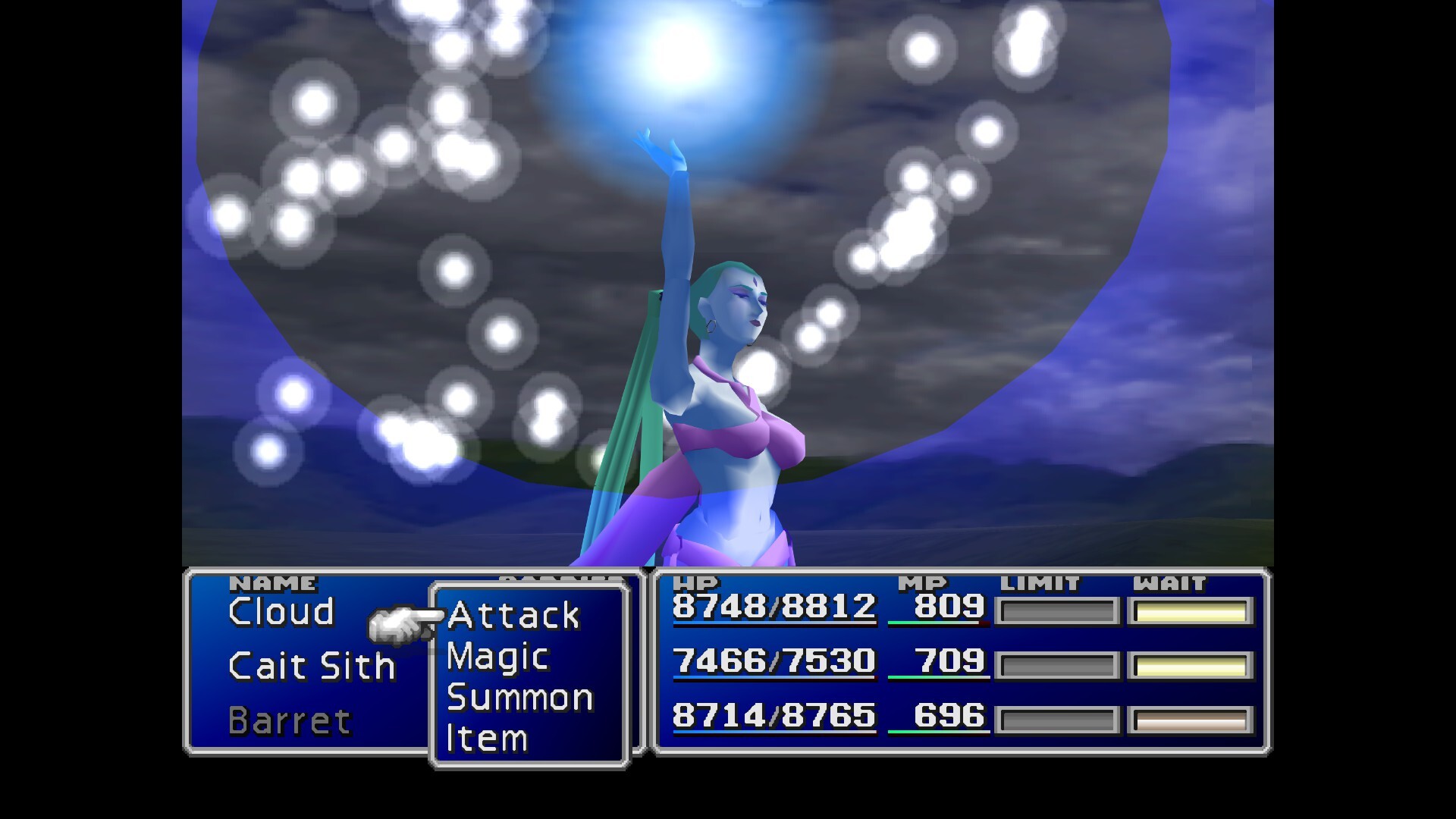
Materia is the main way to assign abilities and reshape party roles. These colored orbs fit into slots on weapons and armor, and their categories provide different functions: Magic Materia grants spells, Summon Materia calls allies such as Ifrit, Command Materia adds battle actions, and other types alter statistics or support linked effects. Equipment determines how many slots are available and whether neighboring slots are linked, so changing a weapon can also change which combinations a character can use. For example, a Support Materia can modify a compatible spell when the two occupy a linked pair. Materia earns AP from battles while equipped; as it grows, it can unlock more abilities, and mastering many Materia produces a new copy. The player can move orbs between party members and equipment, making party setup a continuing part of preparation rather than a fixed class choice.
Character growth combines experience, equipment, and the abilities assigned through Materia. Winning encounters provides experience and AP, while the party also collects gil and items used for recovery, status treatment, and other practical needs. Each character has their own Limit Break set, which develops through use and battle participation; the available Limit command changes as those techniques are learned. Weapons and armor are more than simple increases to attack or defense because they provide different Materia slots, linked pairs, and growth rates. A weapon with a limited or unlinked layout may suit a different ability plan from one that allows several combinations. Menu preparation therefore involves checking who will use each spell or command and balancing that setup against a character’s equipment. The result is a progression loop in which new gear and Materia change both a fighter’s statistics and the actions available in battle.
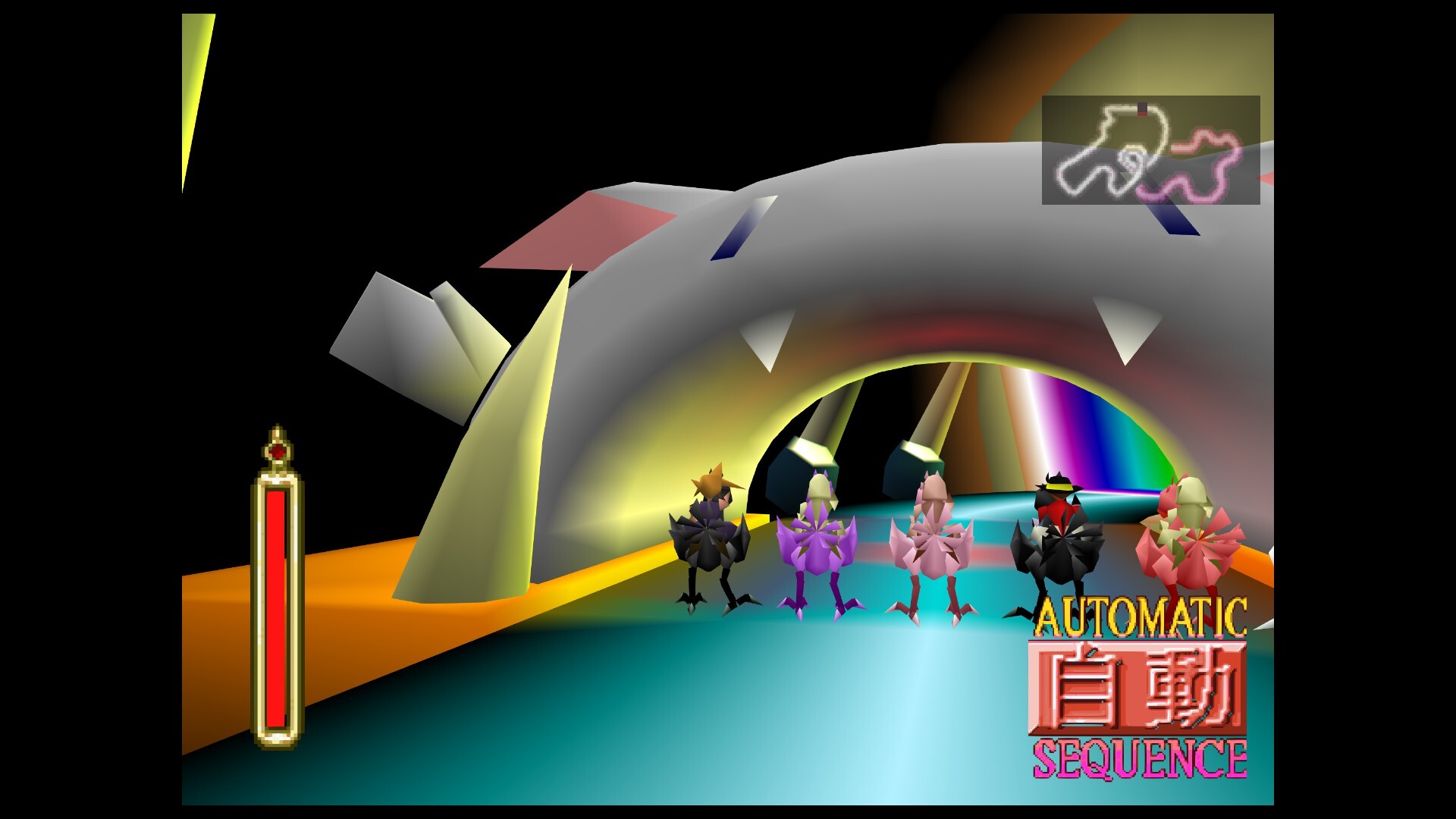
Travel gradually opens a wider range of places and optional diversions beyond the main route. Towns provide shops, conversations, and information, while story locations mix exploration with encounters and set-piece events. The Gold Saucer is an amusement park with its own games and activities. Fort Condor offers strategy battles elsewhere in the world. The player can also pursue side activities such as chocobo raising and racing, which connect to travel and optional rewards. These diversions use their own rules rather than replacing the main party battles: some test timing or movement, while others involve collecting or managing resources. They give the journey additional systems to discover alongside the central conflict, and the game returns to the world map as the player moves between its settlements and regions.
This Steam product is the upgraded version of FINAL FANTASY VII’s 2013 edition, and Square Enix states that its story is unchanged. Its additions affect convenience and battle settings: a speed mode can accelerate battles, travel, and selected events; random encounters can be switched off while story-event battles remain required; and battle enhancement restores HP and MP and fills the Limit gauge. An autosave feature is also included. These options sit around the original role-playing structure of field exploration, party-based ATB battles, equipment, and Materia, allowing the player to adjust the pace or encounter frequency without changing the narrative being told. The game remains the original FINAL FANTASY VII, distinct from FINAL FANTASY VII REMAKE and its later installments, which retell and expand the story through a different format and combat design.
- Developer
- Square Enix; Steam also credits FINE Co., Ltd.
- Genre
- Role-playing game