
About FEZ
FEZ follows Gomez, a small resident of a seemingly two-dimensional world who discovers a third dimension. Rotate the landscape among four viewpoints to connect platforms, uncover routes and search a sprawling network of rooms for cubes, fragments and puzzles that reveal more of the world.
FEZ begins with Gomez living in a bright, flat-looking village. The arrival of a mysterious third dimension changes how he and the player understand that familiar place, setting him on a journey through a world whose landscapes have depth even when viewed from the side. Gomez wears the fez that makes this shift possible, and the journey centers on restoring the stability of a universe that has begun to come apart. The story is deliberately simple in its outline: travel, explore, and gather the pieces that help put things right. Its cast is led by Gomez and the inhabitants he encounters in villages and other areas; the larger sense of history comes from architecture, symbols and environmental details rather than long explanatory scenes. The game leaves room to look around and make sense of its strange places at the player’s pace.
The fez grants Gomez a four-sided view of the world. With a turn of the landscape, the camera shifts by a quarter rotation to show a different face of the same three-dimensional structure. Gomez still runs and jumps as a two-dimensional platform character in the current view, but the apparent arrangement of ledges, ladders and walls changes around him. Two platforms that looked separated can line up in one perspective, while a ladder that seemed broken can become a continuous climb. Rotation is therefore a way to change the route through a room, not a decorative camera spin. Looking at every side helps reveal which surfaces connect and where a jump that seemed impossible becomes a straightforward crossing.
Rooms also use mechanical props whose states reshape a route. Levers can raise or lower water, changing which ledges or passages are reachable; moving platforms travel along tracks that make sense from a particular side; and explosives can break weak sections of rock to open a passage. Ladders can appear discontinuous from one view yet line up from another. Some areas restrict perspective changes, so the player must plan around the available view instead of rotating at will. These devices give each location a concrete task beyond collecting a visible fragment: operate a mechanism, watch how the room changes, and use the altered geometry to cross. The puzzle comes from reading the prop and the space together, not from a new ability that Gomez learns.
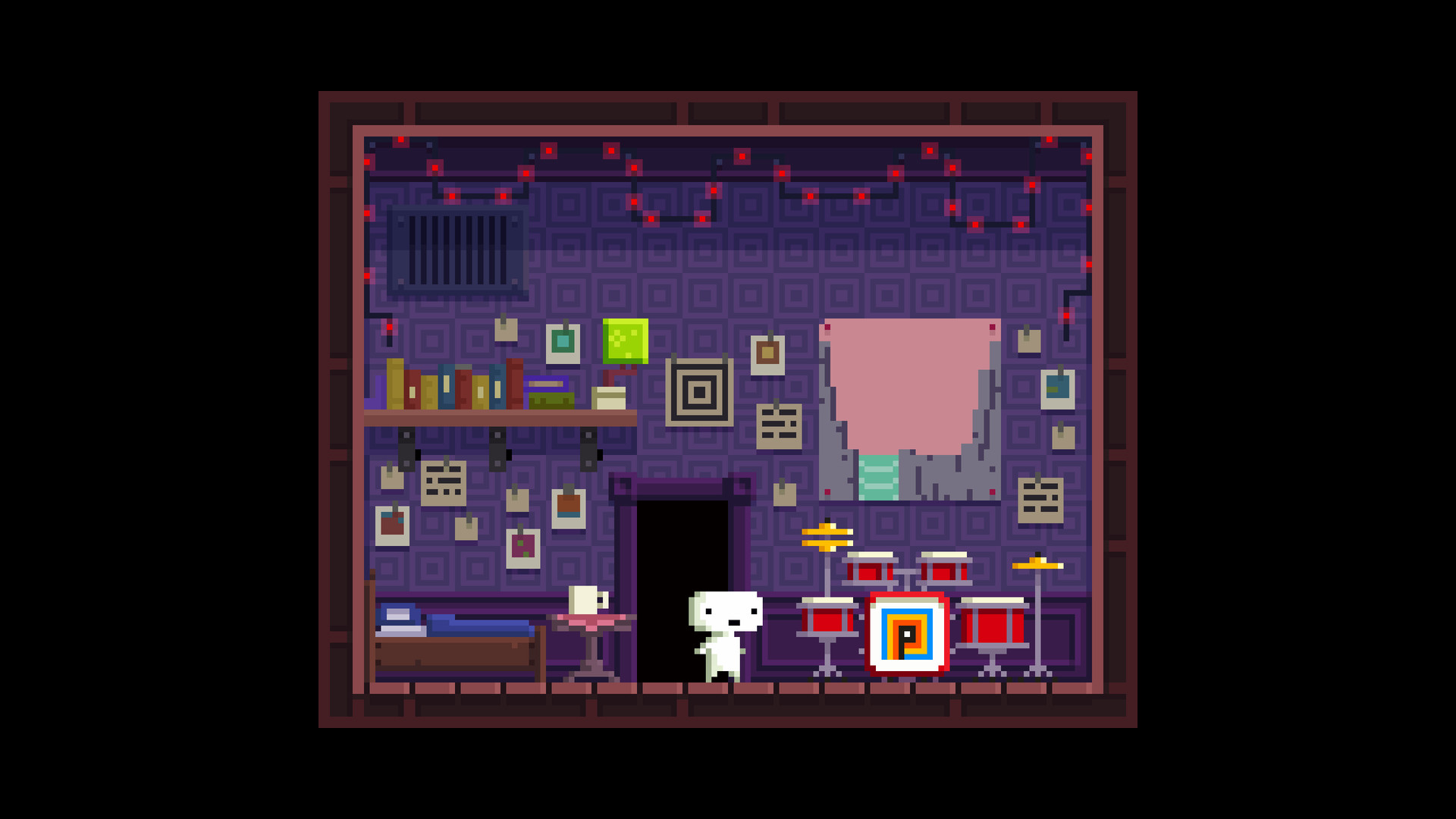
FEZ’s world is a connected network of rooms and larger hubs rather than a straight corridor of stages. Doors link one place to another, and the in-game map gradually fills in as Gomez discovers more of this structure. Its branching layout encourages detours: a blocked door, an unexplored connection or a room marked as incomplete can point toward a reason to return. The map helps show how areas relate, while its symbols also track what kinds of discoveries remain in a room. Moving through the network means alternating between navigation at the world level and close inspection within each space. A doorway can lead to a small self-contained chamber, a new landscape, or another junction in the wider route, so getting oriented is part of the ongoing exploration.
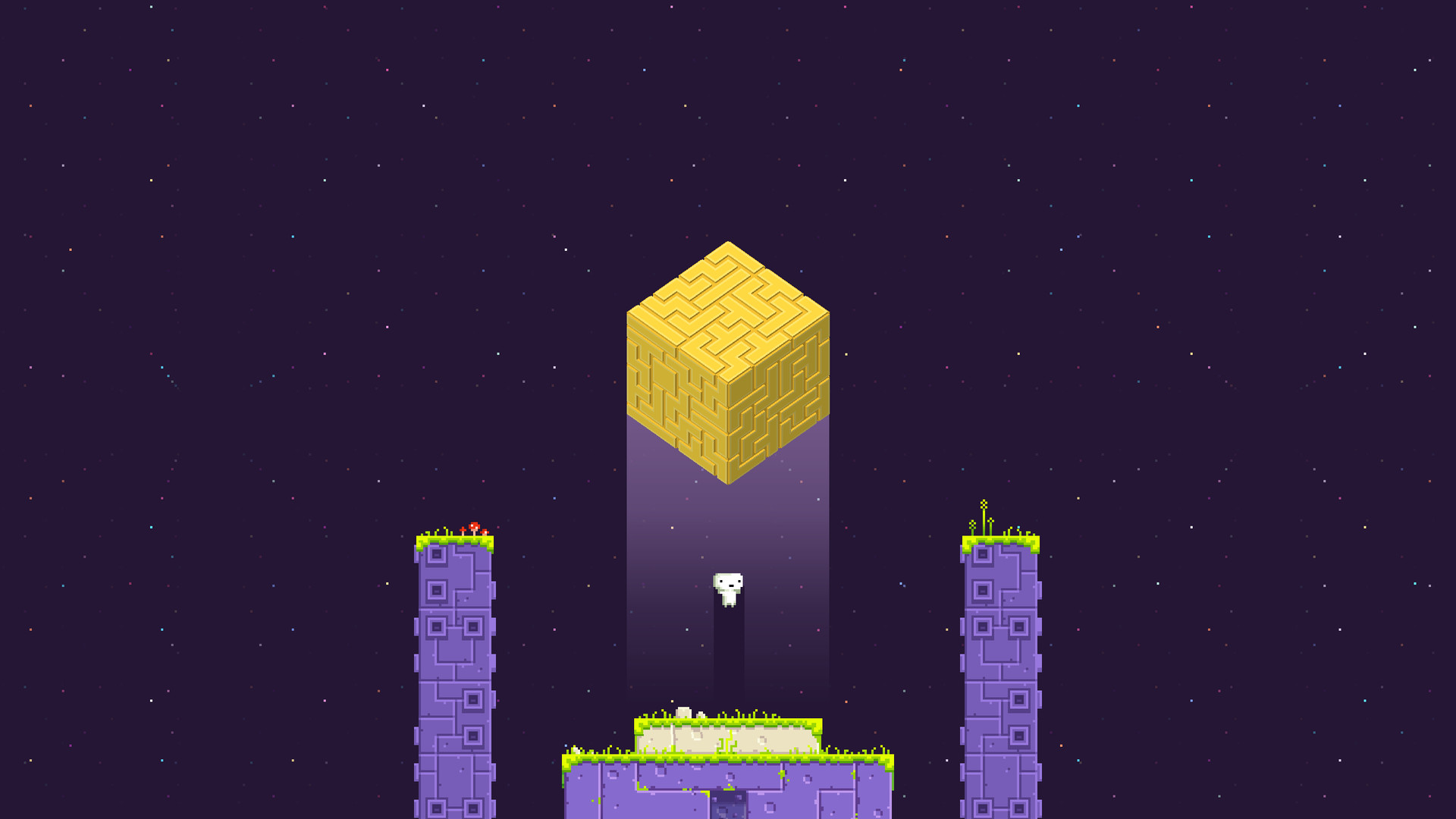
Cubes provide the main thread of progression. Some appear whole, while others are divided into smaller fragments placed around a room or tucked into the geometry. Collecting enough of these pieces forms a cube that can be used to open sealed doors and extend access to the world. Reaching them calls for a mix of platforming and perspective reading: Gomez climbs, jumps and crosses visible ledges, while rotation exposes routes and objects hidden behind the current face. Other rewards include keys and a small range of environmental discoveries, but the cube hunt remains the central reason to revisit places. The game does not steadily teach Gomez a large catalogue of new abilities; instead, the player carries forward knowledge of how existing rules fit together and applies it to new rooms.
Beyond the visible cube pieces, the environment contains puzzles that ask the player to notice patterns and interpret symbols. Shapes, markings and arrangements recur across rooms, while some clues sit in scenery rather than in a dedicated instruction panel. Later challenges draw on that visual language and ask for more than rotating until a platform lines up. Map markings can suggest where a room holds something unresolved, and experimentation helps distinguish a traversal obstacle from a puzzle whose clue is elsewhere. These riddles are part of the exploration loop, but the game does not require a single linear order for every discovery. A player can leave a cryptic room, gather more context in another branch, and return when a symbol or arrangement has acquired a new meaning.
FEZ’s backgrounds contain small movements that make rooms feel inhabited beyond their platform routes. Birds perched in trees take flight as Gomez approaches; a turtle spins on its shell, and an inchworm crosses a ledge in the distance. These creatures do not become enemies or turn the journey into combat. Their motion sits alongside villagers, signs and unusual architecture as part of what the player can notice while moving through a room. The soundtrack also changes with the setting: bright outdoor areas give way to more subdued music in cemeteries, ruins and underground spaces. This shifting atmosphere gives the connected world distinct local character, even when the player’s immediate task is simply to understand a doorway, climb a structure or decide which path to explore next.
- Developer
- Polytron Corporation
- Genre
- Puzzle platformer / exploration adventure