
About F.E.A.R. 2: Project Origin
F.E.A.R. 2: Project Origin follows Sgt. Michael Becket, whose unit is diverted to detain Armacham president Genevieve Aristide shortly before a catastrophic event. The mission draws Becket into Fairport’s crisis, where Alma’s influence, Replica forces, tactical firefights, and enhanced reflexes shape the campaign.
F.E.A.R. 2: Project Origin follows Sgt. Michael Becket, a member of an elite military squad sent to Fairport, Auburn. The squad’s initial assignment is redirected: CentCom orders Becket’s team to collect Armacham Technology Corporation president Genevieve Aristide from her private residence and take her into protective custody. The team arrives in the city only minutes before the blast associated with the original F.E.A.R. operation, after which the routine mission becomes a fight for survival. Becket and the squad move through a crisis tied to Armacham’s Origin research and Alma Wade, whose power is escalating. The story is separate in viewpoint from the first game: the player controls Becket rather than the Point Man. This change lets the sequel show the same wider conflict from the perspective of a different soldier and unit.
The single-player campaign advances through saved checkpoints and completed missions. Becket’s orders establish the immediate objective, but the changing situation repeatedly forces the squad to respond to new threats and gather intelligence. The opening briefing identifies Fairport’s industrial district, Auburn, as the area connected to suspicious activity and names Armacham’s Origin facility as part of the investigation. It also explains Aristide’s significance to the assignment without resolving the mystery behind the events. The route crosses an apocalyptic landscape as the campaign moves through varied indoor and outdoor spaces. The changing locations alter the size and character of combat spaces: tight interiors support close engagements, while more open areas allow different firing lines and movement. Mission selection later allows replay of levels already completed, and continuing a campaign returns Becket to the latest checkpoint.
Combat centres on a first-person weapon loop, with Becket finding firearms and ammunition among enemy forces and abandoned caches. The campaign sets a four-weapon limit in single-player, along with five of each regular grenade type and four proximity mines. If the inventory is full when a new gun appears, the player chooses which current weapon to exchange. The PDA’s DataNet stores information about encountered firearms, including statistics that help compare options such as an assault rifle and combat shotgun. This makes a new pickup a loadout decision rather than an automatic upgrade. The starting equipment includes a standard pistol and submachine gun, and the arsenal expands as missions continue. Close combat remains available through punches, strikes with a weapon, a roundhouse kick, a running jump kick, and a sprinting slide kick. Sprinting also uses stamina, which must recover before another sustained run.
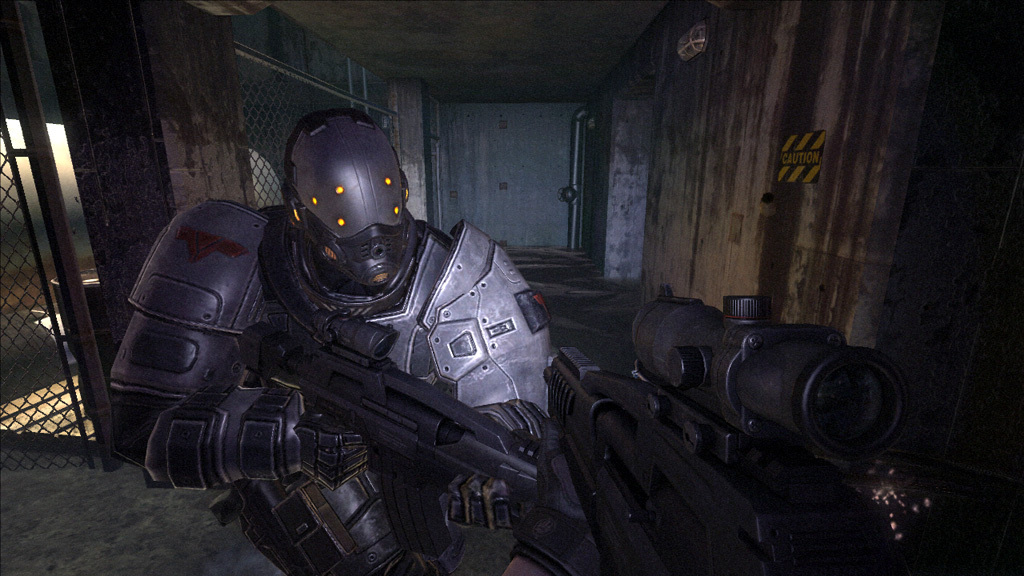
Becket’s enhanced reflexes provide the Slow-Mo ability, which slows events around him while he aims and moves at combat speed. A meter limits how long he can maintain it, and the player can enter and leave the state while energy remains. Reflex Injectors permanently extend the available duration, so finding one affects later encounters as well as the immediate route. The ability is useful when several enemies attack at once or when incoming fire leaves little time to aim, but it is a finite reserve that must be budgeted. Health and armor use different pickup rules: red medical injectors restore a small amount of health immediately when collected, while medkits can be stored, up to three, and used later to restore health fully. Armor vests repair protection against small-arms fire, though explosions and armor-piercing attacks can wear it down quickly. These distinct resources make route pickups and timing part of surviving each encounter.
The environment is an active part of combat and navigation. Becket can move shelves, furniture, or car doors to create cover, clear a blocked passage, and reach computers that unlock doors. Explosive objects such as gas cans, fire extinguishers, and electrical boxes can be shot when enemies are near them, but their blast can also hurt Becket. Enemies react to hazards and surroundings: a soldier caught in fire may try to extinguish it or reach water, then return to combat, while enemies can flank a player who stays mobile or throw grenades to dislodge one who relies on cover. The result is a firefight in which the player’s position, the available objects, and the enemy response interact. Becket can use cover to stabilize a fight, move to another angle, or exploit a volatile object, while opposing soldiers can use many of the same opportunities.
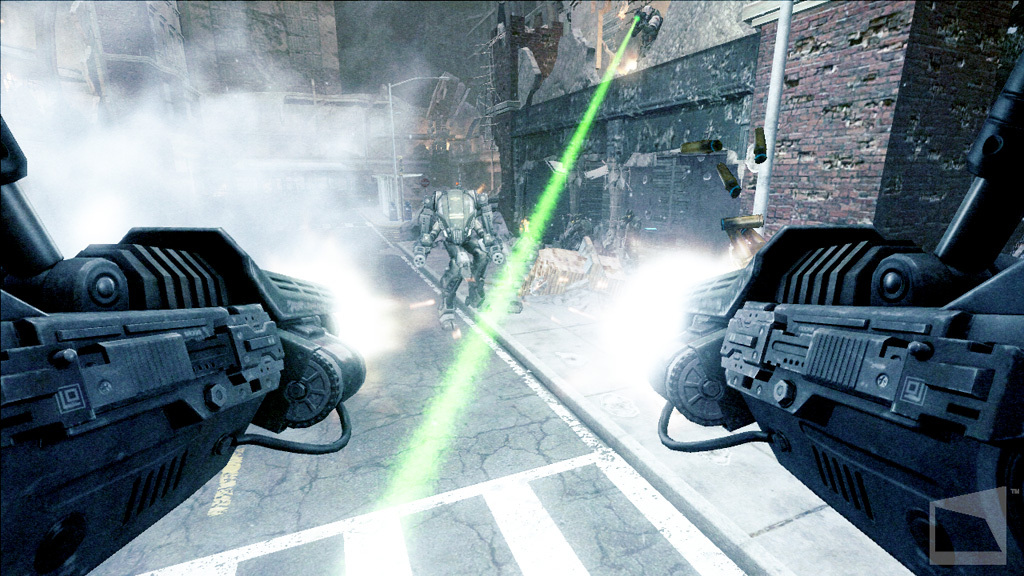
A distinct change of scale arrives when Becket operates an Elite Powered Armor unit, or EPA. The armoured vehicle brings heavier firepower, more protection, and different movement and environmental responses, temporarily reversing the usual relationship between a soldier and the enemies around him. These sequences create intermittent changes in combat pace; the player can also leave the EPA and confront the opposition on foot when a sequence offers that choice. This is a campaign system rather than a permanent equipment slot, so the standard weapon, health, armor, and reflex decisions remain the foundation of play outside the vehicle. Becket’s visor and PDA provide mission objectives, checkpoint progress, gathered intelligence, weapon details, and tutorials for actions encountered in the field. Together, these systems connect the squad’s investigation to moment-to-moment play: the player follows orders, examines the changing city, adapts to tactical enemies, and uses the terrain as the operation deteriorates.
- Developer
- Monolith (Steam product page); developed by Monolith Productions
- Genre
- Action; first-person shooter