
About Far Cry New Dawn
Set in Hope County seventeen years after a nuclear catastrophe, Far Cry New Dawn follows a security captain helping Thomas Rush support settlements across the ruined United States. The Survivors at Prosperity face the Highwaymen, led by twins Mickey and Lou. Rebuilding the home base, crafting ranked equipment, reclaiming outposts and travelling on Expeditions drive the campaign.
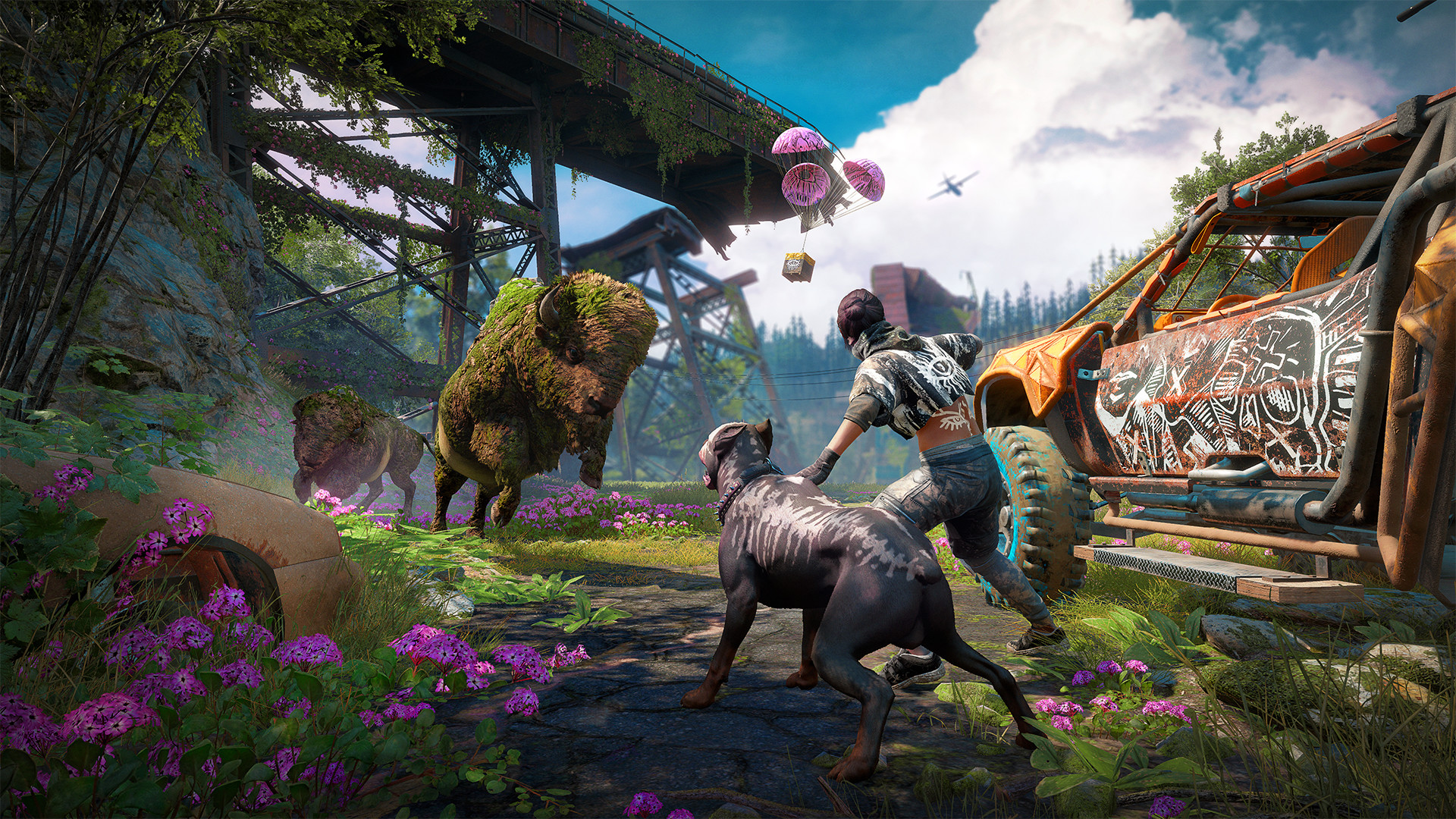
Far Cry New Dawn returns to Hope County, Montana, after seventeen years of nuclear devastation and a period of rapid plant growth known as the superbloom. Familiar roads and structures sit within a changed landscape, where colourful vegetation and wildlife share space with abandoned settlements and fortified raider camps. The player takes the role of a security captain travelling with Thomas Rush, who helps communities rebuild. When the group reaches Hope County, the Highwaymen attack and separate the captain from the crew. The immediate task becomes reaching the Survivors’ base, Prosperity, and helping its residents withstand the raiders. The altered county is the central open world, while missions and Expeditions also take the player farther afield.
The Highwaymen control territory and resources under the leadership of twin sisters Mickey and Lou. Their followers occupy ruined buildings and establish outposts that interrupt travel and threaten the local population. The conflict is not limited to a single fortified base: story missions, specialist requests and encounters with the raiders push the player around Hope County. Several familiar characters return, including Grace Armstrong, Sharky Boshaw, Hurk and Nick Rye, while new survivors such as Nana and Bean can be encountered. Helping these people unlocks practical support. Some become Specialists at Prosperity, while Guns for Hire and Fangs for Hire can accompany the captain and bring their own combat abilities into fights.
Prosperity is both a refuge and an upgradeable home base. Its facilities include the Workbench for weapons, the Infirmary for health, and other services that support travel, companions and crafting. Recruiting Specialists and investing ethanol allow the settlement and its facilities to advance. The Workbench determines which weapon ranks can be crafted, so settlement investment has a direct effect on the firepower available against increasingly durable enemies. Other facility improvements can expand health or unlock travel options. Prosperity is also where the player returns to choose upgrades, craft equipment and recruit help. Its development ties the wider campaign together: outposts and Expeditions produce resources, while those resources strengthen the base that sends the player back into the field.
New Dawn gives weapons, vehicles and enemies ranks, creating a progression layer around combat. A weapon’s rank affects how it performs against enemies of different ranks, and upgrading the Workbench at Prosperity opens access to better equipment. Crafting uses scavenged components rather than relying only on weapons found in the world. The needed supplies come from several activities, including looting locations, searching enemies, hunting and taking resources from Highwaymen. This makes combat preparation part of exploration. A lower-ranked firearm may still be useful against weaker opposition, but stronger raiders encourage the player to improve equipment and facilities. Vehicles also receive ranks, connecting the same resource and upgrade economy to movement around the county.
Outposts are major Highwaymen positions that the player can attack and liberate. A site can be approached using stealth, companions or direct combat, and clearing it gives the Survivors access to ethanol. Once freed, an outpost can be scavenged for an additional payout; doing so hands the location back to the Highwaymen, who return with stronger forces. Reclaiming it then offers a larger reward and a harder encounter. This escalation makes each outpost reusable and gives the player a choice between securing a useful foothold or taking on a tougher version for more resources. Ethanol from these activities funds Prosperity’s facilities, so the repeated outpost cycle feeds back into the settlement and weapon-rank progression.
Expeditions take the captain outside Hope County to self-contained locations across the United States. A helicopter pilot brings the player to sites such as a beached aircraft carrier, a bridge or an amusement park, where Highwaymen hold a valuable package. The task is to locate the target, take it, and survive until extraction. Picking up the package alerts the raiders to the player’s position, turning the return to the extraction point into a pursuit. Expeditions provide resources used in crafting, including rarer components for stronger equipment. Facilities at Prosperity unlock access to this activity and can improve travel options. Expeditions offer a different layout and objective from reclaiming a Hope County outpost, while remaining part of the same resource loop.

The world offers additional ways to collect supplies between story objectives. The player can search abandoned buildings, loot raider camps, hunt wildlife, gather plants, intercept supply drops and pursue vehicles carrying ethanol. Animals can also be recruited as Fangs for Hire after their associated encounters, adding another kind of companion to the roster. These activities give a reason to move through the landscape rather than treating map travel as empty distance. Different resources serve different needs: ethanol improves facilities, while components and materials are spent at workbenches on weapons and other gear. The specific task at hand influences whether the player pushes toward a mission, clears a nearby camp, or gathers supplies before returning to Prosperity.
Perks develop the captain separately from the upgrades at Prosperity. The Grapple perk opens climbs to high points, while others add carrying capacity, vehicle repair or takedowns against tougher enemy ranks. Perk Points come from challenges tied to weapons, exploration, hunting and combat. Treasure Hunts offer another route: these marked locations involve an environmental puzzle, and solving one provides points and materials. Freeing a civilian held by the Highwaymen can also add a point. This gives a different reason to investigate a ruined bunker or stop for an encounter during a journey. Ethanol strengthens facilities, gathered components make equipment, and Perk Points expand what the captain can do personally, so the game asks the player to pursue several kinds of progress across the same landscape.
- Developer
- Ubisoft Montreal (official Ubisoft article identifies the Montreal team as crafting the game)
- Genre
- Open-world action adventure / first-person shooter