
About Far Cry 4
Far Cry 4 follows Ajay Ghale as he returns to the Himalayan country of Kyrat to fulfil his mother’s last wish and becomes caught in a rebellion against Pagan Min. Explore a mountainous open world, fight or sneak through enemy territory, hunt wildlife, craft equipment and shape Ajay’s abilities as the conflict develops.
Ajay Ghale returns to Kyrat, the country where he was born, to scatter his mother’s ashes. His arrival brings him into the conflict between Pagan Min’s regime and the Golden Path, a rebel movement whose leaders, Amita and Sabal, disagree about how Kyrat should be changed. The story follows Ajay through a country shaped by tradition, violence and competing visions for its future. Forests, villages and snow-covered Himalayan heights make up a connected landscape where political struggle meets everyday travel and danger. Missions move the central conflict forward, while decisions during the campaign can affect which Golden Path perspective takes priority. The premise stays close to Ajay’s return and the rebellion he becomes part of, with Pagan Min’s control visible in the occupied territory and the forces sent to defend it.
Kyrat’s height and terrain shape how the player moves between objectives. Ajay can travel on foot or by vehicle, climb through the landscape with a grappling hook, and use a gyrocopter to scout from above. A wingsuit lets him descend through open air toward lower ground, turning a high route into a way to reach a valley or enemy position. These options make elevation useful for reconnaissance and approach as well as travel. The landscape also holds its own threats: wildlife can attack while Ajay is crossing an area or trying to gather resources. The combination of cliffs, roads, forests and mountain routes means that a journey is often a sequence of choices about height, cover, speed and risk, rather than a direct walk between two markers.
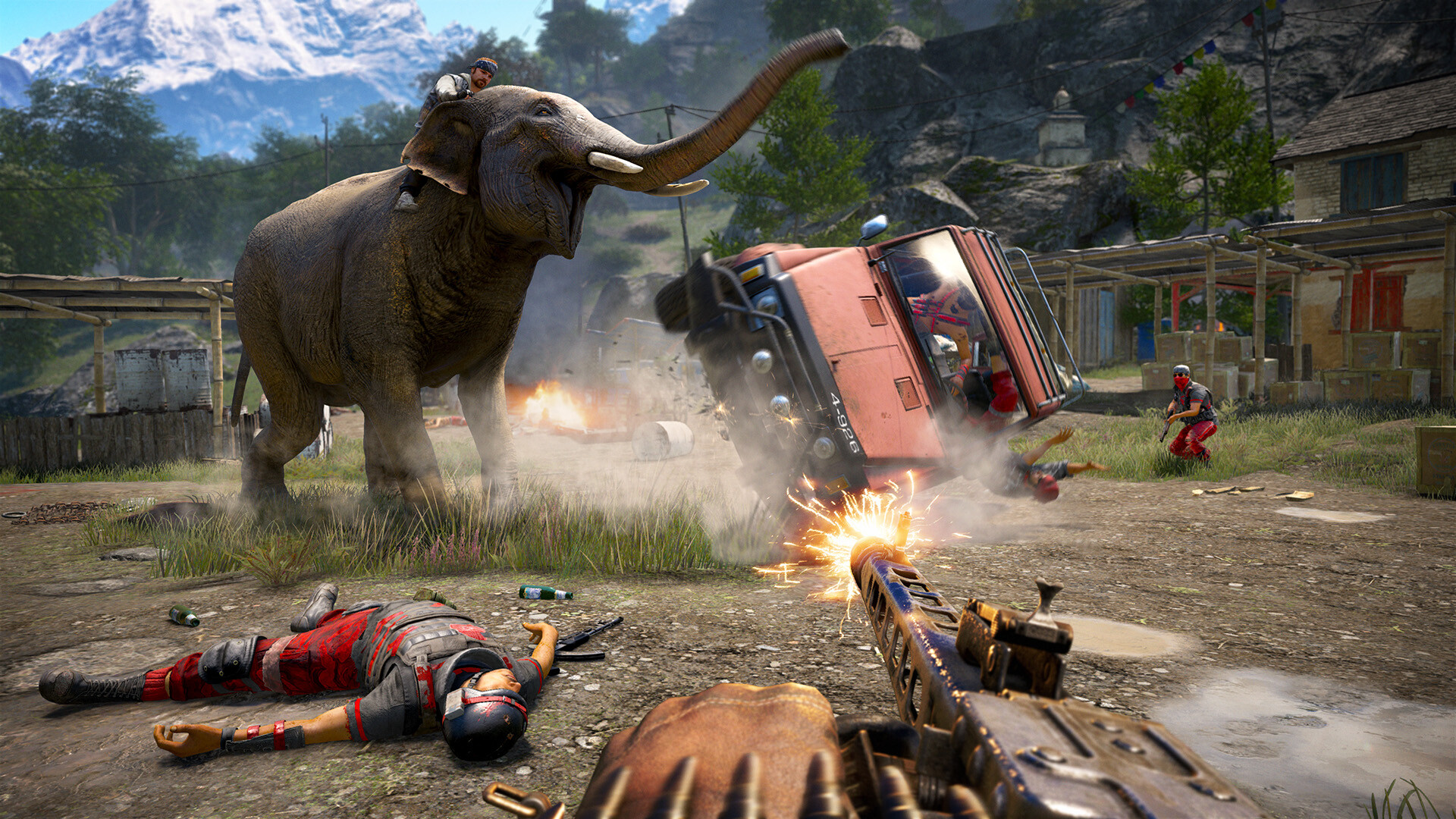
Fighting enemy territory allows for stealth, long-range attacks or a more direct assault. Ajay can survey a site before entering, then decide whether to use a quiet weapon, take advantage of cover or bring stronger firepower. Enemy outposts and larger fortresses are important targets in the campaign against Pagan Min’s forces; capturing an outpost opens fast travel and new quests, and changes nearby patrols from hostile to friendly. Towers provide another kind of objective: reaching their upper levels takes over the radio signal, reveals part of the map and can open access to weapons. A varied arsenal supports different approaches, and weapons can be bought, modified and assigned to slots as equipment develops. Scouting, choosing an entry, handling alarms and responding to wildlife can all change how an attack unfolds.

Hunting ties the wilderness to Ajay’s equipment. Animals leave hides that can be used to make upgrades, so the player has a reason to track wildlife beyond simply avoiding it. Hides must be collected after a kill, and equipment upgrades progress through tiers: ordinary animal hides support the earlier improvements, while later ones call for a hide from a rarer animal. The means of hunting matter, since a bow or knife kill can yield an extra skin and a clean kill contributes Karma. Bait made from animal materials can be thrown to attract predators, adding another way wildlife can enter an encounter. This creates a loop between travel, gathering and capacity: hunt specific animals, bring back the materials, improve equipment and carry more supplies on later excursions.
Ajay’s capabilities and equipment grow through several parallel systems. Experience points earn skill points that can be spent to unlock abilities, while weapons become available through story and side missions, store purchases, looted finds and bell-tower progress. The Tiger and Elephant skill trees focus on different needs: the first develops offensive abilities such as takedowns, while the second improves health and syringe effects. Some abilities also require completing a named activity or mission, so skill points alone do not open every option immediately. Weapon slots and carrying capacity can be expanded by upgrading equipment; shops let the player assign guns to slots and fit supported modifications such as barrels, scopes and magazines. A separate Karma meter rises through certain helpful events and clean animal kills, but falls if Ajay harms civilians or Golden Path allies. Advancing Karma levels gives benefits such as store discounts and access to some weapon rewards. These systems make activity in Kyrat count in different ways: experience develops Ajay, hides enlarge what he can carry, territory progress opens equipment and Karma affects rewards.
The rebellion is only one part of the activity available across Kyrat. Side tasks include helping Golden Path members, rescuing hostages, dealing with enemy couriers and confronting wildlife threats; other activities range from races and armed escorts to the Shanath Arena, where Ajay fights humans and animals. The Arena offers a distinct combat setting built around survival and crowd reaction, rather than territorial control. Far Cry 4 also includes a drop-in co-op mode designed for two players to explore, hunt, fight and take over outposts together, separate from its main story missions. These activities share the same landscape and equipment systems while giving the player different immediate goals, from a campaign operation to a hunt for crafting materials or an open-world challenge.
- Developer
- Ubisoft Montreal (with Red Storm, Shanghai, Toronto and Kiev studios)
- Genre
- Open-world first-person shooter