
About Far Cry 2
A foreign mercenary arrives in a war-torn African country with a contract to find the elusive arms dealer known as the Jackal. Between missions for the UFLL and APR, malaria, unreliable weapons and dangerous travel shape a first-person campaign where preparation and improvised combat are part of the work.
Far Cry 2 places a hired mercenary in a fictional African country where civil war has displaced civilians and left roads, villages and wilderness contested. The player begins the assignment seeking the Jackal, an arms dealer whose weapons sustain both sides of the conflict. The UFLL, or United Front for Liberation and Labour, and the APR, the Alliance for Popular Resistance, each recruit the outsider for operations against their rival. Their leaders and field commanders turn the conflict into a series of contracts, while journalist Reuben Oluwagembi investigates the Jackal and gathers evidence about his place in the fighting. Malaria is present from the outset and remains a practical condition the protagonist must manage as the search unfolds.
Missions begin from a map of the region, with the player choosing routes and deciding when to take available jobs. Faction assignments send the mercenary to attack personnel, destroy supplies or eliminate specific targets, while side work offers different forms of support. Underground contacts arrange errands that earn malaria medicine; gun merchants offer convoy-destruction jobs that open additional weapons for purchase; and assassination contracts pay diamonds. Diamonds also buy weapons and upgrades, so optional work feeds back into the equipment available for later operations. The rewards solve different needs rather than forming one general currency: medicine manages the illness, diamonds expand the arsenal, and captured or secured safe houses provide places to rest and prepare.
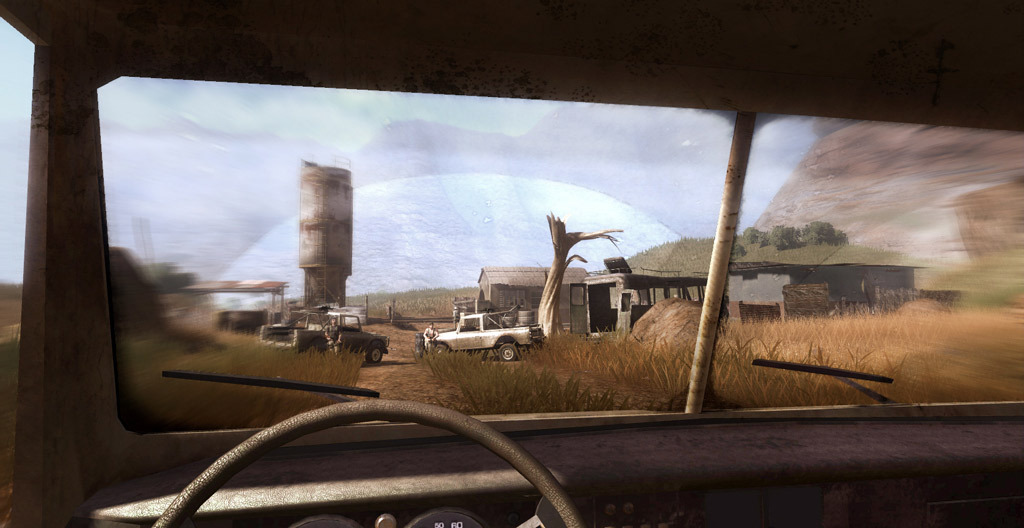
The world is crossed on foot and by salvaged transport, including cars and boats, with the map and a handheld navigation device helping the player orient across long distances. Travel itself creates exposure: militia checkpoints and roadside patrols can interrupt a planned journey, and the same routes may be crossed repeatedly while moving between mission contacts. Safe houses serve as rest points where the player can save, replenish supplies and choose a time to sleep before an operation. Some side tasks let the mercenary improve a nearby hideout, adding practical support for future departures. Reuben’s investigation also provides a reason to search beyond the main contracts, as scattered recordings connected to the Jackal contribute information about the war and its participants.
A selected mercenary companion, called a buddy, can become involved in the campaign and offer assistance around missions. The player may encounter buddies in trouble and help them, and a surviving companion can intervene when the protagonist is badly wounded. This support is limited by the companion’s condition and availability, making it one contingency among several rather than a replacement for planning. Friendships also open alternate mission opportunities: a buddy can propose an additional objective alongside a faction assignment, with a successful detour improving a safe house. The supporting cast is drawn from the wider group of foreign mercenaries in the country, so the player’s chosen character and later relationships determine which particular allies appear in that role.
Combat depends on selecting weapons and approach to fit the site, target and conditions. A camp can be entered quietly at night, approached from a distance with a rifle, or disrupted with explosives and close-range fire. Gun shops let the player buy weapons and improve equipment, including weapon and vehicle capabilities, while diamonds collected through work fund those purchases. Weapons recovered from militia fighters wear down through use: they become dirty, may jam and can eventually break. Purchased weapons are more dependable, which makes the supply network and the choice to spend diamonds part of preparation. When injuries become severe, the mercenary performs a close-up self-treatment before using a medical injection; ordinary health recovery and ammunition management remain important between encounters.
Fire is an environmental system that can change how a fight develops. Grass, brush, trees and structures can catch, while wind affects the direction flames travel; dry open ground is more susceptible than humid jungle, and rain or recent rain makes ignition and spread harder. Fire can pressure guards to flee or redirect their attention, yet a chain reaction may also threaten the player or damage a planned escape route. Its behaviour depends on fuel and conditions rather than following a fixed scripted path, so a Molotov or flare can be a tactical option without guaranteeing a predictable result. This makes scouting the terrain and reading wind and vegetation relevant to a firefight, especially when choosing whether an area effect is worth the risk.

Far Cry 2 also includes a map editor separate from the mercenary campaign. Its tools let players build custom spaces for the game's multiplayer modes, placing terrain, vegetation and structures to shape how a match can unfold. That is a different use of the same environmental ideas that drive the campaign: cover, open sight lines and routes through brush matter when designing a space as much as when crossing one under fire. The editor was included in the original PC and console versions. Its maps are built for matches rather than for the Jackal story, giving players a construction mode alongside the directed faction missions and the open campaign world.
- Developer
- Ubisoft Montreal
- Genre
- First-person shooter