
About Fallout 3: Game of the Year Edition
Leave Vault 101 and search the Capital Wasteland for a missing father in Washington, D.C. Build a character through S.P.E.C.I.A.L. attributes, skills and perks, then explore settlements, follow quests and fight with real-time weapons or V.A.T.S. The Game of the Year Edition also includes five story and gameplay add-ons.
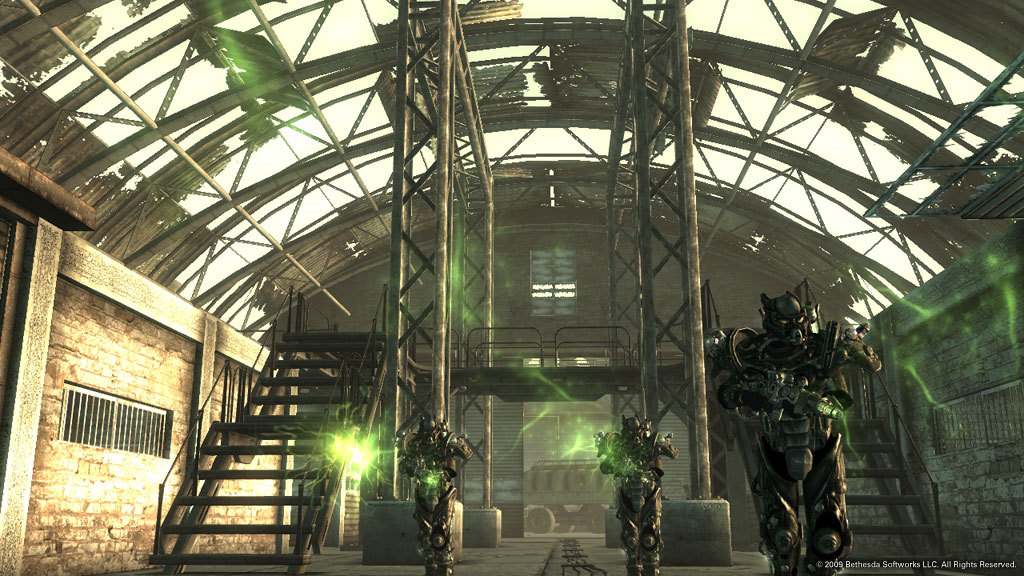
Fallout 3 places the player in the Capital Wasteland, the ruined Washington, D.C. region, in 2277, two centuries after nuclear war. The game opens inside Vault 101, where the player character has grown up under the shelter of Vault-Tec’s sealed community. When their father leaves unexpectedly, the character follows him outside, trading the vault’s controlled routines for a landscape of raider gangs, Super Mutants, feral ghouls and malfunctioning military machines. The world retains the series’ retro-futurist contrast: mid-century American imagery and consumer culture survive among wrecked buildings and improvised settlements, while advanced robots and energy weapons remain part of daily life. The opening establishes the family search, but the manual makes clear that the player can pursue it at their own pace or turn toward other people and problems encountered after leaving the vault.
The Capital Wasteland is arranged as an open region rather than a sequence of missions that must be followed in one order. Roads, landmarks and settlement interiors create routes between local stories, hostile sites and larger quest leads. Megaton, built around an unexploded bomb, is one of the first communities the player can reach; its residents provide conversation, services and jobs, while other settlements and factions draw the character farther across the map. The Pip-Boy collects the information needed to manage this travel: the map records discovered locations, the quest list tracks active objectives, and the radio receives broadcasts when the character is within signal range. A compass points toward nearby locations, threats and quest targets. This makes exploration a loop of following a lead, checking what is nearby, gathering supplies and choosing whether to continue the main search or investigate a detour.
Character development begins with S.P.E.C.I.A.L.—Strength, Perception, Endurance, Charisma, Intelligence, Agility and Luck—and continues through tagged skills and selectable perks. Attributes affect practical abilities: Strength supports carrying capacity and melee attacks, Charisma contributes to Speech and Barter, and Intelligence determines how many skill points are available at level-up. Skills cover distinct approaches such as Small Guns, Energy Weapons, Explosives, Lockpick, Science, Repair, Sneak, Medicine and Speech. They matter beyond combat: terminals can call for Science, doors and containers can test Lockpick, and conversations can open options through Speech or Barter. Perks add a chosen benefit as the character advances, letting a build lean toward accuracy, stealth, toughness or technical ability. Because the player has limited points to distribute, the same obstacle can invite different preparations rather than one universally capable character.
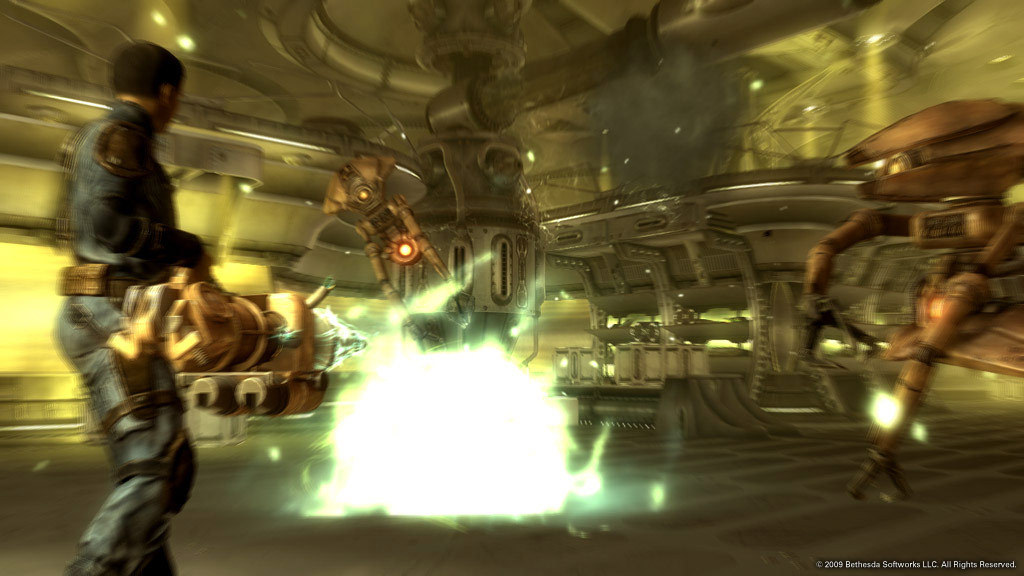
Combat can stay in real time, with the player aiming, moving, firing, reloading or switching weapons, or shift into the Vault-Tec Assisted Targeting System, V.A.T.S. V.A.T.S. pauses the action so the player can inspect enemies and queue attacks against particular body parts; each attack consumes Action Points, and the displayed hit chance varies by target and weapon. Crippling a limb can affect an enemy’s movement or aim, so targeting is a tactical choice rather than simply selecting the largest health bar. Guns, energy weapons, explosives, melee attacks and unarmed fighting each depend on different skills. Ammunition and equipment condition also matter: damaged weapons deal less damage and can jam, and repair uses a similar item as parts, with the Repair skill limiting how far condition can be restored. The combat loop therefore connects aiming decisions to the character build and the equipment kept in working order.
The Pip-Boy’s inventory separates weapons, apparel, aid, miscellaneous objects and ammunition, giving the player a place to equip gear, use Stimpaks or chems, and review a weapon’s damage, condition, weight and ammunition. Radiation is another persistent concern in the wasteland: exposure appears on the status display and can produce harmful effects as it accumulates. The character can change between first- and third-person views, sneak, wait, and use the Pip-Boy light in dark spaces. Quests can be solved in more than one way, and the game tracks Karma as good, neutral or evil; choices and conduct help shape that status. These systems make scavenging functional: a container might supply ammunition, medicine, a weapon to repair with, or an item that supports a skill or quest, while carrying capacity and the risks of travel encourage decisions about what to keep.
The Game of the Year Edition combines the main Fallout 3 campaign with five add-ons: Operation: Anchorage, The Pitt, Broken Steel, Point Lookout and Mothership Zeta. Their entry points appear as radio signals, messages or map markers in the Capital Wasteland, allowing the player to pursue them from the same character. Their content ranges across a military simulation, a new industrial city, a continuation of the main quest, a coastal region and an encounter with extraterrestrials. Broken Steel is particularly distinct because its quests follow completion of the main quest and the edition raises the level cap to 30. The other additions create separate excursions and combat situations alongside the base game’s search for the father. Together, the GOTY package provides the original open-world role-playing campaign and its complete official expansion set, with the core character, inventory and combat systems carrying across the broader package.
- Developer
- Bethesda Game Studios
- Genre
- Role-playing game