
About ELDERBORN
In a mythic age, a barbarian warrior enters a doomed city as tribes seek a new dark messiah. This first-person action fantasy slasher centres on deliberate melee, eleven weapons, enemy-specific tactics and character growth, with catacombs and an ancient city forming a handcrafted route through its single-player campaign.
ELDERBORN places its player in a legendary age of barbarian tribes, where strength governs a harsh world and a new dark messiah is sought. The protagonist is a merciless slayer drawn into the ancient city of doom, a place whose buried history and secrets connect the journey to the world’s larger myth. The premise uses familiar heroic-fantasy material—warriors, hostile creatures, old ruins and a dangerous calling—but presents it through a first-person perspective and a heavy-metal visual identity. Rather than treating the setting as a sequence of detached arenas, the campaign sends the warrior through a connected, handcrafted environment. Its story unfolds through this movement into the city and through discoveries there, while leaving room for the player to shape the warrior’s approach through combat and progression.
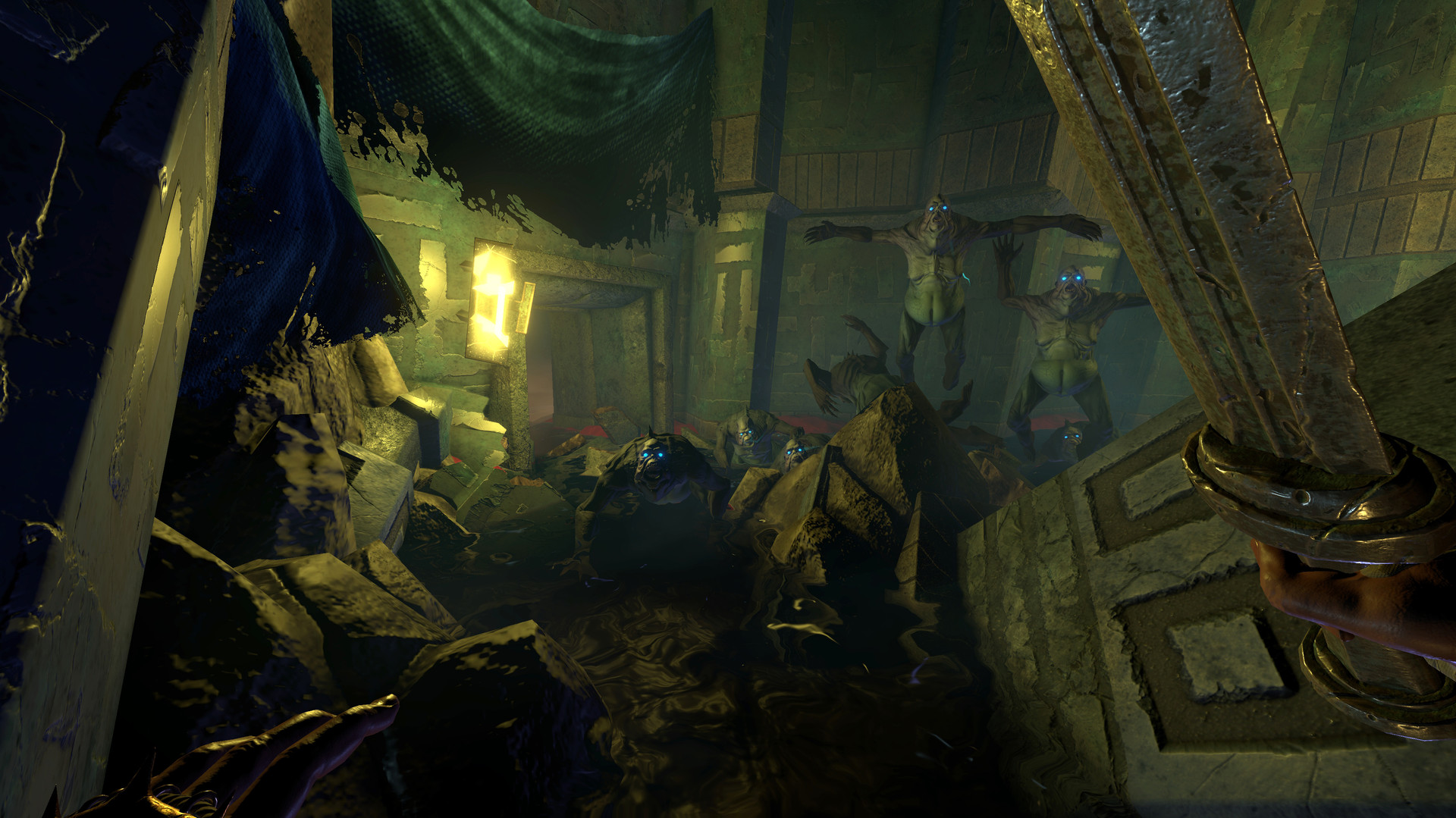
The adventure moves between catacombs, ancient structures and the city itself. These spaces are built as dangerous places to navigate as well as backdrops for combat: corridors, chambers and open encounters put enemies in the player’s path, while the surrounding architecture gives each clash a physical layout. Looking through an area and judging its approaches is part of reaching what lies ahead. The locations carry the game’s dark-fantasy atmosphere through monumental stonework, threatening inhabitants and imagery inspired by metal album art. The world is intentionally compact enough to support a focused single-player journey, but its handcrafted construction gives the campaign a sense of place. Exploration feeds into the larger search for ancient secrets without turning the experience into a checklist of lore or a map-by-map scavenger hunt.
Combat is conducted entirely at close range in first person, so spacing, timing and the direction of an attack matter. The warrior can move around opponents, evade their strikes and answer with a weapon of their own, making encounters a test of reading enemy intent rather than simply holding an attack. Foes have distinct fighting styles, tricks, strengths and weaknesses; observing how a particular opponent behaves helps determine when to press forward and when to create distance. Several threats in one space can make positioning more complicated, because an attack aimed at one enemy may leave the player open to another. The result is a melee loop built around awareness and controlled aggression. Success depends on understanding the immediate fight and using the room to manage it, not on relying on a single uninterrupted swing.
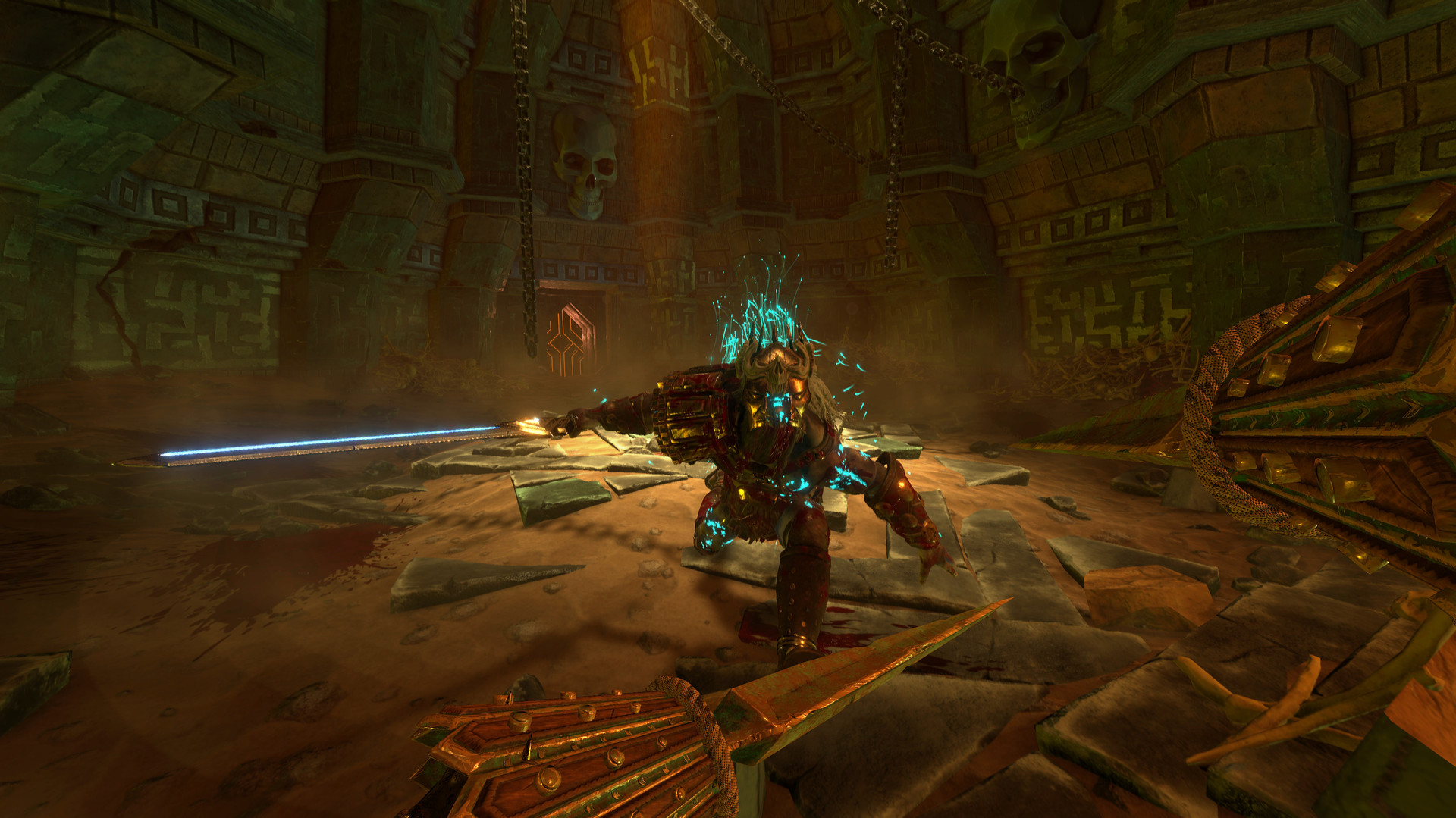
The arsenal includes eleven varied melee weapons to master. Each gives the player a different way to engage with the same basic problem: how to reach an enemy, land a useful hit and stay safe during the response. Changing weapons can alter the rhythm and reach of an encounter, so learning the available tools is part of developing a preferred combat style. The game’s weapon variety works together with enemy differences; a foe’s tactics and vulnerabilities influence which approach is most practical. This does not reduce combat to matching a specific weapon to a checklist. Instead, the player gains options for expressing timing, range and aggression. The first-person view keeps those choices immediate: the weapon occupies the foreground, and the opponent’s movement supplies the information needed to decide what to do next.
Character growth adds an RPG layer to the action. The player develops skills as the campaign advances, with progression intended to support different ways of playing rather than a single mandatory build. That system complements the weapon selection: a chosen skill direction can reinforce how the player prefers to move through fights, while new combat knowledge and stronger tools broaden the available responses. The game describes this growth in souls-like terms, pairing it with demanding, skill-based encounters. Progress therefore comes through both improved character capability and the player’s increasing familiarity with enemy behaviour. The system gives the journey a longer arc than a succession of isolated duels, because the warrior entering a later area can reflect decisions and learning accumulated along the route.
The game’s presentation draws on a particular tradition of heroic fantasy. Hyperstrange describes ELDERBORN as an unapologetic tribute to Robert E. Howard-style fantasy and the popular culture of the 1980s and 1990s. That influence appears in a world built around imposing warriors, ancient places and heightened, metal-album imagery, giving the setting a deliberately mythic scale. The soundtrack follows the same direction: original heavy metal is its foundation, with electronic beats appearing at times. Together, the music and visual style frame the slayer’s journey as a larger-than-life fantasy adventure. They also distinguish the game’s identity from a historically grounded account of barbarian life; its world is stylized, dramatic and designed around heroic-fantasy conventions.
A full play-through is described as an eight-to-ten-hour adventure, giving the journey a defined campaign scale rather than an open-ended world structure. After completing it, players can begin New Game+, which provides another pass through the game. That mode gives the campaign a clear replay option alongside the original route through the catacombs and ancient city. The progression and skill system supplies room to develop a different character approach, while knowledge gained during a first run can inform how the player handles familiar challenges. The game’s principal arc remains the slayer’s journey toward the city’s secrets; the additional mode offers a way to return to that setting after the initial story has concluded, without requiring the public description to disclose how the plot resolves.
- Developer
- Hyperstrange
- Genre
- Single-player first-person action fantasy slasher with souls-like and RPG progression