
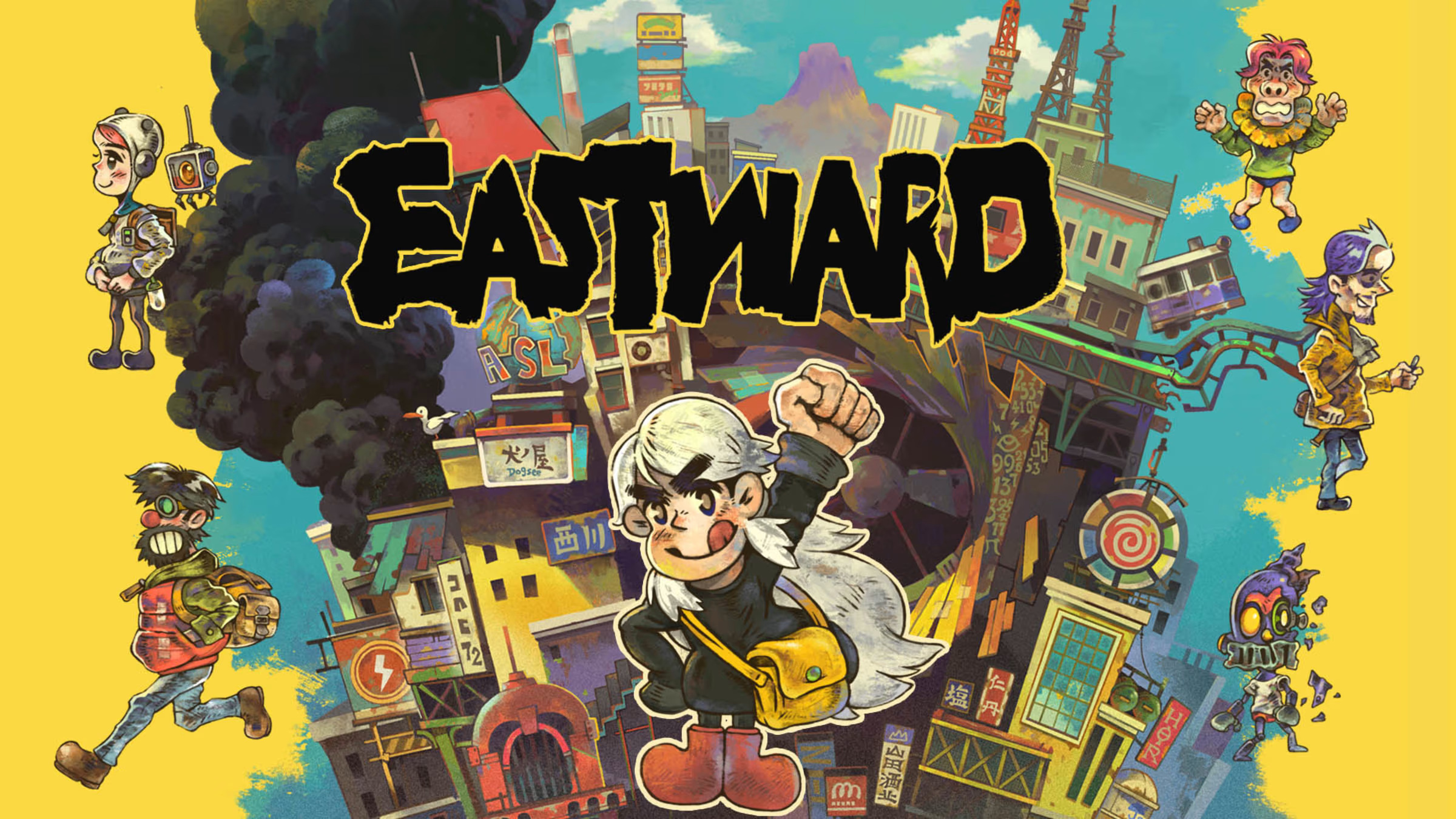
About Eastward
As the human population dwindles and a toxic miasma spreads, miner John and the mysterious Sam leave their underground home and travel east by rail. This single-player adventure pairs top-down exploration and real-time combat with environmental puzzles that ask you to switch between the two characters.
Eastward begins in Potcrock Isle, an underground settlement where John works as a digger and has taken responsibility for Sam, a quiet young girl whose origins are unknown. Their routine in the crowded community is interrupted when they are pushed beyond its familiar rules and toward the surface. The world above is not an empty wasteland: people have built settlements among the ruins, and the threat of the spreading miasma hangs over places where daily life continues. John and Sam’s relationship anchors the journey as the pair encounter new communities and learn that the crisis affecting the land is larger than the rumors and assumptions of their home. The premise is delivered through a story-led adventure, with conversations and local routines giving each stop a sense of who lives there. The narrative keeps its central questions in view without making every detail of the world immediately clear, so meeting people and moving into unfamiliar areas form part of how the setting is understood.
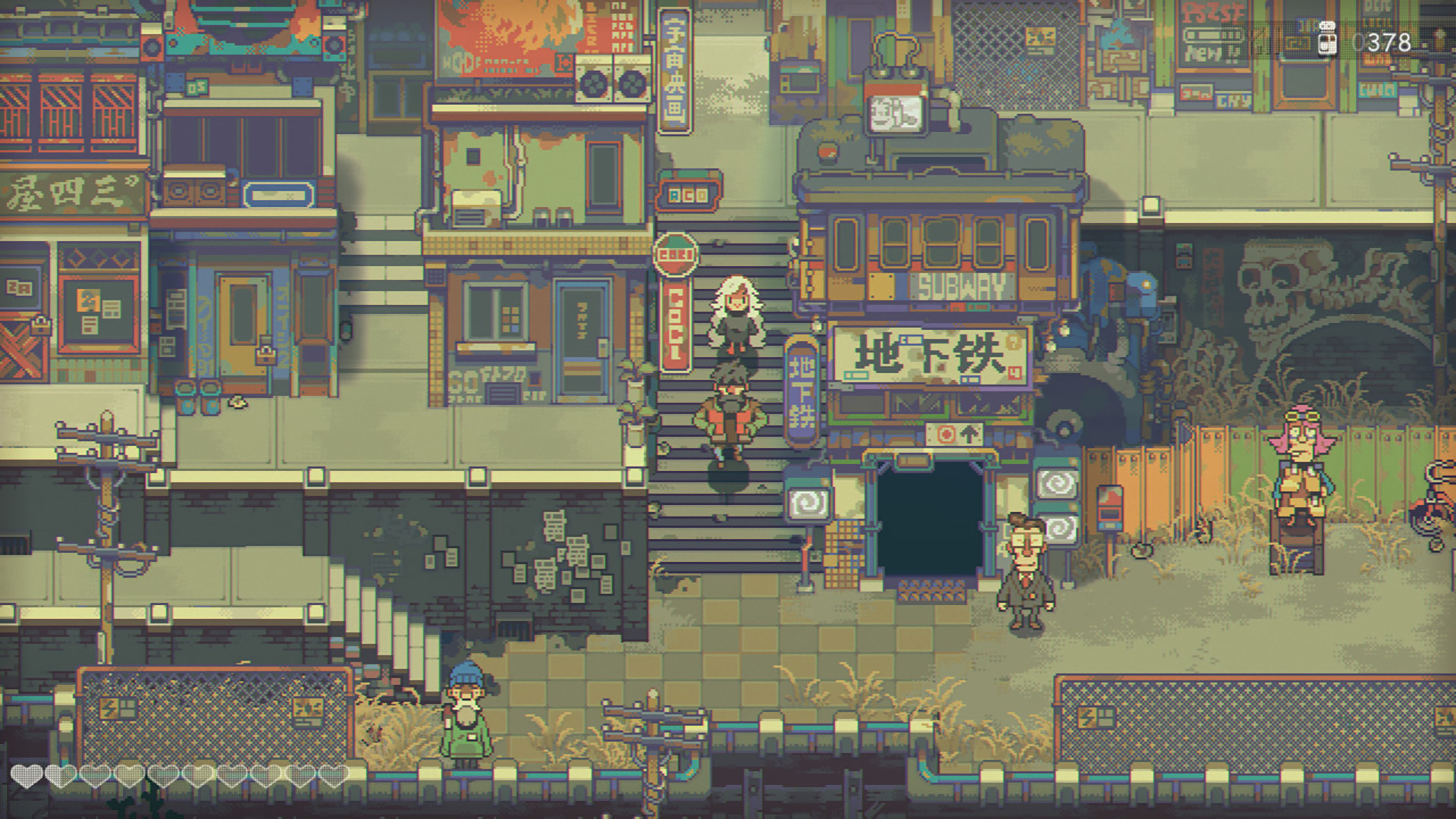
The railway gives the journey its eastward shape. Rather than presenting one uninterrupted open map, the game moves John and Sam between distinct towns and regions, with each stop introducing new streets, inhabitants and obstacles before the route continues. The contrast between Potcrock Isle’s underground life and later places such as New Dam City helps show how differently communities have adapted to the same failing world. New Dam City is a dense urban area of stacked buildings, narrow alleys, storefronts, stairways and everyday objects. Outside settlements, paths lead through forests, campsites and decaying structures where hostile creatures or environmental hazards can interrupt travel. The fixed, top-down view lets the environments layer foreground and background detail; lighting, fog and weather effects add depth to the hand-drawn pixel scenes. The route is guided by the story, but local spaces invite short detours to speak with residents, look through rooms and find useful supplies. Progress comes from reaching the next part of the railway and resolving what blocks the way, not from freely roaming a single seamless continent.
Exploration and puzzle solving depend on using John and Sam together. The player can switch which character leads, and each has abilities that change how a room can be crossed. John is the sturdier adult and handles heavy work and weapons; Sam is smaller and can pass through spaces he cannot, while her psychic energy can affect objects and enemies. Some obstacles require the pair to separate, leaving one character on the far side of a gap, wall or narrow passage while the other activates a route from the opposite side. You then change between them to coordinate actions and reunite them. Other rooms ask you to move objects onto switches, direct an explosive across a gap, or use a character’s power to expose a path. The challenges are arranged in contained spaces, so the relevant machinery and characters are usually close at hand. Dungeons combine these environmental puzzles with enemy encounters and locked progress points; solving a room often opens the next stretch rather than revealing a distant route across the world. The two-character setup makes navigation a small coordination problem as well as a matter of finding the exit.
Combat takes place in real time from the same overhead perspective. John can use a frying pan for close-range attacks and switch to ranged weapons such as a gun, a flame-throwing weapon or a cog-shooter. Different threats and layouts make spacing important: a nearby target may be easier to strike with the pan, while enemies that attack from a distance call for a firearm or movement around the room. Sam adds a different option. Her kinetic or psychic blast can stun a target temporarily, giving John a safer opening to attack or the pair time to move past a danger. The quick character switch is central to this rhythm: interrupt an enemy with Sam, then take control of John to follow up, or use one character while the other occupies a separate part of an encounter. Monster rooms may need to be cleared before the exit opens, and bosses introduce a specific pattern or environmental condition that must be handled before they can be hit effectively. These encounters sit alongside puzzles rather than replacing them, so the player alternates between reading a room’s hazards, choosing a weapon and using the duo’s abilities in sequence.
Supplies connect travel, combat and preparation. John can collect ingredients and other items from the places the pair pass through, then use cooking stations to turn ingredients into dishes. Prepared food restores health and can provide temporary bonuses, making cooking a practical way to prepare for later encounters. Ingredients come from varied sources around the world, including farms, abandoned buildings and areas affected by the miasma. The cooking interaction includes a timing-based bonus: pressing at the right moment can improve the dish’s effect. Money earned along the way can be spent at shops on items and equipment, while exploration can uncover health increases and other useful objects. These rewards support the next stretch without turning the game into a deep character-build system: John’s weapons and Sam’s powers remain the key tools for handling the specific puzzles and enemies the story introduces. Save points are presented as refrigerators, which preserve progress and offer brief, food-themed remarks. The checkpoint’s character fits the game’s domestic humor, while its regular placement gives players a clear point to return to after moving through a dangerous room or a new area.
The world also contains Earth Born, a self-contained role-playing game that characters can play on televisions found along the way. Its presentation shifts from Eastward’s action-adventure exploration to a deliberately old-fashioned, turn-based quest. A memory card is needed to start it. Earth Born gives the player a limited seven-day run to defeat a Demon Lord; losing does not erase every gain, because travel points and party members unlocked during an attempt carry over to later runs. Pixball capsule machines in Eastward provide statues that grant useful items inside Earth Born, linking the side activity to objects collected in the main adventure. The game within the game has its own party and progression, making it a distinct change of pace from John and Sam’s real-time encounters. Residents discuss it, and the screens where it can be played make it feel like a shared pastime in this setting. It remains an optional activity within the base adventure, rather than a separate campaign required to follow John and Sam’s route.
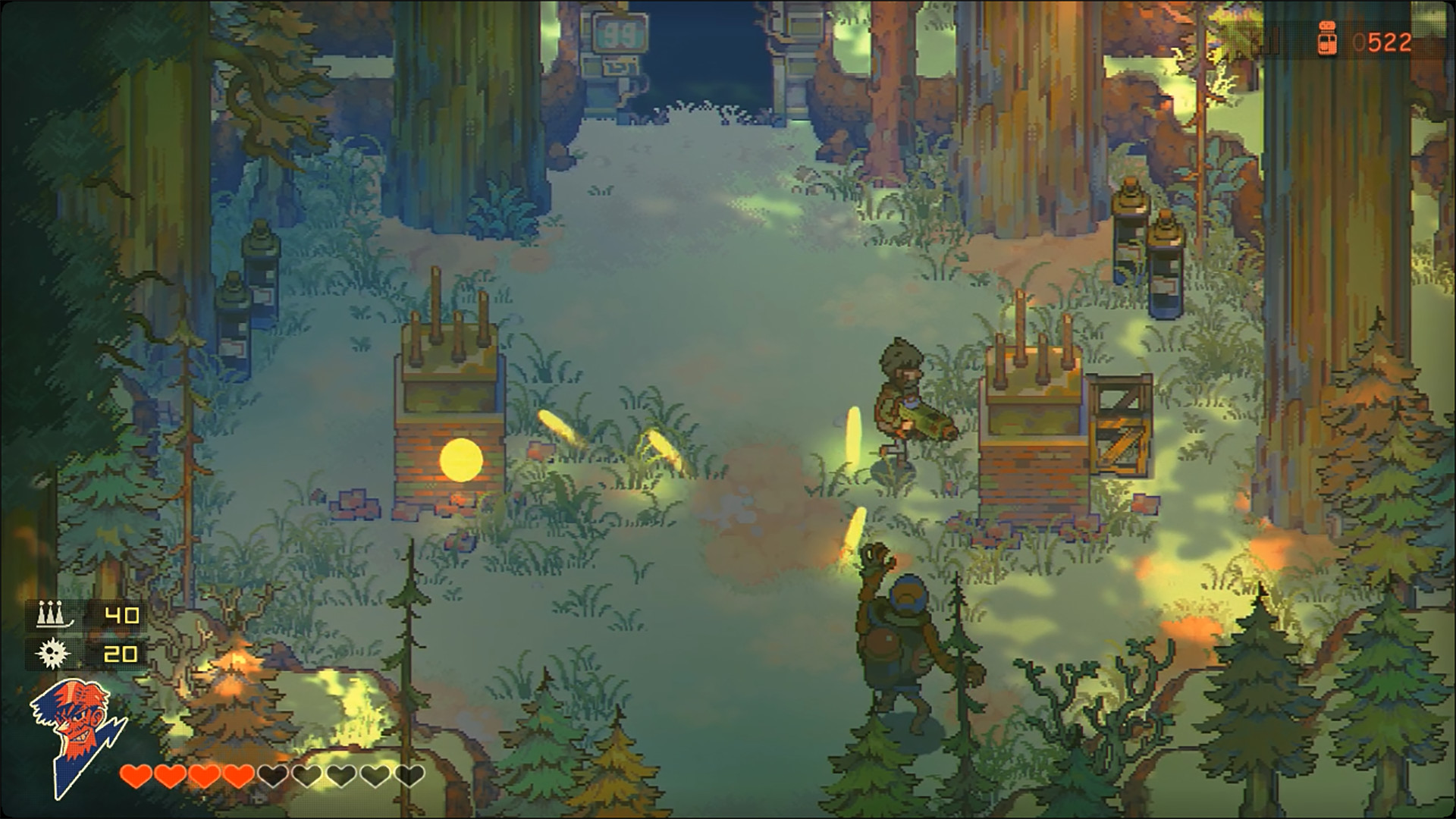
Eastward’s presentation supports the shift between intimate town scenes and dangerous travel. Characters communicate through text and expressive movement, while the environments use dense pixel art, multiple visual layers and modern lighting effects to make underground rooms, crowded streets and open wilderness feel different from one another. The soundtrack is composed by Joel Corelitz, with sound design by Hyperduck Soundworks. The mix of ordinary conversations, eccentric residents and sudden danger gives each stop its own tone without changing the basic travel structure. This profile describes the Eastward base game: a single-player story adventure built around John and Sam’s journey, local exploration, puzzles, combat, cooking and the optional Earth Born activity. Eastward: Octopia is a separate DLC with its own farming-focused adventure and is not part of the base-game systems described here.
- Developer
- Pixpil
- Genre
- Single-player adventure game / action RPG