
About Dyson Sphere Program
In Dyson Sphere Program, a space engineer builds an automated industry across a procedurally generated star cluster to supply energy to a central supercomputer. The player directs Icarus, develops production lines, links planets with transport ships and constructs a Dyson Sphere around a star. The game remains in Early Access and includes the Dark Fog threat.
Dyson Sphere Program is set in a future where humanity has created the CentreBrain, a supercomputer intended to expand the reach of virtual worlds. The player is a space engineer working on the COSMO alliance’s Dyson Sphere Program: constructing a megastructure around a star to harness its energy for the CentreBrain. The engineer is represented in the field by Icarus, a mechanical suit that travels between planets and carries out construction. The premise gives the factory building a large-scale purpose, but the work is incremental. An operation begins with a small workshop and local resources, then grows into an industrial network spanning several planets and, eventually, the wider star cluster. The player coordinates that expansion through exploration, automated production and construction rather than through a scripted campaign of character events.
Each new game generates a different star map, with planets that have their own mineral distributions, environments and orbits. The player explores these worlds to discover the layout of the system and choose where to travel next. Planetary rotation creates day and night, while neutron stars, white dwarfs, red giants and black holes add distinct celestial landmarks to the universe. Icarus is the vehicle for this exploration and can be customized component by component, allowing the player to alter the appearance of the mech used to traverse the system. Discovery frames the geography of each playthrough: the arrangement of worlds and stellar bodies gives the player new sites to inspect as the engineering project expands beyond its initial planet.
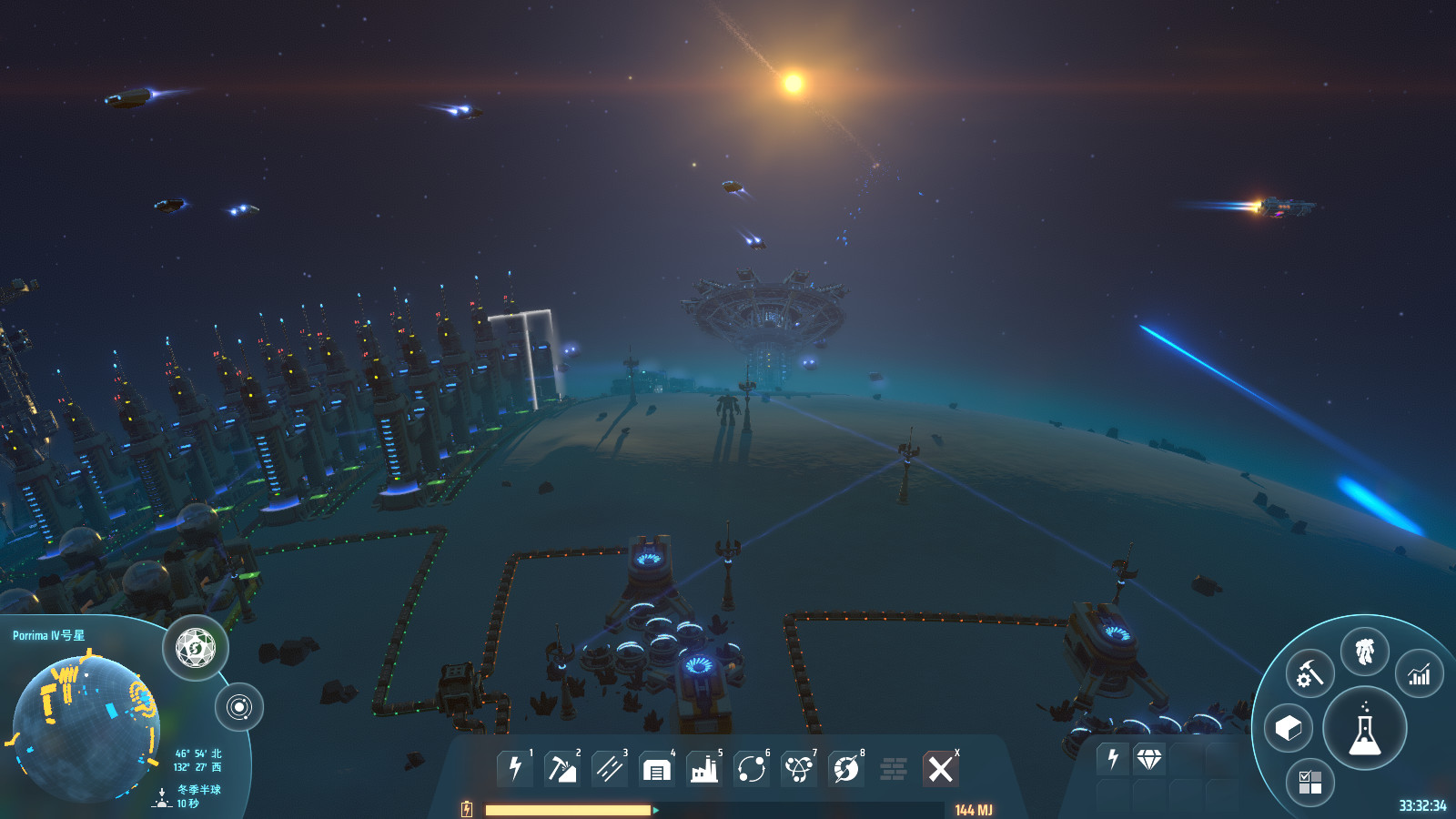
On a planet, the player turns mineral resources into an automated production system. Mining buildings extract materials, conveyor belts carry them to processing facilities, and the resulting products move onward to other stages. Structures and belts snap to a grid, helping align long production lines and factory layouts. The player develops from basic transport and processing toward more complex operations with diverse outputs; those goods support technological advances and the requirements for Dyson Sphere construction. This system makes the design of a factory a continuing task: the player must arrange extraction, movement and processing so the facilities produce a stable flow of the materials needed by later steps. A blueprint stores the factory design for deployment at another site, but the resources needed to run that design still have to be arranged there. Reusing a layout therefore carries its construction pattern to a new location while leaving the destination supply plan to the player.

When one planet cannot supply everything required by the project, the industrial network reaches across space. Interplanetary routes connect resource sites with factories on other worlds, and fleets of transport ships carry materials between them. This creates a division of work across planets: a world with a useful deposit can contribute to a distant production site, while the receiving world can feed those shipments into its own industrial network. The player must establish the route that connects the two ends of that supply chain and keep the wider operation coordinated as it grows. Conveyors handle movement through a factory on the surface; the ships address the distance between planetary sites. Together, the two scales let production extend beyond the limitations of a single world.
The project’s main construction goal is a Dyson Sphere that gathers energy from a star. The player can build Dyson Shells on multiple orbits, connect nodes and customize the pattern of each layer. This orbital structure relies on the automated industry that supplies the materials and technological advances needed to construct it. As the sphere develops, factory output and large-scale engineering remain linked: production provides the inputs, while orbital construction directs them toward the energy-harvesting structure. The game also supports displaying completed constructions on a planet’s surface, giving the player a view of accumulated work at ground level. The sphere is therefore both a practical objective for the industrial system and a visible expression of how far that system has expanded.
The current Early Access build includes the Dark Fog, a hostile mechanical presence that attacks factories and can target Icarus. The player must place defensive structures while continuing the construction project; the store page notes that more active operations can draw more frequent assaults. Combat consequently becomes another planning need alongside industrial development: factories must operate while their sites are protected from attacks. The current Steam page labels the combat system as its first part and identifies Dyson Sphere Program as an Early Access game, whose scope may continue to change. The store page describes the Dark Fog as mechanical bodies that seek high-energy targets and attempt self-replication. Its overview also warns that Icarus alone should not face their numbers: defense facilities are part of protecting the industrial operation. Since active operations are associated with more frequent assaults, expanding production also increases the importance of planning protection for the factories involved.
- Developer
- Youthcat Studio
- Genre
- Science-fiction sandbox construction, simulation and strategy with factory automation and exploration