
About Duck Detective: The Secret Salami
Eugene McQuacklin is a recently divorced duck detective whose latest case begins with stolen lunches at a call centre. In The Secret Salami, he interviews an animal cast, inspects their workplace and fills the gaps in written deductions with the clues he finds. A small office mystery grows into a stranger sausage conspiracy without losing its noir comedy.
Eugene McQuacklin has the name and gravelly detective manner for a hard-boiled mystery, but his life is considerably less composed than his professional voice suggests. He is recently divorced, low on luck and unusually attached to bread. The Secret Salami sends him to a call centre to look into missing lunches, an assignment that sounds almost too small for a private investigator. That modest starting point is deliberate. A workplace contains people who see one another every day, keep ordinary routines and may know far more about a coworker's habits than they first admit. The absence of a meal can be treated as a silly nuisance, yet a repeated theft raises questions about access, motive and who would benefit from making another employee look suspicious. Eugene is asked to examine those ordinary details closely. Happy Broccoli Games describes the case as a sausage-based conspiracy, but the path from a missing lunch to its larger secret is the substance of the mystery. This overview leaves the culprit and the later turns alone. The important starting situation is that a detective who would prefer to sound commanding has to do the unglamorous work of listening to office gossip and looking at things other people walk past.
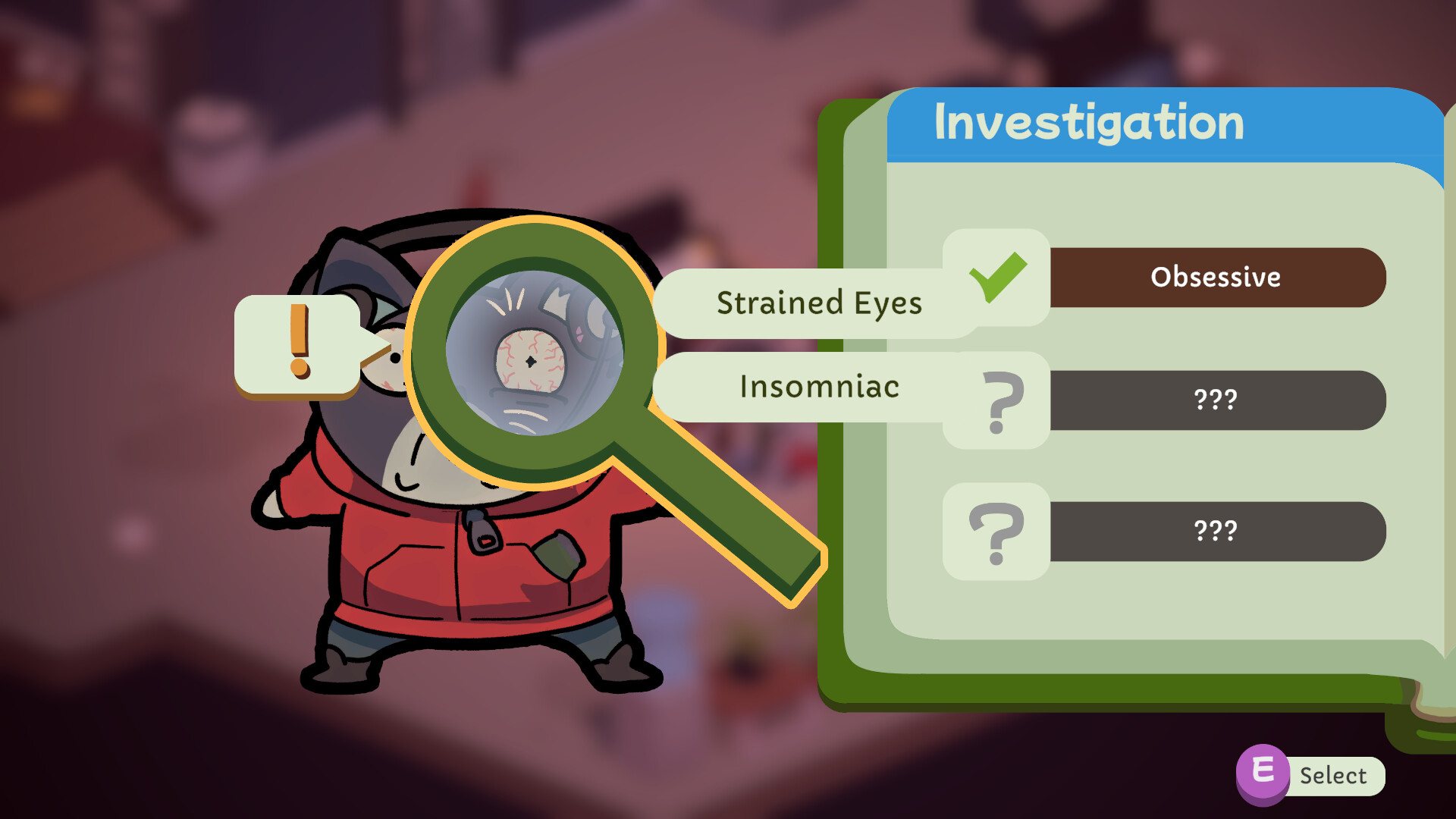
Investigation means moving through the workplace, clicking on objects and talking to its animal employees. A magnifying-glass view lets Eugene inspect details of a person or scene rather than relying on their first explanation. The evidence may come from a physical clue, a line of dialogue or the relationship between two pieces of information. What makes the game different from a story that merely pauses for a multiple-choice answer is its written deduction system. A sentence with missing words asks the player to place collected facts into the gaps. Correctly connecting the terms turns notes into a conclusion Eugene can use. The format gives shape to reasoning that would otherwise live only in the player's head: a name, object or relationship has to fit the statement being tested. Filling every blank is not the same as understanding the case, because the significance of a word depends on the sentence around it. When a deduction does not work, returning to a room or conversation can reveal which assumption was premature. The game makes clue collection approachable while still requiring the player to think about how observations belong together.
The setting is compact enough that its social details matter. A call centre is full of shared spaces, workstations and people who may hear a colleague's routine without paying attention to it until something goes missing. Eugene can revisit a person with a more specific question after finding evidence elsewhere. An employee's apparent role in the office may be helpful context, a misleading impression or a reason to inspect what has been left nearby. The developer has said that a job in bus-company customer service helped inspire the setting and its central turn, though that real experience is not a template for the game's full plot. It explains why the mystery begins amid ordinary work rather than in a grand mansion or police station. The studio drew on more demanding deduction games, including Return of the Obra Dinn and The Case of the Golden Idol, but deliberately made this case a shorter and more casual adventure. The player can follow a distinct collection of suspects and spaces without maintaining a huge external chart. The difficulty lies in noticing what a small group of people has failed to say. The studio’s stated inspirations clarify what has been simplified and what has been retained. In those larger deduction games, evidence can accumulate across many locations and demand painstaking cross-reference. Eugene’s case concentrates the same pleasure of making a connection into a smaller workplace and a sentence the player can test. It does not ask the player to remember an enormous family tree before the first useful inference. The location itself acts as a memory aid: a face seen near a workstation and an object found in a shared area can be put back into their social context. This is why the apparently minor lunch theft works as an opening rather than a throwaway gag. It gives the player a concrete, local question before the significance of other details has become clear.
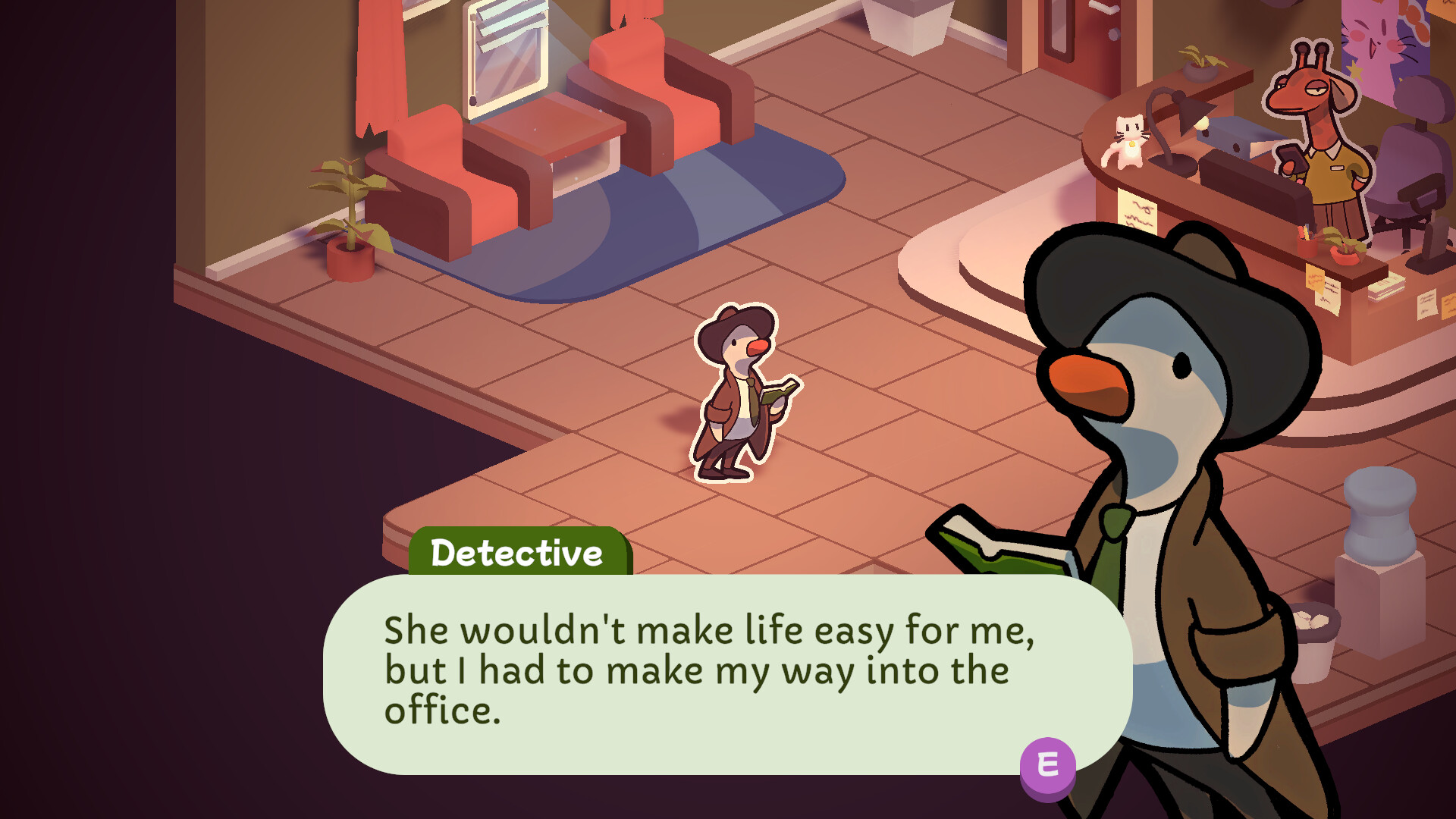
Noir is an influence on the presentation rather than a promise of a grim crime thriller. Eugene speaks and carries himself like a detective worn down by the world, while the other characters are expressive animals in a bright, stylised space. The contradiction lets a mundane stolen-lunch complaint sound momentous without requiring the game to turn cruel. Fully voiced dialogue gives each suspect more than a line of text to be sorted into a clue sheet. Delivery, hesitation and personality help distinguish the people Eugene questions, even though the written facts still need to support any formal deduction. Bread jokes and duck puns run through the premise, but the investigation has its own rules. The developer's described aim was to let players discover plot turns for themselves while keeping a cosy, accessible tone. That depends on withholding some answers. An amusing first impression of an animal does not prove anything, and the player is asked to replace that quick judgement with observations from the office and the people inside it. The voice performances also establish the gap between Eugene’s self-image and the reception he gets from other people. He may frame himself as the centre of a dramatic case, while an employee just wants an irritating workplace problem solved. That contrast makes the serious act of checking evidence more legible amid the jokes.
The Secret Salami is designed as a contained case rather than a sprawling campaign. Official store descriptions frame it as roughly a two-to-three-hour mystery. That scale permits a full investigation to have a beginning, a sequence of discoveries and a conclusion without asking the player to keep track of dozens of unrelated crimes. Eugene's personal troubles provide continuity while the call-centre puzzle provides a specific problem to solve. The game alternates between searching and constructing deductions, so a useful conversation may send the player back to the evidence list, and a gap in that list may point back to a person worth questioning. Its visual approach is similarly economical: cartoon characters and readable spaces keep attention on the telling details. There are no combat encounters or character builds to distract from the case. The meaningful action is asking, noticing and deciding what an incomplete statement needs before Eugene can say it with confidence.
Happy Broccoli Games developed and published the original 2024 release, with PC and Nintendo Switch versions among its launch platforms. The later Ghost of Glamping is a separate, standalone Duck Detective case, so its campsite and companion should not be folded into this call-centre story. A player can start here and learn the method along with Eugene: inspect a room, interview its occupants, collect words with evidential weight and test how they fit. The premise may be playful, but its structure respects the satisfaction of making a connection yourself. A lunch can disappear for an ordinary reason, or it can reveal a wider pattern; the detective cannot know which until the workplace has been read carefully. Eugene's own unsteady life makes his confident noir pose funny, while his actual work gives the short mystery its forward motion. The title's salami is a promise that the case will become odder than the first complaint suggests, not a licence for an overview to explain the solution before the player gets there.
- Developer
- Happy Broccoli Games
- Genre
- Short comic detective adventure