
About DOOM: The Dark Ages
DOOM: The Dark Ages is a single-player prequel that follows the DOOM Slayer through a medieval war against Hell. Its first-person combat pairs familiar firepower with the Shield Saw, while dragon and mech sequences widen the battlefield. Ruined castles, forests and hellscapes frame a dark fantasy and science-fiction account of the Slayer’s earlier legend.
DOOM: The Dark Ages places the Slayer in a conflict that precedes the events of DOOM (2016) and DOOM Eternal. The story casts him as a formidable weapon serving gods and kings while demonic forces threaten worlds beyond. This medieval war gives the series’ familiar struggle against Hell a different visual and political setting: the Slayer is a champion within a larger order, even as the war threatens to escape its control. The single-player campaign follows that premise as a cinematic account of the figure whose legend has become central to the modern DOOM games. Its tone combines dark fantasy imagery with science-fiction elements, treating the medieval frame as another setting for the franchise’s clash between human powers and infernal armies.
The game remains a first-person shooter built around direct confrontations with demon hordes. The Slayer brings back recognizable weapons such as the Super Shotgun and gains a new defensive-offensive tool in the Shield Saw. It can block incoming attacks and serve as a weapon, changing how the player approaches enemy pressure. Bethesda describes combat as more grounded than recent entries: the player is encouraged to stand and fight amid demon-infested battlefields. That emphasis gives defensive timing and weapon choice a visible role in each encounter. Combat still centers on aggressive momentum, but the shield adds another way to engage threats before answering with gunfire or close-range force.
The Shield Saw also changes how the player reads the levels. It can break loose barricades and help uncover routes, secrets and rewards within expansive environments. The official gameplay account calls these the largest-ever play spaces made for a DOOM game, with abandoned temples, dark forests, brutal hellscapes and unfamiliar worlds among the locations. Rather than limiting progression to a chain of arenas, levels invite the Slayer through broader spaces where combat and discovery share the route. Their variety changes the backdrop and scale of encounters while preserving the first-person perspective. These spaces extend the war beyond one fortress or front line, making exploration part of the campaign’s movement through a conflict that reaches across worlds.
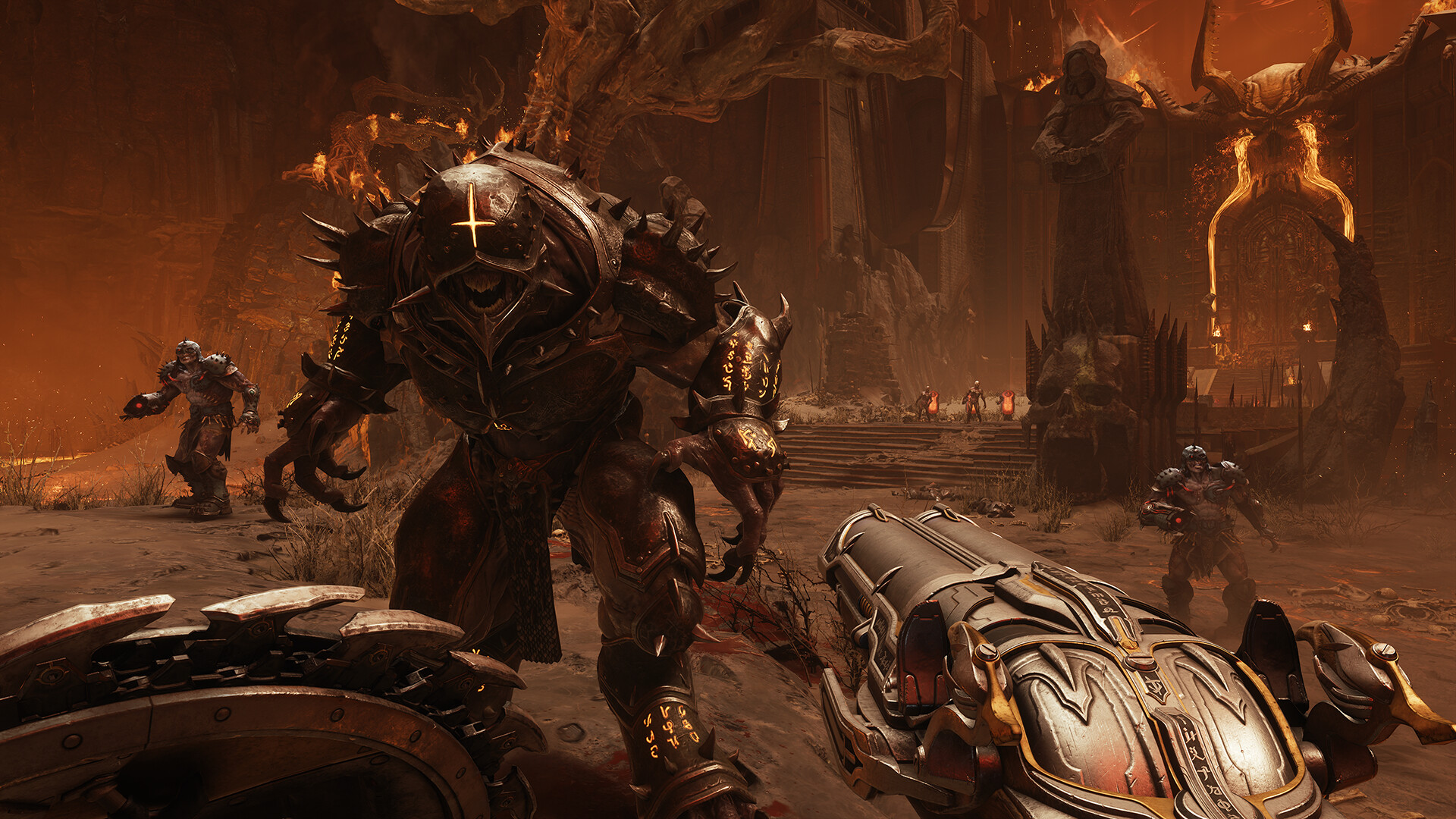
The Shield Saw has both defensive and offensive uses. It can block incoming attacks, parry or deflect projectiles, and power a Shield Bash that carries the Slayer through an enemy line. Thrown across a fight, its spinning blades cut through lesser demons; against larger foes it can lodge in them and interrupt their advance. The tool also breaks loose barricades, opening paths to secrets. This makes it relevant in both combat and exploration: a single contextual input can answer pressure in an arena, while the same shield can alter the space beyond it. Its combination of defense, movement and attack gives the game a recognizable centerpiece without reducing every encounter to firing the same weapon.
The Slayer fights under the authority of gods and kings, yet Hell’s armies remain the immediate enemy. Their leader seeks to destroy him and become the only being feared, placing a personal threat within a larger campaign of invasion. The story joins two pressures: the Slayer’s service within the powers that control him and the expanding demonic danger he must repel. This is framed as the beginnings of a legend rather than a continuation beyond DOOM Eternal. The prequel position helps explain why the game focuses on the Slayer’s role as a weapon and on the conditions that shape the early part of his saga.
The campaign’s visual scale is paired with a broad combat kit. Alongside firearms such as the Super Shotgun, the Slayer can use a flail, spiked mace and electrified gauntlet. The finisher system accommodates attacks from different angles, adding variety to close encounters. These tools sit within a war-scarred fantasy realm rendered with idTech technology, from abandoned temples and dark forests to brutal hellscapes. An original score blends metal with medieval influences, reinforcing the collision of old-world imagery and futuristic violence. The presentation supports the game’s central contrast: the Slayer is a weapon controlled by higher powers, yet every fight gives the player a direct role in how that force is applied.
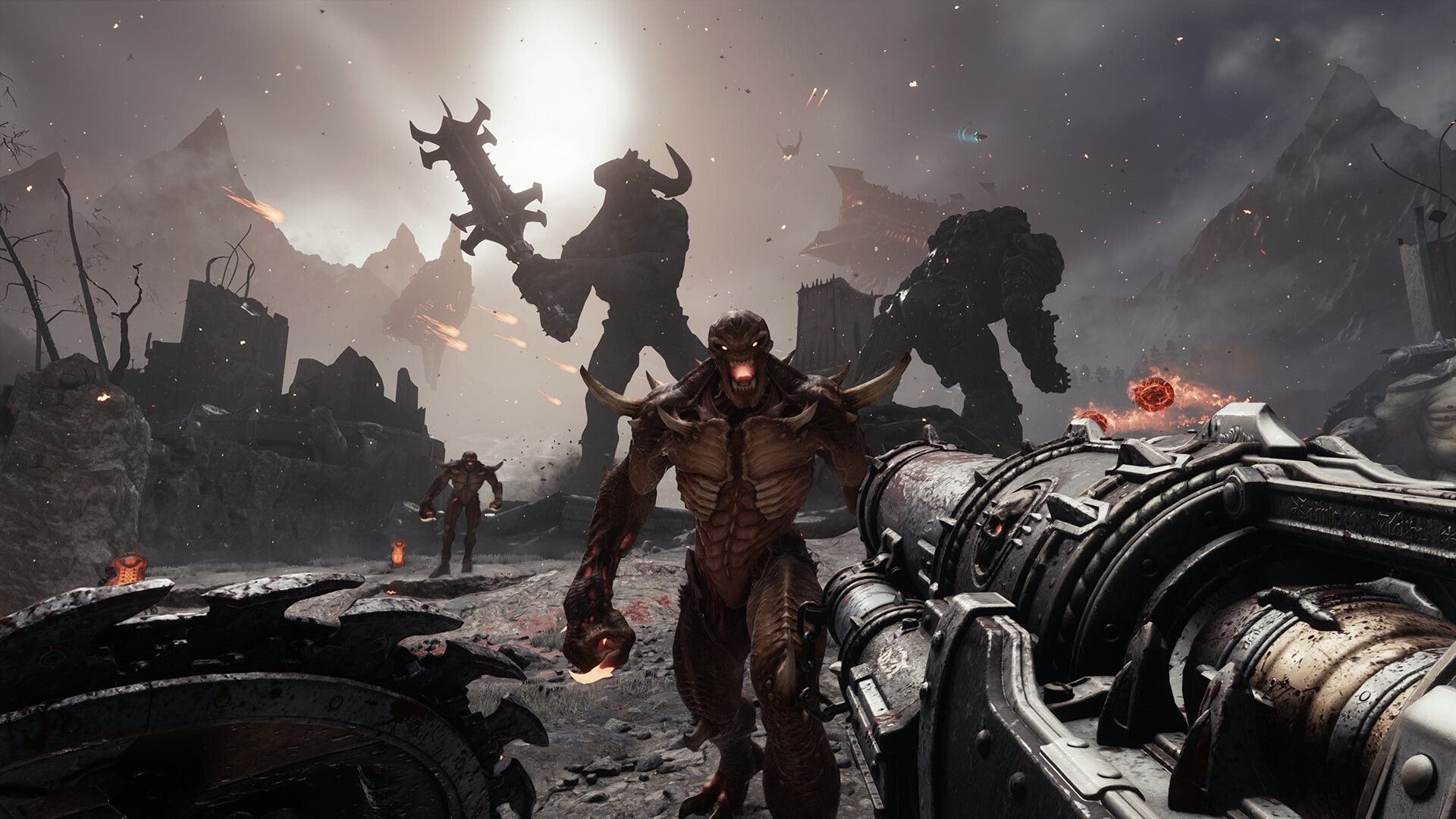
Exploration gives the campaign room to vary how a level is approached. The large play spaces contain secrets and routes that can be uncovered by breaking barricades, and collected spoils can be spent to upgrade equipment and abilities. That reward loop ties searching off the main path to the Slayer’s growing capacity in combat. Adjustable gameplay settings also let players tune details such as the projectile-parry window or overall game speed. These options sit alongside the Shield Saw, melee weapons and firearms to make encounters adaptable while preserving their focus on direct action. They reward players who explore carefully and experiment with the tools available, connecting discovery to the battle ahead. The setting carries the Slayer from temples and forests to hellish realms, placing that flexible combat within a war against Hell shaped by his service to gods and kings.
- Developer
- id Software
- Genre
- Single-player first-person shooter; dark fantasy and science-fiction action