
About DOOM (2016)
DOOM (2016) is a first-person shooter set after a demon outbreak overruns the Union Aerospace Corporation’s Mars facility. As the lone DOOM Marine, you move between industrial installations and Hell, fighting at close range, scavenging resources from combat, and improving weapons and equipment as the campaign advances.
DOOM (2016) opens inside a Union Aerospace Corporation research complex on Mars after its systems and personnel have been overwhelmed by demons. The player controls the DOOM Marine, awakened into the crisis and sent through the facility as humanity’s immediate line of defence. UAC technology and demonic intrusion occupy the same spaces: laboratories, mining infrastructure, processing areas and interdimensional research sites are broken open by the invasion. The campaign moves from the red planet into Hell and back through these connected environments, with the UAC’s pursuit of Argent energy forming the reason the disaster reaches this scale. The Marine’s route crosses places built for scientific work and extraction, making the facility’s research operation part of the setting as well as the source of its crisis.
Combat is built around forward movement and active recovery. There is no cover-based defensive loop or automatic health regeneration, and enemies pressure the Marine across open arenas rather than waiting behind a single firing lane. Running, jumping, circling and changing elevation help avoid attacks while keeping a target in view. When a demon is weakened into a stagger, a Glory Kill can be triggered at close range; the finishing move varies with position and returns health, while keeping the encounter moving. This makes an injured enemy a resource opportunity as well as a threat. A chainsaw provides another deliberate answer to a crowded fight: it consumes fuel, with larger demons requiring more, and its use supplies ammunition. The practical rhythm is to pick the right weapon for the current enemy, keep changing position and turn openings into supplies before the next wave closes in.
The campaign’s arsenal combines familiar firearms with weapons suited to different ranges and enemy groups. The shotgun and Super Shotgun handle close engagements, while the plasma rifle, heavy assault rifle, rocket launcher and Gauss Cannon give the Marine other ways to control a larger arena. The chainsaw and BFG 9000 sit outside the ordinary weapon selection and offer limited, high-impact options. Weapon mods change how a gun behaves: the assault rifle can use a scope with penetrating shots or a rack of micro-missiles, and the shotgun can fire a charged burst or an explosive round. Field Drones found during missions unlock a choice of mod for weapons already acquired. Weapon points then improve equipped mods, with further mastery challenges tied to using them in specified ways. This progression rewards trying each mode of fire instead of relying on a single gun throughout the campaign.
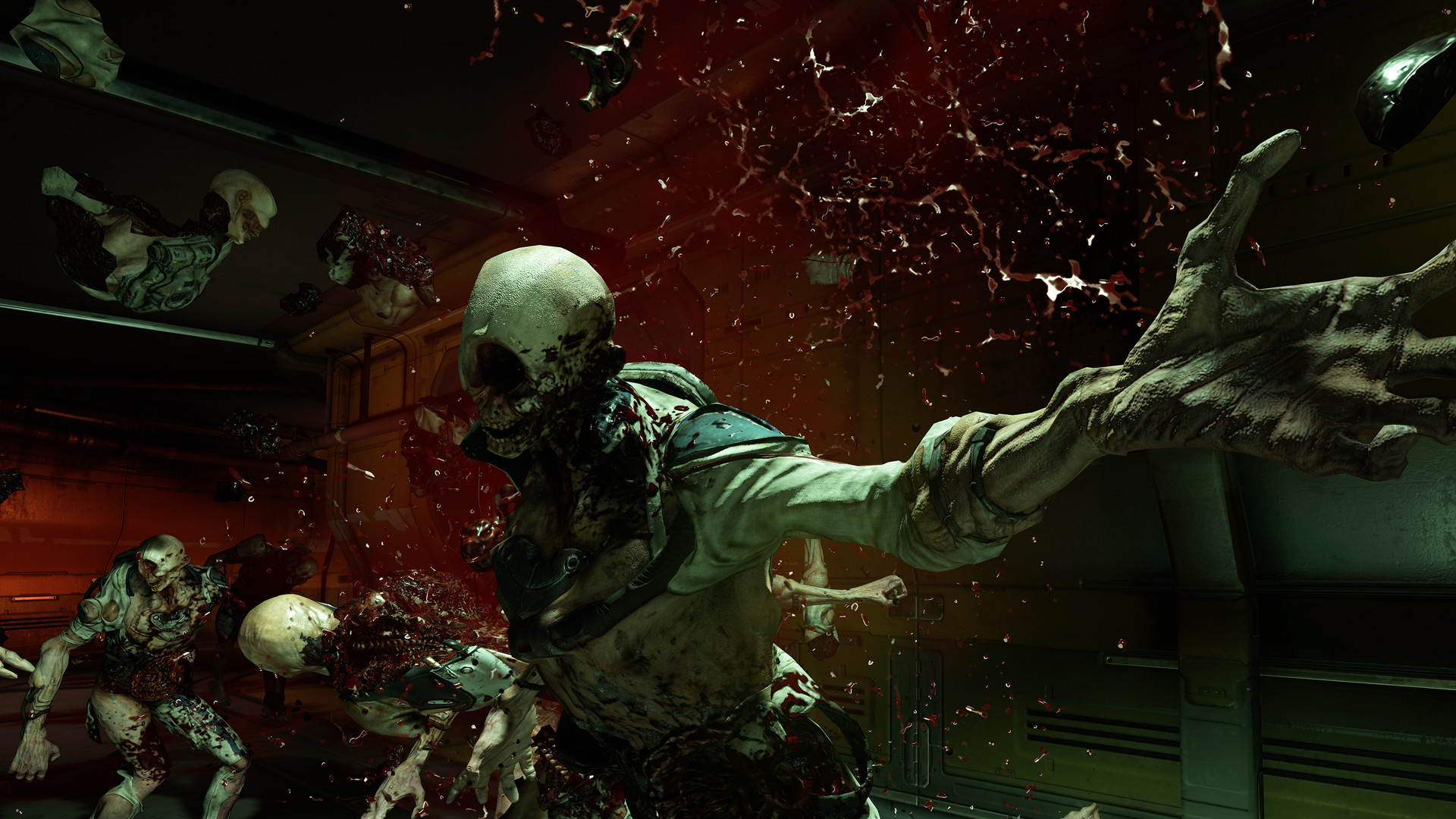
Exploration feeds several other kinds of growth. Elite Guard bodies carry Praetor tokens that can be spent on suit capabilities, including environmental resistance, equipment capacity, faster equipment recharge, and improved navigation scans. Argent Cells let the player direct energy into maximum health, armour or ammunition capacity, so choosing a category shapes the Marine’s reserve resources. Rune stones lead to short Rune Trials, which ask for a defined combat task under a constraint; completing one unlocks a passive ability that can be equipped and later improved through its own challenge. A rune can, for example, extend how long a demon stays staggered or improve control after a double jump. These systems are distinct: weapons change through Field Drones and weapon points, the suit through guard tokens and cells, and runes through trials. Hidden paths and mission challenges therefore contribute to combat options as well as completion records.
The environments alternate between functional UAC spaces and the fractured landscape of Hell. The Mars facilities include a mining operation, industrial processing rooms and the Lazarus research complex, where architecture carries the expedition downward toward a portal. Hell is presented through broken terrain, ruined structures, unstable walkways and deep pits rather than as another cleanly organized base. Movement connects the spaces: the Marine jumps gaps, climbs ledges and crosses platforms while fighting, and routes may branch toward resources, secrets or a way forward. Automaps and suit scanning upgrades help orient the player, but they do not turn each level into an open-world map. The campaign retains a sequence of authored missions, with combat arenas and traversal links arranged around objectives. Looking away from the main route can reveal logs, hidden rooms, upgrade supplies and small connections to earlier DOOM imagery.
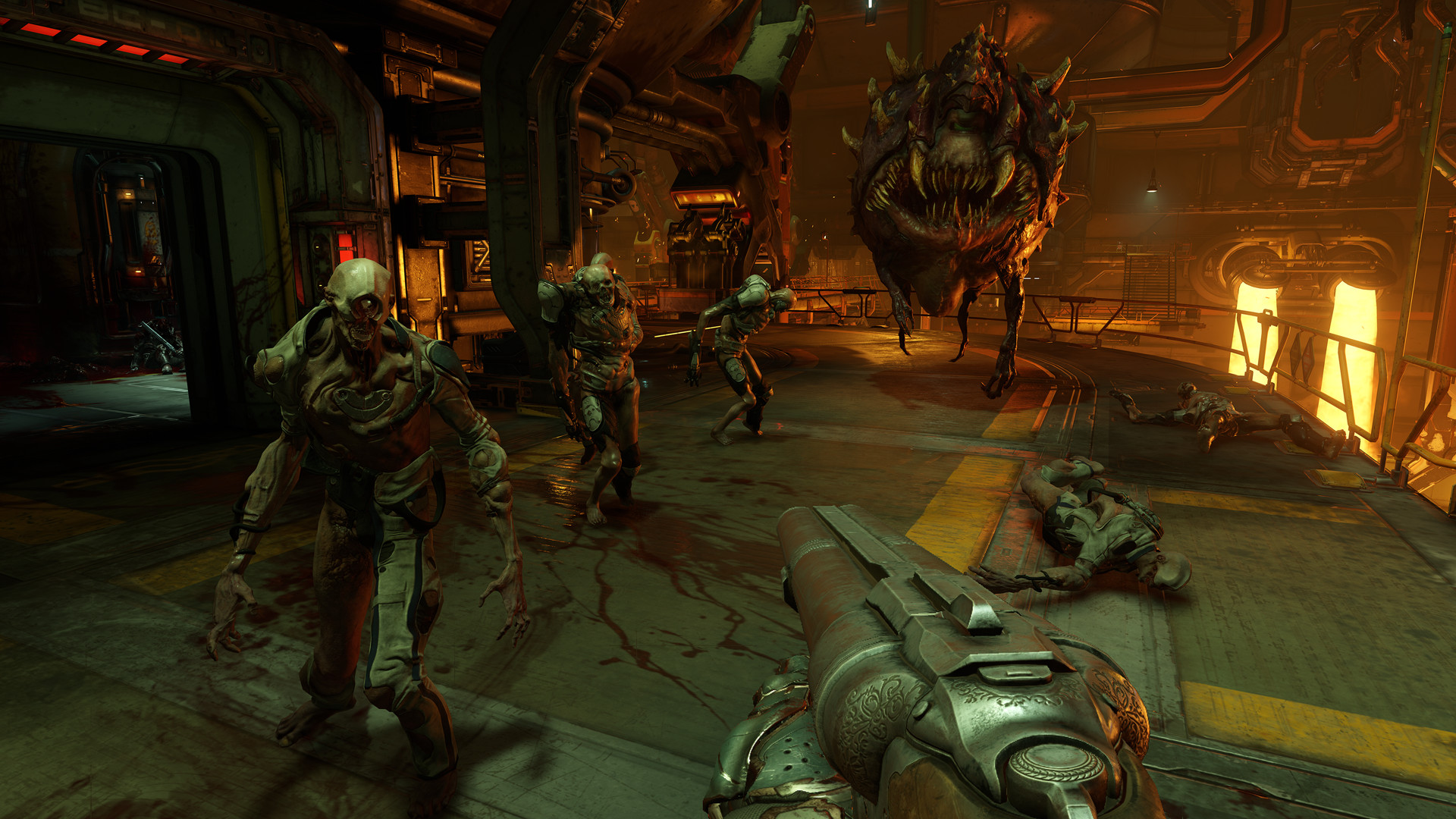
The story keeps its focus on the conflict between the Marine’s immediate mission and the UAC’s attempt to control the crisis. Argent energy research links the company’s industrial ambitions to its interdimensional experiments, even as the facility’s breach makes the danger impossible to ignore. The Marine’s response is physical and unsparing; communications from the control room supply context and objectives, but the player is free to smash equipment and interrupt the corporation’s plans while pushing through its compounds. Demons have different shapes and attack patterns, from ranged pressure that forces movement to larger bodies that demand heavier fire or a close-range finish. Encounter spaces combine those behaviours instead of making every fight a line of identical targets. The plot follows the attempt to contain the outbreak and deal with the mechanism that brought it through, while logs and environmental details fill in parts of the UAC’s research history.
Beyond the single-player campaign, the original release also included arena multiplayer and SnapMap. Multiplayer matches used fast movement, weapon pickups, power-ups and demon transformations, with modes built around individual or team competition. SnapMap was a separate in-game editor and sharing hub: players could assemble and decorate maps, add ready-made or custom gameplay logic, and publish creations for others to play. That supported experiences ranging from a compact single-player challenge to cooperative waves with a timed shop between rounds. It was a creation system rather than another chapter of the Marine’s campaign, so its objectives and enemy arrangements could differ from the main story. The editor gave players tools to build new situations from the game’s available pieces.
- Developer
- id Software
- Genre
- First-person shooter