

About Donut County
Donut County begins with a raccoon called BK collecting a town's belongings through a remote-controlled hole. The opening grows as it swallows more, turning each resident's home into a small physics puzzle. When BK joins the people he has dropped underground, his friend Mira and the displaced neighbours want an explanation.
Donut County gives a raccoon named BK a remote-controlled hole and a reward for filling it with other people's belongings. The arrangement sounds like a delivery job from his side of the screen; from the town's side, homes and neighbours are disappearing. When BK ends up in one of his own holes, he finds Mira, his best friend, and a group of residents stranded far below the surface. They ask him what he has done, and their accounts turn the earlier act of sweeping up scenery into a sequence of personal losses. The game moves between that underground gathering and the places that were swallowed. A home is more than a pile of objects sized for a puzzle: its furniture, animals and odd possessions tell the player whose space the hole has entered. BK's pursuit of prizes keeps colliding with the fact that he knows many of the people being displaced. Mira's presence gives the story an immediate relationship rather than leaving the raccoon to explain himself to an anonymous crowd. The premise is comic, but its central question is direct: what does it mean to treat a town, and the people living in it, as a source of disposable stuff?
The player moves the hole across a small scene instead of steering BK through the streets. At first only little objects fit. Each object that drops in enlarges the opening, making the next size of clutter reachable until an entire structure can disappear. That growing diameter is both the visual joke and the most basic rule of progression. A large target may be visible from the beginning, but it does not follow that the hole can take it immediately. The player has to read the scene by scale, clear a path through small objects and reconsider what has become possible after the opening widens. Movement is free rather than locked to a grid, and the holes do not behave like a conventional platform-game character with jumps or attacks. Their position and timing matter because an object has to meet the opening in the right state. Each resident's area is compact enough that its particular arrangement can carry a puzzle: a building's shape, a movable piece of equipment or an animal above the ground may matter more than simply finding the largest available thing. The changing scale makes the same scene look different by the time its last few objects remain.
Swallowing something is not always the end of its role. Donut County can combine objects inside the hole, and it can eject some of them back into the world. The Steam description gives examples ranging from cooking soup to breeding bunnies and launching fireworks; each asks the player to think about what the unseen contents are doing below the surface. Creator Ben Esposito has explained that a level might change the hole's behaviour rather than merely add more things to collect. Water in the opening, for example, prevents ordinary collection until the player deals with that condition. A snake can extend an interaction above ground, where a plain opening could not reach. Fire can change how another object behaves after it falls in. In a fireworks scenario, a lit projectile shoots upward instead of staying swallowed, so the moment of collection and the point from which it emerges become part of the puzzle. These examples make the hole a tool with context-sensitive rules, not just a vacuum whose capacity steadily increases. The player learns a new possibility by watching the relation between two ordinary-looking things change.
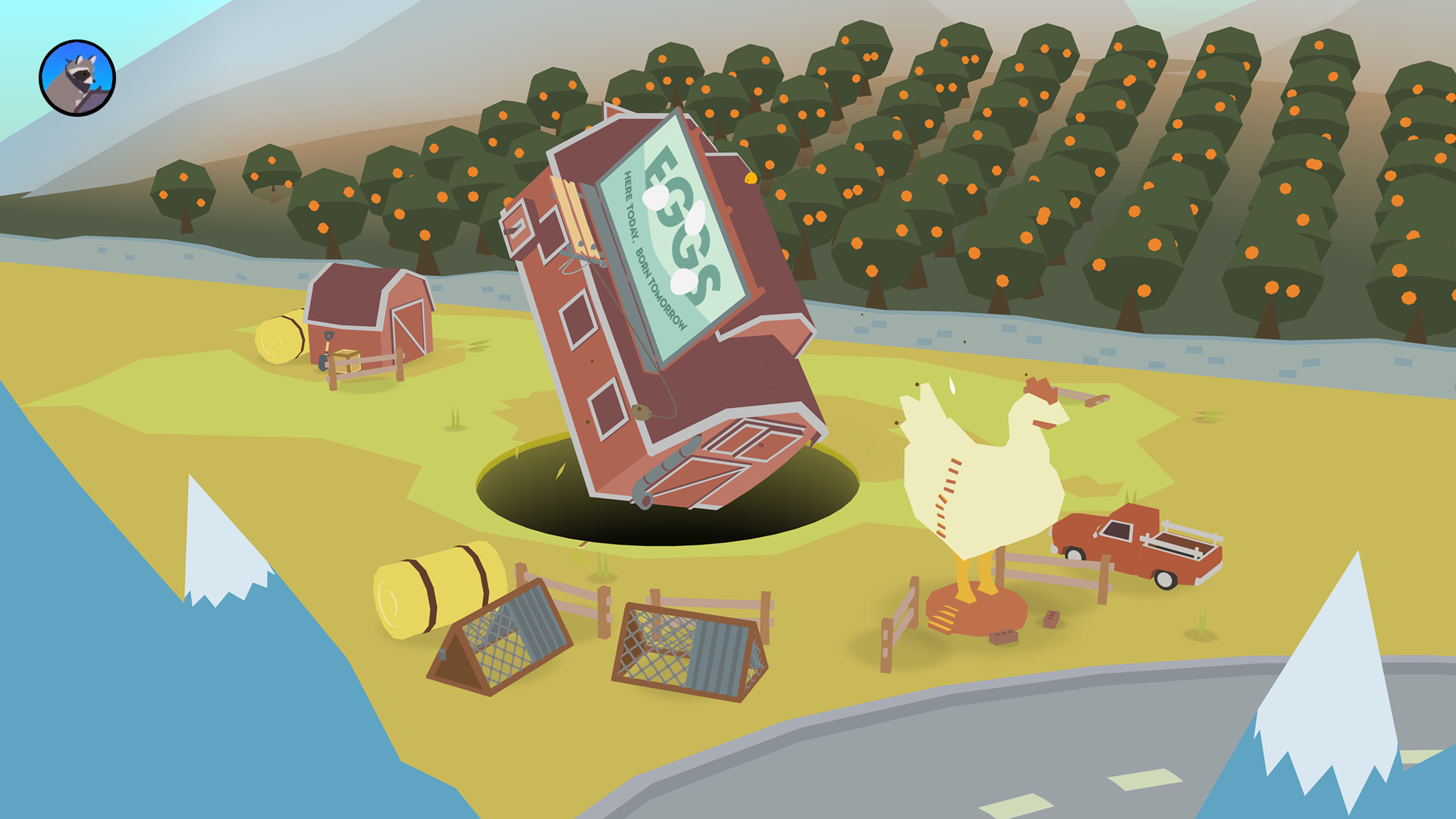
The stages are tied to particular residents and places. Esposito has described designing each puzzle around the person who lived there, keeping the scale intimate rather than turning the premise into a race to consume an entire city. That choice gives the environments a narrative function. A set of possessions suggests a life before the hole arrived, while a peculiar prop can become the centre of a level's mechanical trick. The player may first look at an object as an obstacle too large to swallow, then realise it can be made to act on something else, expelled from the hole or affected by another item placed inside. This is closer to an adventure puzzle built from a location's character than a sequence of identical growth challenges. The underground conversations link those scenes to the residents who lost them. As one account follows another, the act of playing through a home and the act of listening to its owner supply different views of the same event. The game's structure gives the trash-collecting scheme a social cost without requiring a huge map or a sprawling cast. Each compact setting has room for its own rule and for a small piece of the town's larger story.
There is no conventional combat build behind the raccoon's plan. The creator has described the puzzles as designed without fatal fail states, and the emphasis falls on testing how a scene responds rather than surviving an enemy encounter. A launch can be destructive or funny, but it is an environmental action, not evidence of a weapon system or fighting progression. This also shapes the rhythm of discovery. If a first attempt at combining objects produces an unexpected result, the player can study it and try a different order; a mistake need not erase a lengthy run. The game can still ask for thought about sequence. The opening may need to reach a certain size before an object fits, while a temporary state such as fire changes what a later object does. A visible solution can therefore depend on preparing the hole, positioning it and choosing when to collect. Esposito has said the simple premise left only a few principal decisions—position, timing and what had already been put inside—and the levels build variety from those constraints. The physical comedy works because the rules remain legible enough for a player to form a hypothesis and then see it play out in the scene.
Donut County uses brightly coloured, stylised environments and short character exchanges to make that erasure feel light on its surface, even as the underground gathering shows the consequences. Its soundtrack was made chiefly by Daniel Koestner, with Esposito contributing other tracks; the music and the game's visual simplicity give each small setting a distinct mood without burying the objects that matter to a puzzle. Ben Esposito developed the game, and Annapurna Interactive published it in 2018. The publisher now links PC, PlayStation, Xbox, Switch and mobile storefronts, while the PlayStation listing identifies the original PS4 edition as a one-player game that can also be played on PS5 through backward compatibility. On Steam, a separate original-soundtrack item is audio content rather than an extra town or another playable story. Across those listings, the central experience remains the same connected set of resident-centred scenes: the hole grows, a location's peculiar rules interrupt the easy act of swallowing things, and the people who lived there have something to say once BK reaches them underground. The final shape of any scene depends on learning how its objects behave together, not on collecting a permanent arsenal or levelling the raccoon. The idea began as a hole-in-the-ground prompt at Molyjam, but the finished game gives that single joke a town of named residents and homes whose disappearance has to be accounted for.
- Developer
- Ben Esposito
- Genre
- Single-player story-based physics puzzle game