
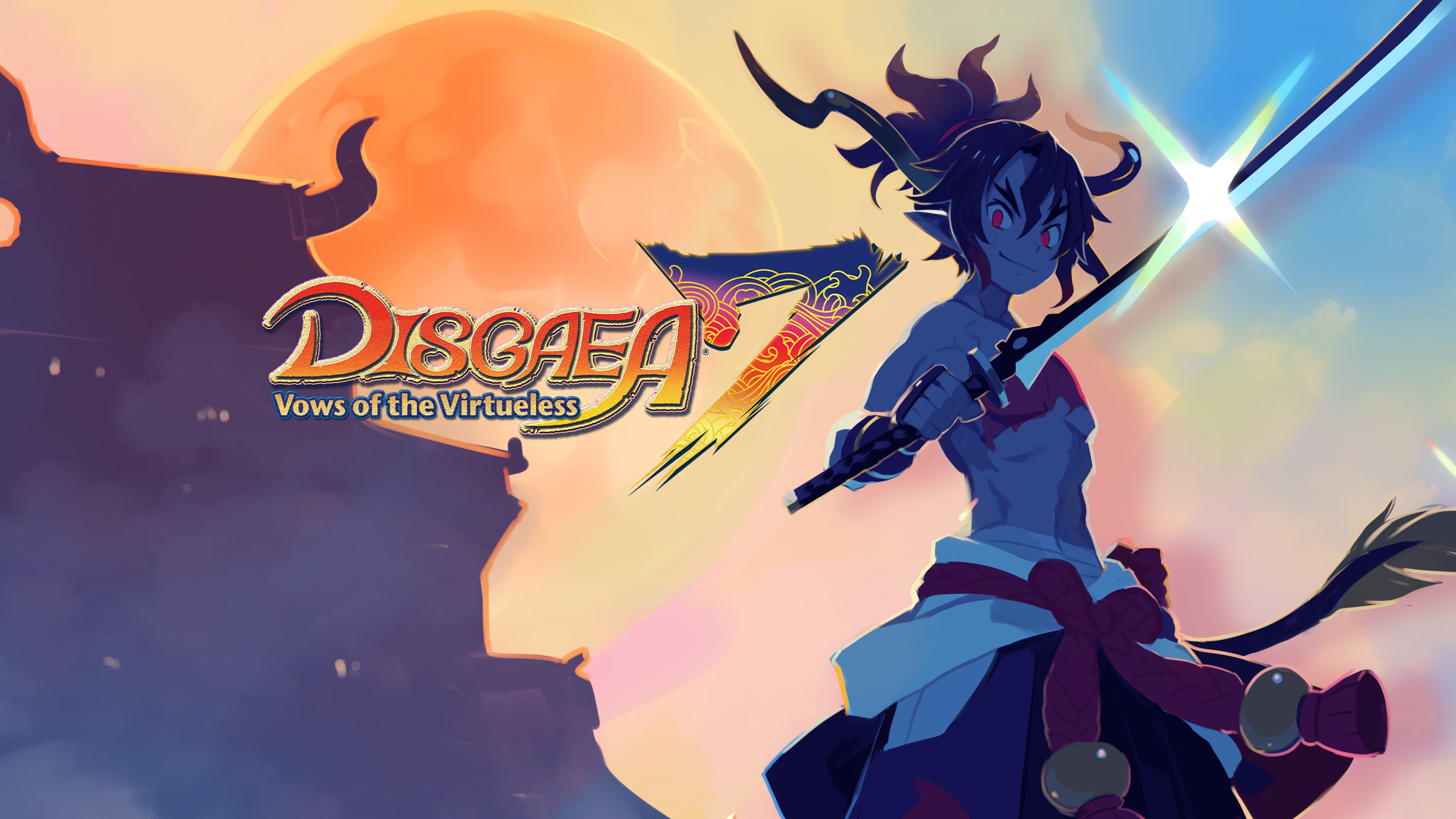
About Disgaea 7: Vows of the Virtueless
In Disgaea 7: Vows of the Virtueless, Fuji and Pirilika travel through Hinomoto, a cluster of demon realms where bushido has been displaced by a harsh code of destruction. Lead a team through turn-based grid battles, recruit and develop more than forty classes, and use Jumbification, Hell Mode, item growth and optional auto-battle to shape a sprawling strategy RPG campaign.
Disgaea 7: Vows of the Virtueless is a strategy role-playing game set in Hinomoto, a collection of Netherworlds shaped by feudal-Japanese imagery and the series’ irreverent demon society. Each realm has its own strange identity: one is associated with vengeful spirits rising from hot springs, while another exists inside an enormous space sardine. Hinomoto once valued bushido, but that code has been pushed aside under an oppressive order. The contrast between solemn warrior traditions and demon selfishness gives the setting its central tension. The story follows Pirilika, a wealthy visitor fascinated by Hinomoto’s culture, and Fuji, a lazy, self-serving samurai who accepts a contract to protect her. Their journey brings them into conflict with the regime and introduces a changing group of allies, rivals and local personalities without requiring knowledge of earlier Disgaea stories.
Pirilika’s idealised interest in bushido and Fuji’s practical, win-at-any-cost outlook give the opening chapters a built-in disagreement about what honour means. Fuji claims to be physically allergic to empathy, so gratitude and affection can trigger an exaggerated collapse; Pirilika approaches the world with the enthusiasm of a tourist whose knowledge does not always match the place itself. Their contrasting motives create the basis for a comic adventure about a contract that is less straightforward than it first appears. As the party travels through Hinomoto, it encounters demons with their own ambitions and ideas of loyalty. The broad conflict concerns the loss of bushido and the attempt to challenge those enforcing the new order, while the character comedy comes from the gap between heroic language and the cast’s self-interest. The tone can turn from slapstick to earnestness, but the premise remains focused on Fuji, Pirilika and their growing crew rather than a crossover with earlier protagonists.
Most of the campaign is played through discrete, turn-based battles on three-dimensional grid maps. Before committing to an action, you position units within their movement ranges, consider the height and shape of the terrain, and choose attacks or skills against enemies. Elevation and line of approach can affect whether a unit can reach a target, while Geo Panels add coloured zones whose effects change the statistics of units standing on them. A map is therefore both a set of tactical lanes and a rules puzzle: moving onto a panel may improve one side’s position or expose the other to a disadvantage. The player can field human and monster classes, each bringing different weapon affinities, abilities and battlefield roles. Attacks are selected in the team’s turn, and the order of actions lets a group concentrate damage, remove a dangerous opponent or set up a safer position before the enemy responds. Victory returns the party to the story’s sequence of stages and feeds into character and equipment development.
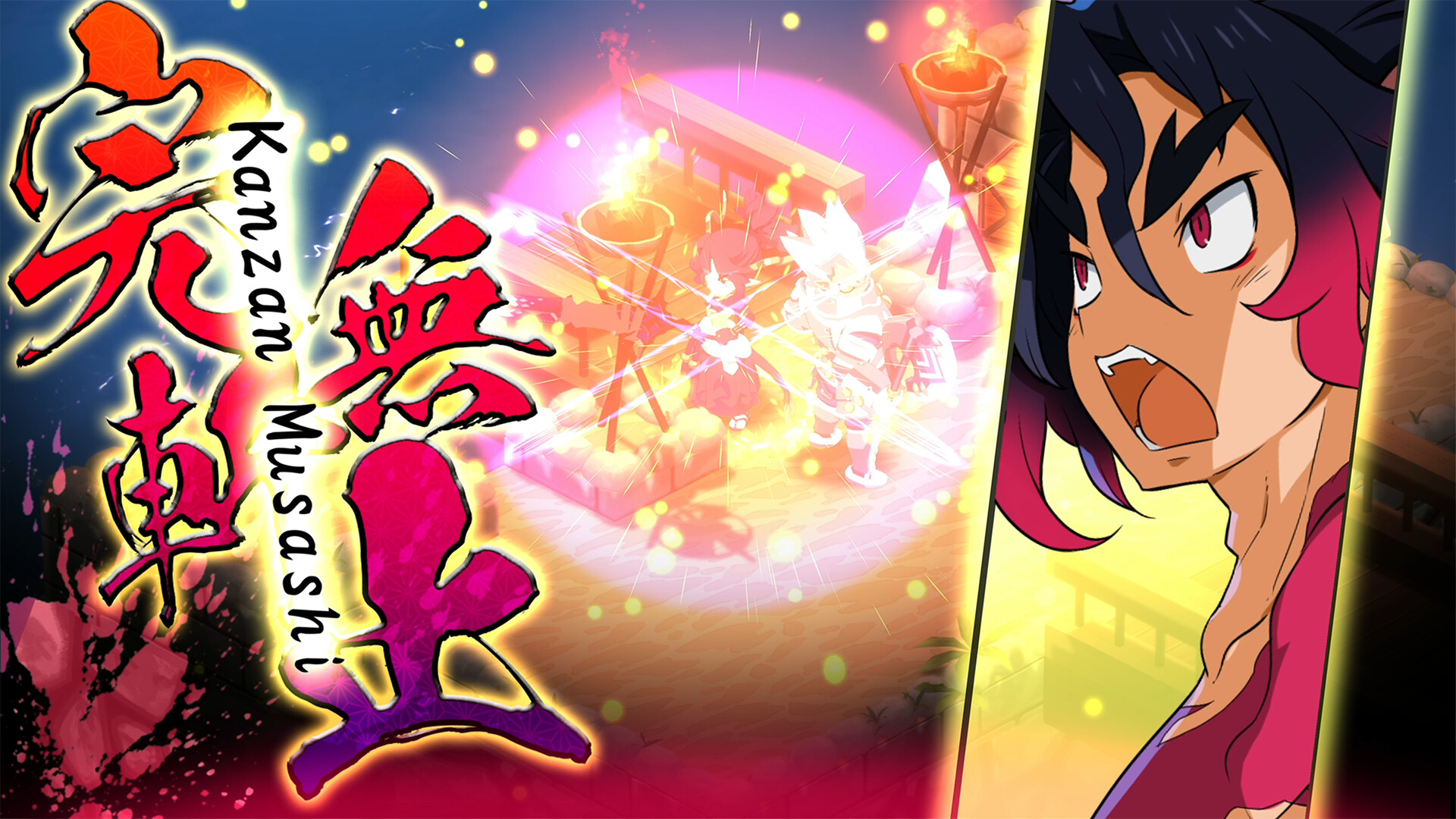
The roster supports a wide range of team designs, with more than forty character classes in the original release. Returning roles such as Clerics and Gunners sit alongside Hinomoto-themed additions, including the Maiko, Bandit, Zombie Maiden and Big Eye. A class is more than a costume: its weapon choices, movement characteristics and skills influence where it fits in a formation and which opponents it can handle well. Story characters have individual abilities, while generic units can be created and trained as the player’s roster changes. Skills consume resources or depend on positioning, so a unit’s place in the turn order and its distance from targets matter alongside its statistics. The wide roster works with the game’s recruitment and customisation systems: you can raise new specialists, replace or supplement established party members, and adjust equipment as maps introduce different enemy groups and terrain. The result is a campaign where tactical battles repeatedly meet a parallel task of building a team that suits the player’s preferred solutions.
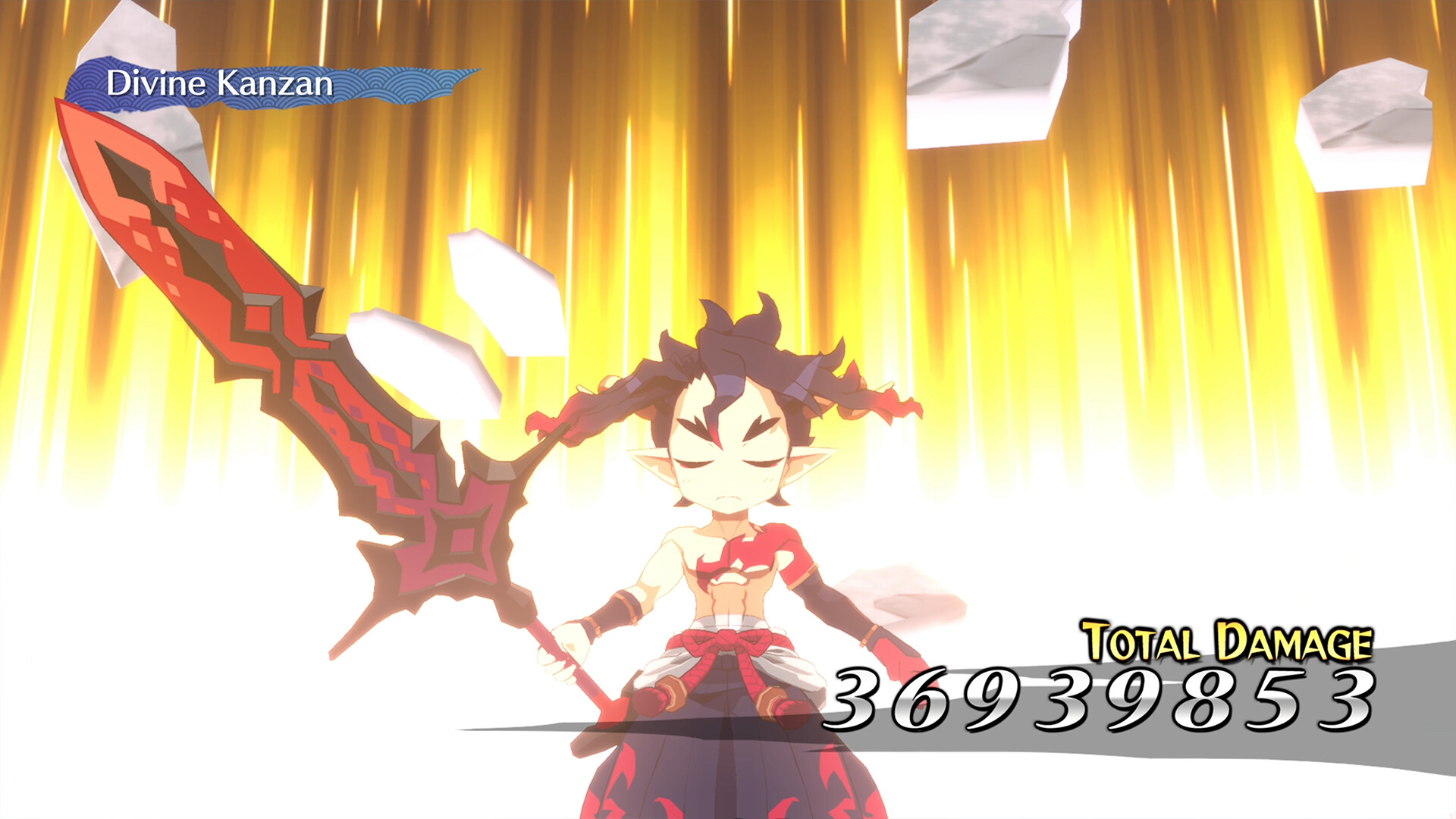
Several signature systems add dramatic exceptions to the ordinary grid fight. Jumbification expands a character into a giant combatant whose attacks can affect broad areas, while its Jumbility supplies a passive effect across the battlefield. Enemies can use the same transformation, making the timing of a response part of the encounter rather than a one-sided power-up. Hell Mode gives eligible story characters a more powerful temporary state tied to their individual abilities. Item Reincarnation works on equipment rather than the character: an item can be reborn as a different item type, carrying forward growth and potentially changing its use. These systems connect spectacular moments to longer planning. A giant unit can change immediate board pressure; a transformed item can alter a character build beyond a single battle. The game also includes Demonic Intelligence auto-battle. In the original game this is unlocked for stages after a manual clear and uses Poltergas, a resource earned by completing stages yourself. It offers a way to automate repeat fights while leaving first clears under direct control.
Character growth and equipment development continue outside the main story battles. Levels, class skills, equipment and team composition can all be tuned, and the Item World provides a repeatable way to enter an item and fight across successive floors. Clearing those battles increases the item’s level and can improve what it contributes to its wearer; encounters can also contain Innocents, creatures whose stat effects can be managed to strengthen equipment further. Item Reincarnation offers another route once an item has been developed, turning it into a new form instead of treating its first category as permanent. Innocents can be bred, fused or fought to consolidate and raise their effects, so item growth involves both the floors an item contains and the inhabitants attached to it. An improvement to a weapon or piece of armour then feeds back into the statistics of its wearer, linking repeated item battles to the strength of the roster. The Netherworld Hospital and other hub services support the cycle between battles, recovery and roster management. Because the same tactical maps can be revisited for training, the campaign’s battles are also part of a longer progression loop: the player returns with different classes, skills or gear, then uses those gains to take on the next challenge. Auto-battle is available for a cleared stage, giving the player a way to revisit a familiar encounter while keeping its first clear under direct control.
After areas have been brought to peace in the story, Netherworld Sightseeing lets Fuji and his companions revisit them. This feature opens up character conversations, local activities and minigames, including Demon Shogi, which uses the game’s battle instructions to clear a stage quickly, and the Hinomoto Martial Arts Tournament. The post-story structure also includes further battles and ranked online competition built around teams programmed to act automatically under changing stage rules. Those modes extend the game’s emphasis on roster construction: a team must be assembled not only to survive a manually directed encounter but, in ranked play, to operate according to the behaviours selected for it. These are separate activities connected to the same cast and combat systems, rather than an uninterrupted open-world exploration format. The original release’s presentation uses three-dimensional characters and environments, animated skill cut-ins and deliberately outsized attacks, with dialogue and comic timing carrying much of the story’s personality. The PC edition offers keyboard-and-mouse and controller input, along with graphics options. Disgaea 7 Complete is a later, separate edition with additional content; paid story episodes, cosmetics and other DLC associated with the original release should not be assumed to be included in Vows of the Virtueless.
- Developer
- Nippon Ichi Software, Inc.; Systemsoft beta, Inc. (Steam app listing)
- Genre
- Strategy role-playing game with turn-based grid combat